Guides
Factory tours checklist for 2027: compare guided, virtual and self-guided options
Factory tour options checklist for 2027 helps U.S. teams evaluate guided, viewing, demonstration, self-guided, and virtual formats against real site conditions.
Use this checklist to select one factory-tour format for a pilot. It helps a team compare options against the site's real limits instead of choosing the most dramatic experience on paper.
What to take away
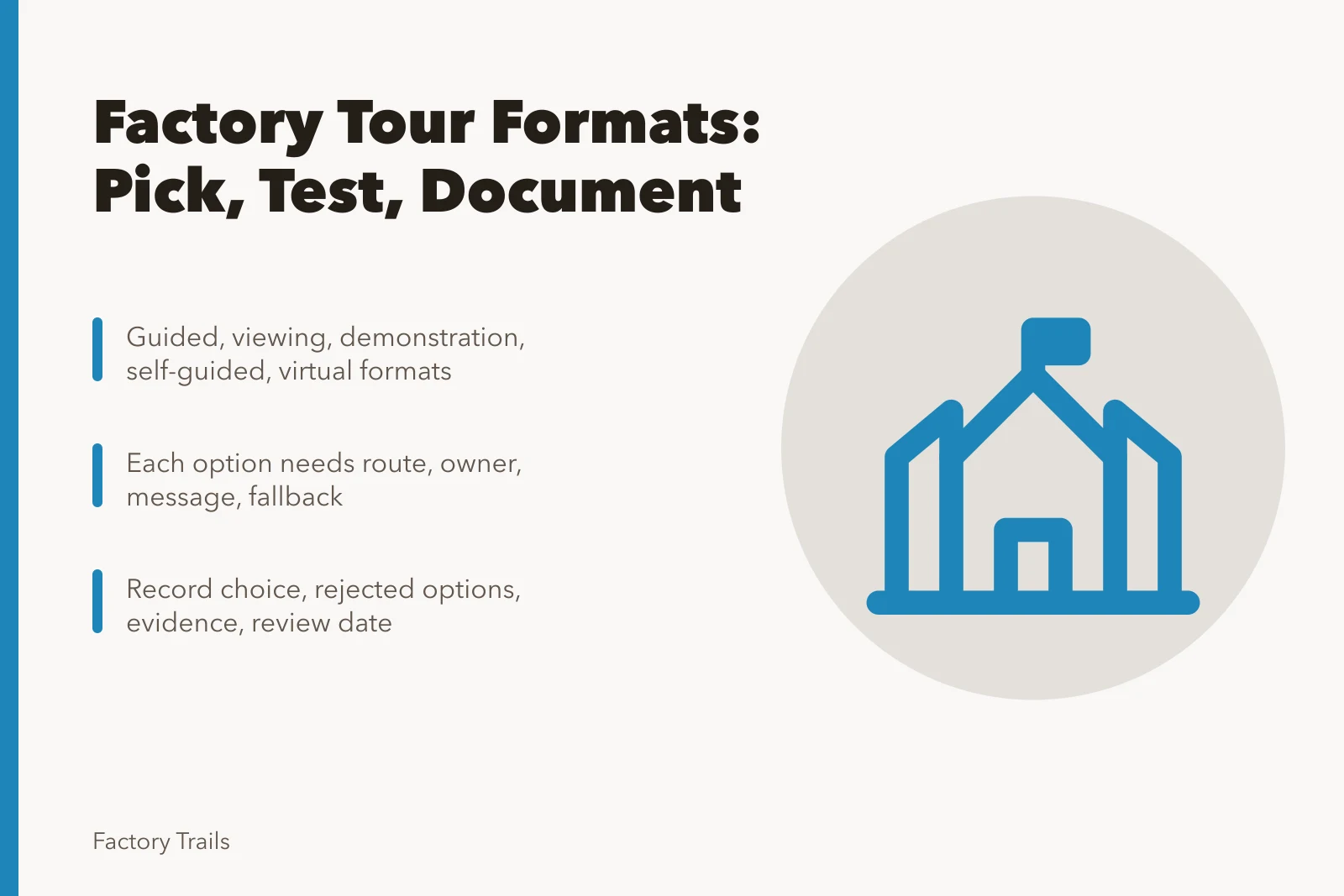
- Each option needs its own route, owner, visitor message, and fallback.
- A virtual or viewing option can be a primary format, not only a substitute.
- Choose the format that can be tested under normal operating conditions.
Comparing the five formats: what to check
| Format | Visitor does | Check first | Example |
|---|---|---|---|
| Guided | Follows a host through set stops | Host workload, route timing | Ford Rouge Factory Tour, Dearborn, Michigan |
| Viewing | Watches production from a set area | Sightlines, sound, group size | Boeing Future of Flight, Mukilteo, Washington |
| Demonstration | Watches a skilled task up close | Who can run it, reset time | Corning Museum of Glass, Corning, New York |
| Self-guided | Moves alone through marked stops | Signage, boundaries, flow | Tabasco factory tour, Avery Island, Louisiana |
| Virtual | Uses media and narration off site | What it cannot replace | Hanford B Reactor virtual tour |
Then run the seven checks against the format you are considering.
| Check | What to confirm |
|---|---|
| Visitor goal | What the visitor should understand, experience, or be able to do |
| Access boundary | Which areas are permitted, restricted, visible only, or digital only |
| Staffing | Roles required for setup, live delivery, supervision, and reset |
| Capacity | The route, platform, or demonstration constraint that sets the limit |
| Content | Script, signs, media, or map that must be accurate and current |
| Fallback | What visitors receive if access, production, weather, or staff availability changes |
| Test | The smallest pilot that proves the core promise |
The National Park Service's Hanford B Reactor virtual tour provides access to a significant industrial space while explaining that in-person visits are authorized only through guided Department of Energy tours. The relevant option-selection lesson is to be explicit about what a virtual format can show and what it cannot replace.
Option-selection checks
- Visitor goalunderstand, experience, or do
- Access boundarypermitted, restricted, visible, digital
- Staffingsetup, delivery, supervision, reset roles
- Capacityroute, platform, or demo constraint
- Contentscript, signs, media, map accuracy
- Fallbackaccess, production, weather, staff changes
- Testsmallest pilot proving core promise
For a guided option, test the physical route and the host workload. For a self-guided option, test whether visitors can find every stop and understand boundaries without staff prompting. For a virtual option, test whether the narrative, media, and instructions work for the intended audience.
Cost tracks staffing hours for guided and demonstration formats, media and platform fees for virtual, and printing for self-guided. Ask each site for current pricing rather than a figure from a past season.
The decision note
The decision note is one page. Fill these fields before the team buys signs, cameras, or booking software.
Field / What goes in it
- Format and site
- One of the five formats, plus the pilot site
- Visitor outcome
- What the visitor should know or do afterwards
- Rejected formats
- Each alternative and the limit that ruled it out
- Evidence
- Date of the walkthrough, group size, what failed
- Limits accepted
- Known gaps, such as noise at one stop
- Review date
- The date or tour count that reopens the choice
The National Park Service planning framework starts with a visitor outcome and the resources that can support it. The National Archives says agencies should manage web information as records when it documents business. The Department of Justice explains that effective communication decisions depend on the communication's context and complexity.
Run the checklist twice. The first pass is a design conversation, when several formats are still possible. The second happens after the team has walked the proposed visitor journey under ordinary conditions.
On the second pass, look for specific evidence: the viewing stop was hard to hear at the planned group size, not a general claim that the route needs improvement. Assign one person to collect the evidence and one person to make the option decision. The same person can hold both roles on a small team.
Keep the checklist dated. Conditions that shape a choice can change with staffing, production timing, public demand, or the condition of visitor materials. A dated review shows whether the team reconsidered the option after those facts changed.
For 2027, confirm three things with each site: when the booking window opens, whether entry is timed, and how far ahead hosts and guides are scheduled. Ask how quickly peak weeks fill, since small-group slots are limited. Where entry is timed, walk-ins may not be available, so hold a backup date.
Common questions
Can an option be selected before exact costs are known?
Yes, if the decision is limited to a pilot. Mark cost inputs as pending and avoid presenting the pilot as a permanent offer.
What is a fallback option?
It is the defined experience offered when the planned route or activity cannot operate, such as a viewing stop, demonstration, or virtual explanation.
Who should choose the format?
The program owner should decide with input from operations, safety, visitor delivery, and the people responsible for the proposed content.