Guides
How to run a factory tour case study method with real evidence
Factory tour case study method for 2027 helps U.S. operators document context, questions, evidence, observations, limits, findings, and practical next steps.
A useful factory-tour case study is a record of a real decision, not a promotional story with a happy ending written in advance.
It explains what the program was trying to improve, the conditions that shaped the work, the evidence collected, what changed, and what remains uncertain. That structure makes the study useful to a future host, a facility contact, a tourism partner, or a prospective client considering paid placement.
A finished study usually runs two to four pages plus an evidence log. The shape is fixed before collection starts, so a thin result is as publishable as a good one.
What to take away
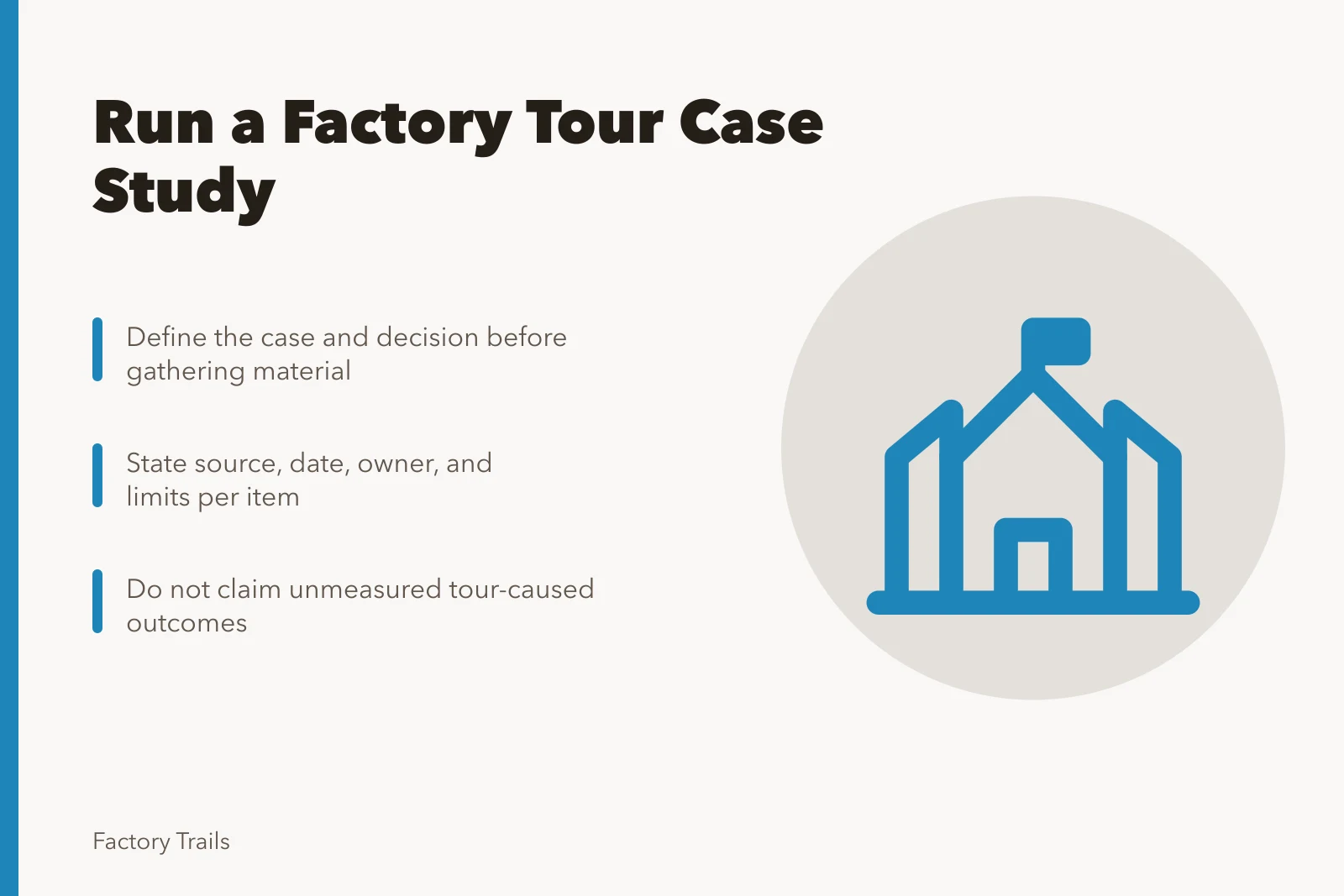
- Define the case and the decision before gathering material.
- Separate observed facts, participant feedback, and interpretation.
- Use an evidence plan that states the source, date, owner, and limits of each item.
- Do not claim a tour caused an outcome that was not measured.
- End with a practical next step and a review date.
Copy this shape for your own case definition:
This case examines whether a revised arrival guide reduced first-time visitor confusion during Saturday morning factory tours from May through July.
Choose a narrow case
Avoid a topic such as "our factory tour improved." That statement has no clear boundary and invites inflated claims. A narrow case can be about a revised arrival message, a new group check-in process, a seasonal route alternative, a shorter host briefing, a booking change, or a pilot for one visitor type.
Pick one market per case. A study that mixes United States and Canadian sessions blurs the conditions a reader needs to interpret the result.
The model sentence above specifies the change, the experience being examined, the audience, and the time period. It also makes clear what the case does not examine, such as long-term ticket growth, plant operations, or safety performance.
Describe the program before judging it
The CDC's program-description guidance sets out the elements a program description should cover: need, inputs, activities, outcomes, context, and stage of development. Use the same structure for a tour case study. A reader needs to understand the starting point before a reported result has meaning.
CDC's credible-evidence guidance explains that evidence should be useful for the questions being asked and feasible to collect. Apply that test before the first session. A booking-message archive can show what guests received; a session observation can show what happened during that session. Neither supports a claim it was not designed to answer.
Describe the program
| Element | Factory-tour example |
|---|---|
| Need | Visitors frequently call for entrance directions. |
| Inputs | Program owner time, current map, host notes, booking platform access. |
| Activity | New confirmation message and sign at the approved entrance. |
| Output | Updated booking text, map, and host handoff. |
| Intended outcome | Fewer direction calls and on-time check-in. |
| Context | Weekend coach groups, industrial-site entrance, temporary roadwork. |
Keep the description factual. Do not label an outcome as achieved until the evidence supports it. A new map is an output. A reduction in confusion is a possible outcome that needs observation or data.
State the question and the decision
Each case should answer a question that could change a future decision. Good questions are specific and answerable with the evidence the program can reasonably collect.
State the question
| Weak question | Strong question |
|---|---|
| Did visitors love the new process? | Did guests using the revised confirmation arrive at the correct entrance more consistently during the pilot period? |
| Is the route better? | Did the alternate route allow the host to complete the promised interpretive sequence during documented weather disruptions? |
| Did the tour grow? | What changed in completed sessions, arrival timing, and host-reported bottlenecks after the new booking rule? |
The decision should be equally clear: retain the change, revise it, test a different version, or stop using it. A case study without a decision is just a report of activity.
Build an evidence plan before collecting stories
An evidence plan identifies what data will be collected, how, when, and from whom. It can distinguish documents, observations, interviews, and existing records. For a tour program, this prevents the common mistake of collecting only favorable comments after a change has already been made.
Build an evidence plan
| Evidence item | How collected | What it can support | Limitation |
|---|---|---|---|
| Booking confirmation version | Archived page or export | What information guests received | Does not show whether they read it. |
| Arrival observation | Host record at check-in | Observable arrival pattern | May vary by host and day. |
| Visitor comment | Optional short survey or email | Experience and clarity from that visitor's view | Not representative without careful sampling. |
| Session log | Existing operating record | Start time, route used, fallback use | Does not explain every cause. |
| Facility contact note | Approved site communication | Known route or access change | May not be public information. |
Decide who owns each source and how personal information will be limited. Do not copy visitor names or sensitive facility details into a public case study. Aggregate, anonymize, or omit information when needed.
Evidence log. One row per item you cite. Keep the log with the case file so every claim can be traced.
| Session or period | Source | Owner | What it can support | Limit |
|---|---|---|---|---|
| Session 1 | Archived confirmation | Program owner | Text guests received | Does not show who read it. |
| Session 1 | Host check-in record | Lead host | Arrival entrance and time | One host, one day. |
| Session 2 | Optional short survey | Program owner | Clarity from the visitor's view | Not representative. |
Observe the actual visit
The observation plan should follow the visitor journey: booking, arrival, check-in, briefing, movement, key stops, questions, and departure. Record what happened rather than what the observer hoped would happen. "
Observation form. One form per session. Print it or copy the fields into a shared file.
Field / Entry
- Date, session, weather
- Visitor count and mix
- Entrance used, arrival time
- Check-in and briefing start
- Route and stops delivered
- Questions the host could not answer
- Deviations from the plan
- Observer name or initials
If two people observe, give them the same short form. Agree on the meaning of terms such as late arrival, route change, or unanswered question. Consistent definitions make comparison possible.
Use interviews and comments carefully
Open comments add context, but they are not proof of a general result. Ask one or two focused questions, such as "What part of arrival was unclear?" or "Which stop best explained the production process?" A single strong quote can illustrate a pattern; it cannot create one.
When using staff input, identify the role rather than naming people without permission. Hosts and employees often see where a route or briefing breaks down. Their observations can guide the case, but technical or safety concerns should still go through the facility's established process.
Analyze without exaggerating
Compare like with like. A Saturday coach group should not be compared casually with a weekday individual-visitor session. Note the period, visitor mix, weather or operating changes, and any difference in host coverage. If the evidence is too thin, say so.
Use language that matches the proof:
| Evidence available | Responsible language |
|---|---|
| One pilot observation | "During the pilot, the host observed..." |
| Several consistent session records | "Across the recorded sessions, the pattern was..." |
| Visitor comments | "Several respondents described..." |
| No controlled comparison | "The case cannot establish that the change caused..." |
The last sentence is important. Case studies are valuable because they preserve context, not because they turn every operating change into a universal finding.
The National Archives records-management profile covers assigning responsibility for records. Name one owner for the case brief, evidence log, facility-fact review, and public version. That owner coordinates the file, while site roles keep authority over controlled facility information.
Write the case study
Use a predictable public structure:
- Context:site, audience, operating condition, and problem.
- Question:the decision the study will inform.
- Change tested:what was introduced or revised.
- Evidence:sources, dates, and collection method.
- What happened:factual observations and relevant feedback.
- Interpretation:what the team thinks the evidence suggests.
- Limits:missing data, unusual conditions, and what was not measured.
- Next step:retain, revise, test again, or stop.
This structure makes it possible for a sponsor, agency, or local business to understand what a placement opportunity represents without disguising advertising as research.
Worked example. The figures below are illustrative. They show the shape of a finished case, not a real program.
Context. Weekend coach groups at an industrial site, roadwork at the usual entrance, four weeks of direction calls. The setting and the problem come first, not the result.
Question. Did the revised confirmation message send guests to the approved entrance?
Change tested. New confirmation text and one sign at the approved entrance, from May.
Evidence. Archived confirmation, host check-in record, and one observer per session, with dates.
What happened. In the recorded sessions, most parties reached the approved entrance. Three used the old one and still arrived before the briefing.
Interpretation. The message looks helpful, but host coverage varied.
Limits. No comparison group, one season, one market.
Next step. Keep the message, retest next season, review in October.
Budget the study modestly
Most useful cases do not require a large research budget. Plan on about one hour for the design meeting, observation during sessions you already run, and roughly four to eight staff hours for writing, review, and the evidence log.
Cash costs are typically near zero. A paid survey tool, translation, accessibility support, photography, or outside evaluation typically adds a few hundred to a few thousand US dollars, depending on scope.
Do not promise a case study before deciding who will do this work. A program that collects no reliable before-and-after information should publish a descriptive project story, not a result claim.
Final review checklist
Before the final review, compare the draft with the original case brief. Verify that every section still answers the same question and that no late comment has changed the scope without being recorded. If a new question emerged, preserve it as the next case instead of forcing it into the current finding.
This simple boundary protects the study from expanding beyond its evidence.
Public case study structure
- Contextsite, audience, condition, problem
- Questiondecision the study informs
- Change testedwhat was introduced
- Evidencesources, dates, method
- What happenedfactual observations
- Interpretationwhat evidence suggests
- Limitsmissing data, unusual conditions
- Next stepretain, revise, test, stop
It also gives editors a defensible reason to decline unsupported additions, promotional promises, and anecdotal claims that cannot be traced to the documented observation period.
The National Archives web-records guidance notes that online content can document official business. Save the published version with the evidence log and review note. If a claim is corrected later, retain the change date and reason.
Before publishing, ask:
- Does every factual claim have an identified source?
- Does the title state what the case actually covers?
- Are observations, comments, and interpretations clearly separated?
- Does the next step follow from the evidence, rather than a preference?
- Has a responsible site role reviewed any facility-specific statement?
Common questions
Can a case study include a sponsor?
Yes, if the relationship is disclosed and the sponsor does not control the factual conclusion. Keep paid placement clearly separate from the evidence section.
How many sessions make a valid case study?
There is no universal number. State the number observed and the dates. Do not generalize beyond what the evidence can support.
Can visitor reviews be used as evidence?
They can illustrate experience, but they should not be treated as a representative measurement unless the collection method supports that conclusion.
What if the test did not work?
Publish the useful lesson if the facts support it. A case that shows why a route or message was revised can be more valuable than a forced success story.