Guides
Factory tours case study checklist: set scope before you draft
Factory tour case study checklist for 2027 helps U.S. writers set scope, separate sources from observations, record limits, and publish checkable findings.
What to take away
- Set one question and one named public experience before you draft. The case study covers that program, not the whole company.
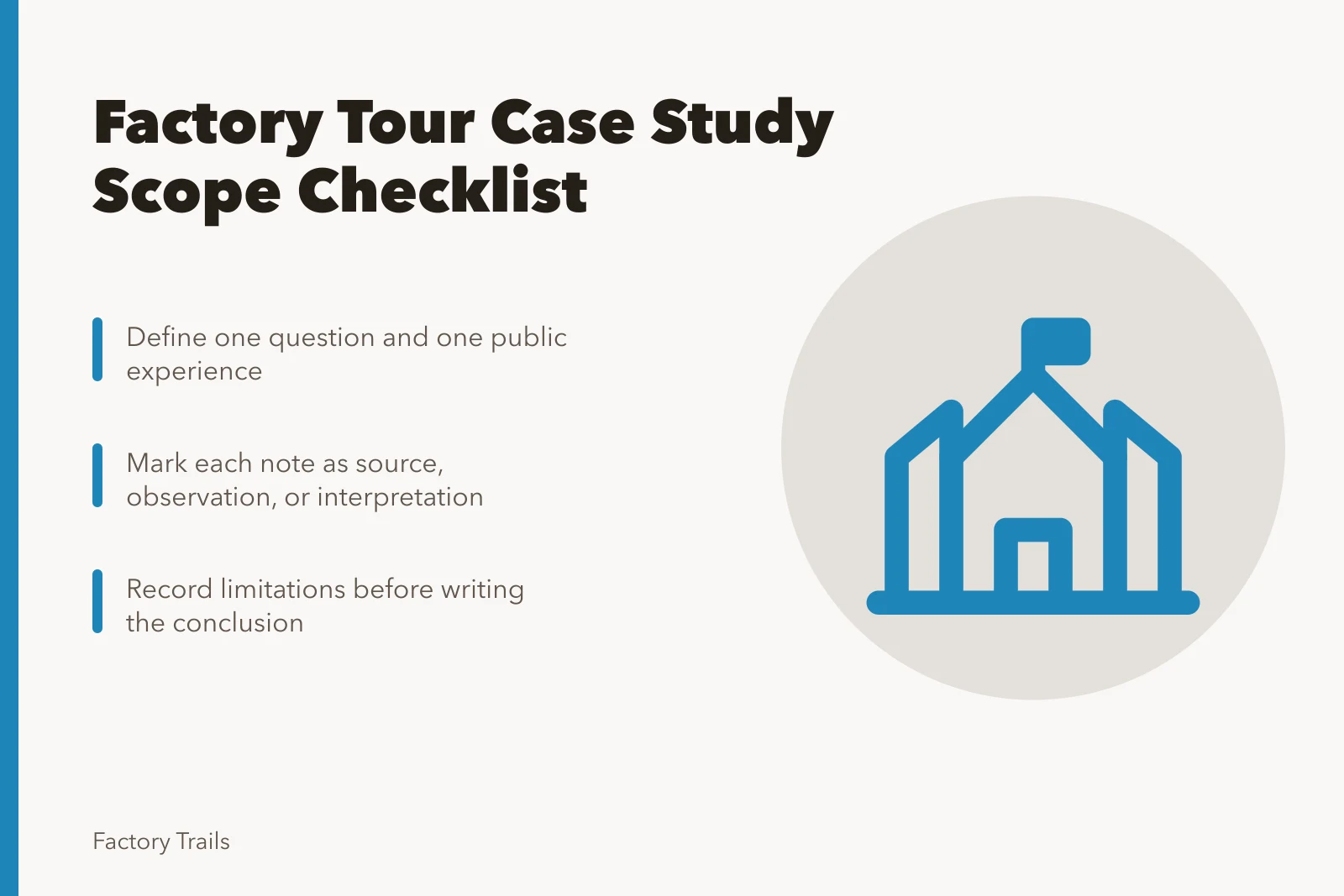
- Fill seven rowsquestion, public boundary, operator terms, historical evidence, observation, limitations, correction path.
- Archive the operator's terms page and record the date you saved it.
- Where a live rule shapes a reader's plan, cite the operator rather than your own notes.
- Close with a publication decisionpublish, narrow, defer, or remove.
The seven rows and where each item comes from
The checklist is a planning document, not a scorecard. Each row records something you can point to after the draft is finished. If you still need to plan the visit that feeds the study, the 2027 planning checklist covers booking, dates and the questions to send an operator first.
| Check | What a finished note looks like | Where it comes from |
|---|---|---|
| Question | One public experience and one thing to examine | Your scope note |
| Public boundary | Where a visitor may lawfully go | Operator page, ticket page, on-site signs |
| Operator terms | The live page saved with its save date | Operator site or ticketing provider |
| Historical evidence | The source for each past process or event | Park, museum or archive record |
| Observation | Date, place and what was actually seen | Your field notes |
| Limitations | Claims this evidence cannot support | Written after the visit |
| Correction path | How a reader sends a supported correction | Contact route on the published page |
Do not open the draft with a company history. Start at the question. A museum demonstration may need two or three historical facts, but one visit cannot judge an industry.
Field and Draft Checklist
- Questionnames experience and study focus
- Public boundarywhere visitors may lawfully go
- Operator termssave page and review date
- Historical evidencesource for past events
- Observationdate, place, what was seen
- Limitationsclaims evidence cannot support
- Correction pathhow readers submit corrections
Example: one filled row from a Hershey visit
Hershey's Chocolate World in Hershey, Pennsylvania is a visitor center. The working factory is not open for public tours, and the Wikipedia entry on Hershey's Chocolate World records that split.
Question: Does this public attraction show visitors a working chocolate factory? Source: the operator's own site, plus the encyclopedia entry above. Observation, dated: the visit is a ride through a visitor center, with no production floor on the route. Limit: this note says nothing about Hershey Company plants, staffing or output.
The row is short on purpose. It answers one question and rules out three others.
A working site produces a different boundary. Lowell National Historical Park in Massachusetts runs working textile machinery and tours, so a visit there can describe a running line: National Park Service page for Lowell National Historical Park.
For a wider set of comparison sites, the guide to Alabama's industrial heritage sites covers places beyond Sloss Furnaces in Birmingham.
Current terms, routes and the boundary of one visit
One tour, one facility, one date can carry a useful case study. It cannot stand in for an entire company or a whole season.
Operator terms live in a few places: the operator's own site, the ticket or booking page, and any current conditions page the park or museum keeps. Save the page, note the date, then keep both with the draft.
Turn the checklist into a route from question to claim:
- Name the public activity and the date or date range under review.
- Separate what the operator states, what you saw in public, and what you infer.
- Write down what this evidence cannot establish.
If a live rule affects a reader's trip, quote the operator's page instead of your notes from the day. A booked, timed underground visit is a good test of that habit: the Britannia Mine Museum underground tour explains how seasonal booking works in British Columbia.
Canada is a useful second market for comparison. The Royal Canadian Mint tours page separates the Winnipeg production facility from the Ottawa boutique mint, which is a distinction your boundary row should record.
Correction path and review date before you publish
A claim table ties every factual sentence to its evidence: source, date, exact statement, limit, and next review date. Anything with no source becomes an interpretation or leaves the draft.
The correction path row names a real contact route, such as an editor address or a form, so a reader can send a supported correction. Save the completed checklist with the draft, date the file, and name the responsible editor.
Check image captions as well, because a credited image needs a scope note when it did not come from the visit you describe.
The list of common mistakes in working factory visits is worth a pass before you publish, since it flags the errors that survive into print.
If a claim still lacks support, narrow the claim or defer the piece. The decision sits at the end of the checklist, not the start.