Reviews
Working factory visit planning questions to ask before you compare routes
Working factory visit planning questions for 2027 help U.S. teams compare route options, clarify visitor access, assign approvals, and adjust sessions.
What to take away
- Settle five questions before comparing routesthe learning outcome, session capacity, required safety gear, confirmed access details, and an approved fallback.
- Compare options on outcome, duration, capacity, access and fallback. Floor area is not a comparison criterion.
- Give every answer a named confirming role and a date before the invitation goes out.
- Working plants approve visits on their own calendar, so start 2027 conversations before the public tour season.
- "Fully accessible" is not an answer. Confirmed details and a contact for individual questions are.
The five planning questions
- What should a visitor understand by the end of the route, and which role approves that outcome?
- How many visitors fit on the route at one time, and how many guides does that need?
- What protective equipment is required, and who provides it?
- Which access and circulation details are confirmed for guests, and who answers individual questions?
- What is the approved alternative if a line, an area or an elevator is unavailable on the day?
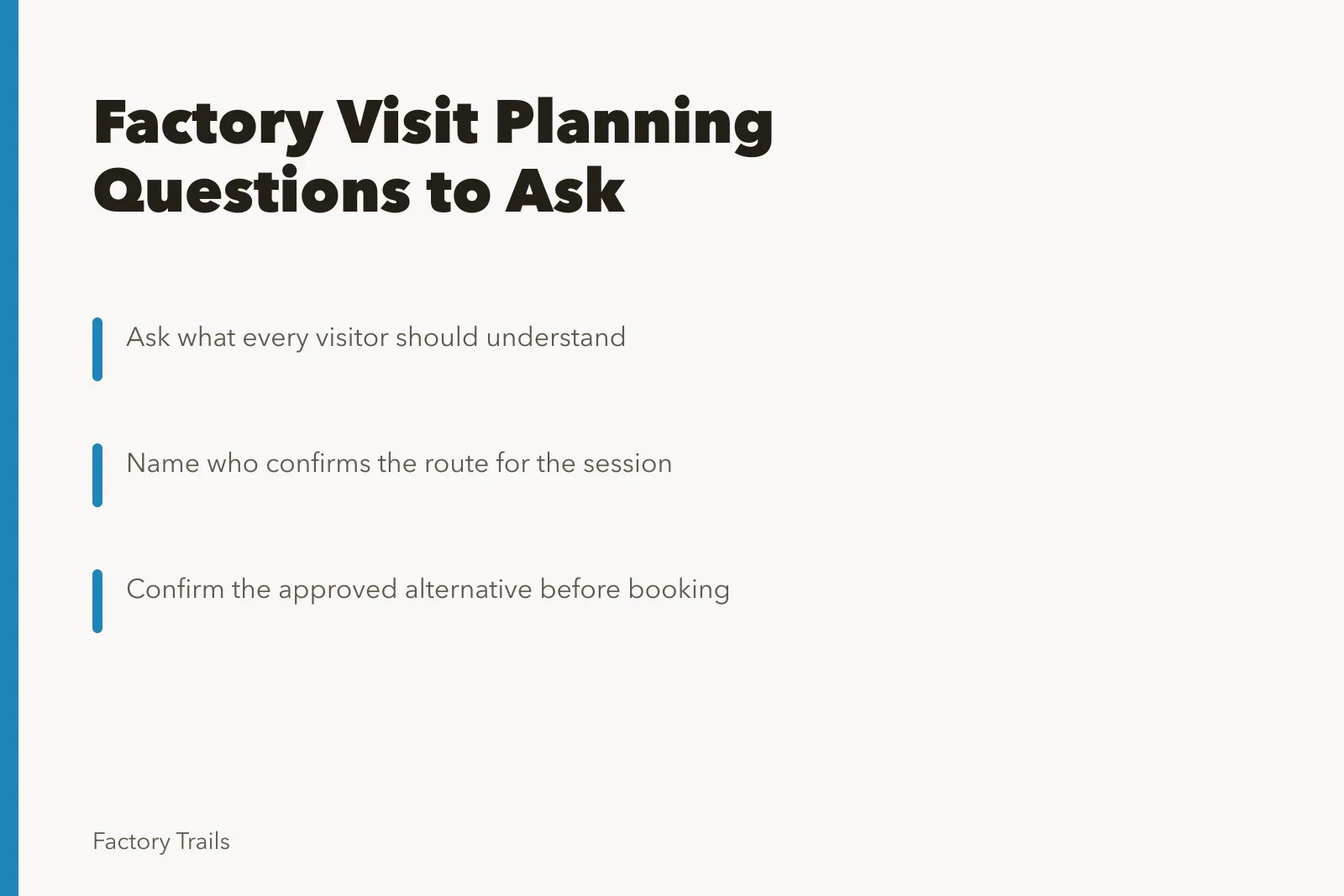
Factory Visit Planning Questions
- What should every visitor understand?
- Who confirms the route for this session?
- What can the guest expect from arrival to exit?
- What is the approved alternative?
- What may the host explain or photograph?
These five produce decisions rather than discussion. They also feed the questions to ask before you book a session, so the guest message and the route agree.
Questions for the planning meeting
| Question | Why it matters | Who confirms |
|---|---|---|
| What is the approved learning outcome? | A short route can still carry the purpose. | Program owner |
| How many visitors per session? | Capacity drives staffing and session count. | Visitor program lead |
| What protective equipment is required? | Guests cannot be asked to guess. | Plant safety manager |
| Which access details are confirmed? | Unconfirmed claims reach guests as facts. | Site access lead |
| What is the fallback? | A closure on the day needs a scripted answer. | Host supervisor |
| Who briefs the hosts? | The route and the talk must match. | Program owner |
The OSHA rule on general protective equipment, 1910.132, sets out when employers must provide protective equipment (OSHA 1910.132). Ask the safety manager which items the site supplies and which the guest brings.
Route comparison criteria
Ask
- Learning outcome
- What will the guest understand?
- Duration
- How long on the floor, door to door?
- Capacity
- How many per session, and per guide?
- Access and circulation
- Which route details are confirmed?
- Fallback
- What replaces a closed area?
Weak answer
- Learning outcome
- "They see the whole plant."
- Duration
- "About an hour, depending."
- Capacity
- "We can split them up."
- Access and circulation
- "It is all accessible."
- Fallback
- "We will find something."
Score each option against the five criteria before you rank them. A route with a strong outcome and a weak fallback is still a weak route.
For routes with an underground or confined section, capacity and fallback carry more weight than duration. The Britannia Mine Museum underground tour shows how a booked time slot controls group size.
Example: two options at a working plant
Chocolate World in Hershey is a visitor center, not the factory floor, and the plant is not open for public tours (Hershey's Chocolate World). A route that promises production lines and delivers a visitor center fails the outcome test.
The Royal Canadian Mint runs a production-facility tour in Winnipeg and a separate operation in Ottawa (visit the mint). One brand, two routes, different outcomes and capacities. Compare them on the five criteria, not on the brand.
2027 lead times and approval cycles
Working plants route visit requests through safety, security and communications. Those reviews do not follow the public tour calendar. Ask the host for the approval sequence and the cut-off date for a confirmed booking.
Lead times vary by site. A typical range runs from several weeks to several months, so treat an unconfirmed date as a placeholder.
Session timing often decides which route works. Two routes with equal capacity may need different start times around shift changes. Ask when the floor is quiet enough for a host to talk.
Put guide fees, transport and deposit terms into your 2027 scope checklist before ranking options. A route you cannot staff is not a route.
Who signs off, and what to write down
The roles differ at most plants. A program owner confirms the learning outcome. A safety manager confirms protective equipment. An access lead confirms circulation. Expect three separate answers.
If the answer is "someone will know on the day," the item is open, not answered. Replace it with a name and a date.
Log each answer with the confirming role, the date and the next action. Carry unresolved items into the factory visit care questions you take to the next meeting.