Guides
How to build a working factory visit planning checklist teams can reuse
A reusable factory visit planning checklist starts with the purpose, the approving role, and a route result you can state plainly to guests.
A reusable checklist is a record of what the plant confirmed, not a script for the visit. Build it once around the purpose, the approving role, and the route result, then re-confirm the parts that change.
What to take away
- Name the site role who approves the visitor route before anything is published.
- Write the route result as normal route, approved alternative, or not available.
- Keep one dated guest message so a corrected version can replace it cleanly.
- Re-confirm route and host coverage before every session, not once a year.
- File the actual group count, route used, and open questions after each visit.
Scope and approval
| Check | Ready when |
|---|---|
| Purpose | The visit has one learning or community outcome, written in guest language. |
| Audience | Group type, expected count, and organizer contact are known. |
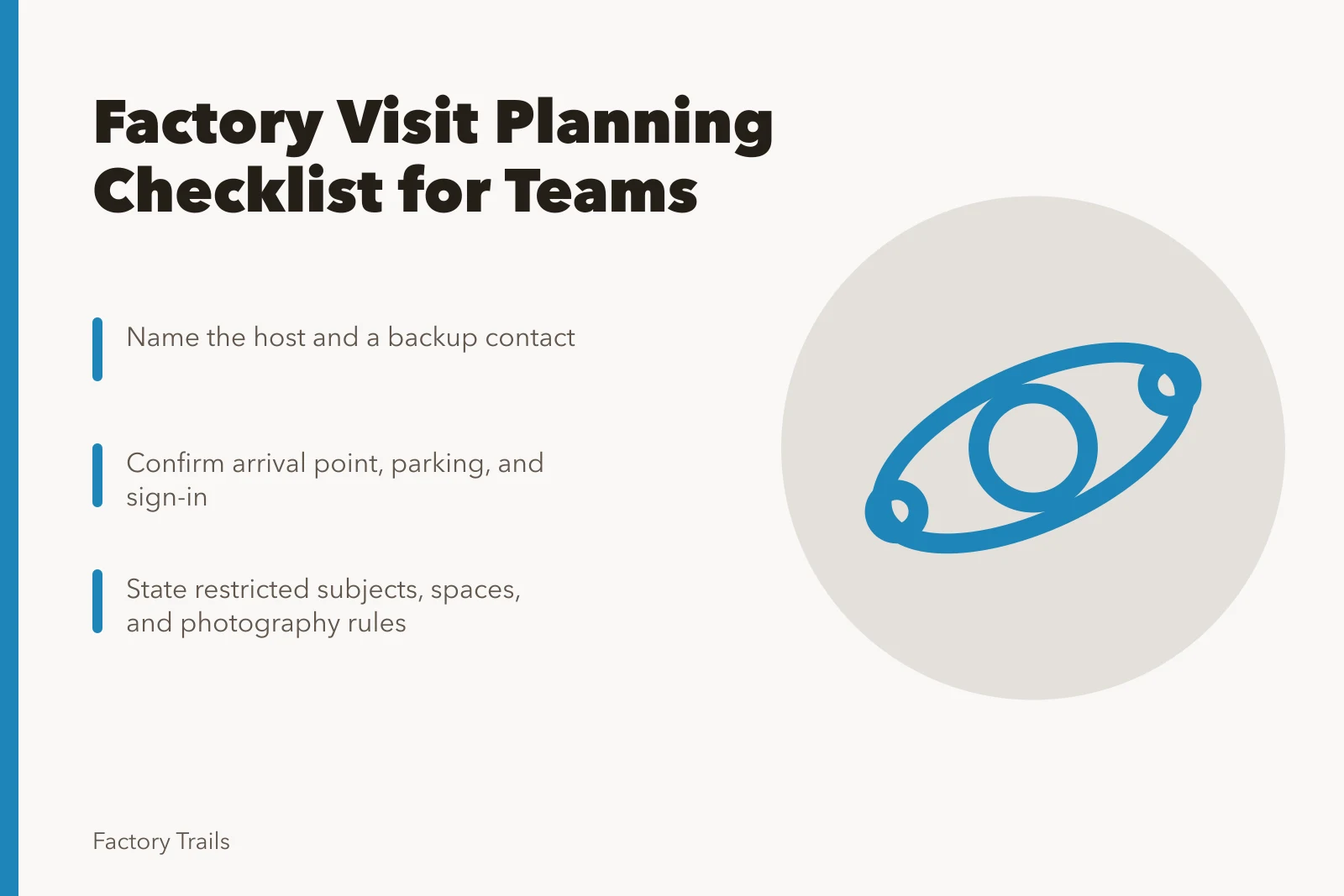
| Boundaries | Off-limits subjects, spaces, and photography rules are stated. |
| Facility contact | A named person confirms the visitor-facing route. |
| Host | A prepared host and a backup contact are assigned. |
An old itinerary proves nothing about today's route. Ask the responsible site role for the current result and record which of the three answers came back. That single line is what the program owner communicates.
Scope and approval readiness
- Purposeone learning or community outcome
- Audiencegroup type, count, organizer contact
- Boundariesoff-limits subjects, spaces, photography
- Facility contactnamed person confirms route
- Hostprepared host and backup assigned
Arrival and route
- Directions name the actual arrival point, not just the street address.
- The organizer holds the arrival window and a late-arrival contact.
- Parking, drop-off, sign-in, and waiting instructions match the current site plan.
- The host carries the current route version and a way to reach the facility.
- Guests know which questions to raise before the visit, not at the gate.
The National Park Service's Fort McHenry group-arrangements FAQ asks large groups to have the leader speak with staff and settle an entry plan before the group arrives. A working plant is not a national monument, but the narrow lesson holds: fix the arrival sequence and the organizer's role before anyone reaches the door.
Start with the purpose, not the route
The National Park Service interpretive-planning program plans around what a visitor should come away with. Ask the same question first: what should a guest understand or ask by departure? That answer separates the purpose from any one stop, so an approved alternative can still be judged against it.
Write the purpose in guest language. Keep the details the facility must confirm on a separate list. A public promise built on an unverified operating condition is the failure this split prevents.
Make the guest message communicate
The Department of Justice effective-communication guidance ties the right aid or service to the nature, length, complexity, and context of the exchange.
It is not a site-access approval, and a factory visit team should not treat it as one. It does support asking whether the confirmation, the host's explanation, and any alternative format carry the essential information to the intended guest.
Keep a contact path for questions that need individual consideration. Record only what the facility confirmed, and route technical questions to the roles that own them.
Keep the current version and its changes
The National Archives web-records guidance treats web content as a record when it documents official business. Keep the dated guest message and the checklist result with the session brief. When a detail changes, update the public wording and note why, so an old arrival instruction never reaches a new session.
The guest message
Prepare one approved message covering these points:
- time
- arrival point
- expected duration
- requirements
- restrictions
- the change contact Date it. If the plan moves, the program owner can see exactly what the organizer received and send a corrected version.
Day-of and follow-up
Before the session, confirm route availability, host coverage, and any visitor-facing change. Afterward, record the actual group count, the route used, any change made, and every open question with a named owner. Date that note before filing it with the checklist.
Common questions
Should the host approve the route?
No. The host receives the approved route and walks it. The responsible facility role decides whether that route is available on the day.
What is the minimum fallback plan?
One approved alternative, one decision contact, and the message the organizer receives if the normal visit cannot run. Anything less leaves the group waiting at the gate.
When should the checklist be repeated?
Re-confirm the current-condition items before every session. Repeat the full review whenever the site, the route, guest requirements, or the program format changes.
Who answers safety and access questions?
The plant's own safety officer and its published visitor rules, or the site's accessibility statement. This checklist records confirmations; it does not set them.