Guides
Part of How regional adaptation shapes working factory visits
How regional teams keep working factory visit records under control
Regional factory visit records guide for 2027 helps U.S. teams track approved local messages, condition checks, route changes, and responsible contacts.
What to take away
- Keep one folder per facility, named for the facility, not the state or region.
- Name each file with facility, season and document type, so one search returns one current version.
- Hold five recordsfact sheet, confirmation, condition check, change log and contact list.
- Set a retention rule in writing. A common range is the current season plus the three before it.
- Close the handoff by having the new coordinator open the live files and name the next review trigger.
The five records a facility folder holds
A working plant tour is not the same product as a visitor center. The record should say which one the group enters. Hershey's Chocolate World is a visitor center, and the factory is not open to public tours, per Wikipedia's Chocolate World entry. A file that blurs the two will mislead a host.
| Record | What it proves | Typical owner |
|---|---|---|
| Facility fact sheet | Current arrival point, parking, tour start time, group size limit | Regional coordinator |
| Confirmation record | Who approved the guest-facing message, and on what date | Site contact |
| Condition check note | What was verified on the route before the visit, and what changed | Host or guide lead |
| Change log | Which audiences received a corrected instruction, and when | Regional coordinator |
| Contact list | Who owns the next visitor-program decision at that site | Program manager |
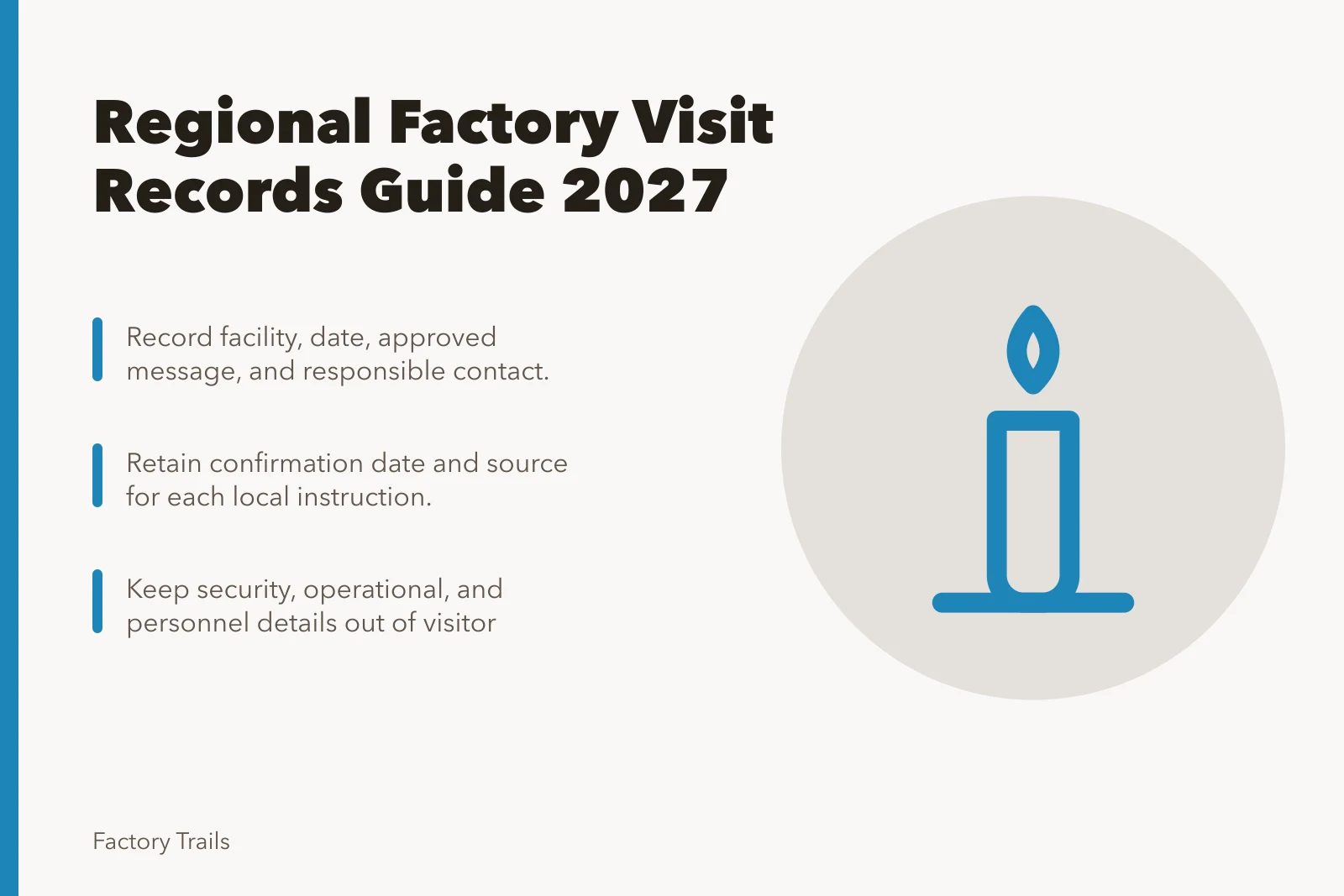
Local Record Set
- Facility fact sheetarrival and timing
- Confirmation recordwho approved message
- Seasonal review notewhat was checked
- Change logaudiences received corrected instruction
- Contact listowns next decision
Contacts are the row that fails most often, because staff move between plants. The common factory visit mistakes write-up lists the failure patterns worth checking before a season opens.
Example: a file name that survives a season
Use a fixed order: facility, season or date, document type, version. A spring 2027 route change at the Pennsylvania visitor center becomes hershey-pa-2027-spring-route-change-v2.docx. A fall condition check at an Alabama furnace site becomes sloss-birmingham-2027-fall-condition-check-v1.pdf.
Keep names lowercase and hyphenated, with no personal initials. The pattern should outlive the person who set it up.
Two habits hold it together. Keep one live version, and move older ones to a superseded folder as v1 and v2, never as "final" or "final2". Then keep an index file per facility listing the live documents and their review dates.
Booking-led tours need the slot in the name as well. Records for a Britannia Mine Museum underground tour should carry the booked time, the guide and the headcount in one file, because operators rebook those slots often.
Condition checks and route changes
A condition check note is not a plant memo. It records the visitor route: gate, walkway, stairs, viewing platform and the stops where the guide speaks. Add the protection the site requires, such as eye protection under OSHA 1910.133 or safety footwear under OSHA 1910.136.
A closed walkway or a new glass panel changes what the guest sees and what the guide says. Write the change into the change log the same day and mark which audiences received the correction. Confirm the route version the group actually walked, because two groups in one week can see different lines.
Where the folder sits
Start with the facility identifier, not the state or the region. Alabama holds Sloss Furnaces plus a set of other industrial sites, each with its own visitor arrangements. A reader working through Alabama's industrial heritage sites sees how differently each one runs its visits.
Group by program owner next, then by season. A folder called "Dave's visits" dies when Dave moves on. SharePoint, Google Drive, Airtable and Notion all hold the five records, and the first two keep file version history.
Canada shows the same rule across two operations. The Royal Canadian Mint runs a Winnipeg production-facility tour and an Ottawa boutique mint experience, and the mint's visit page treats them as separate bookings.
Retention: how long to keep local visit records
The National Archives' records scheduling guidance explains that retention schedules set how long records stay available and what happens at the end. Visitor programs rarely have their own schedule, so borrow the nearest one and write it down.
A workable rule for a regional team: keep the current season, the three preceding seasons, and any file tied to an open claim or dispute. Destroy the rest on a set date each year.
Photos, permissions and media files
A source can support a local fact without granting reuse rights. Record the source, the license or permission, the credit line and the published placement in the visit folder. Fair use is fact-specific, so treat each image as its own decision.
Handoff to a new coordinator
Handoff is a walkthrough, not an email with a link. Run this check with the new owner in front of the live files.
- Open the live files for each facility.
- Name the next review trigger.
- Confirm which contact owns the guest message.
- Note the date of the check in the file.
Scope the handoff against a written list, the way the factory tour budget checklist does for costs and staffing. That ties the review to a number.