Guides
How manufacturing museums should keep regional records editors can trust
Manufacturing museum regional records for 2027 help U.S. editors track stop roles, sources, visitor boundaries, changes, and itinerary review dates.
Use a short record for every stop in a regional manufacturing-museum guide. The record makes it possible to update one museum, route, or program without rebuilding the entire itinerary from memory.
What to take away
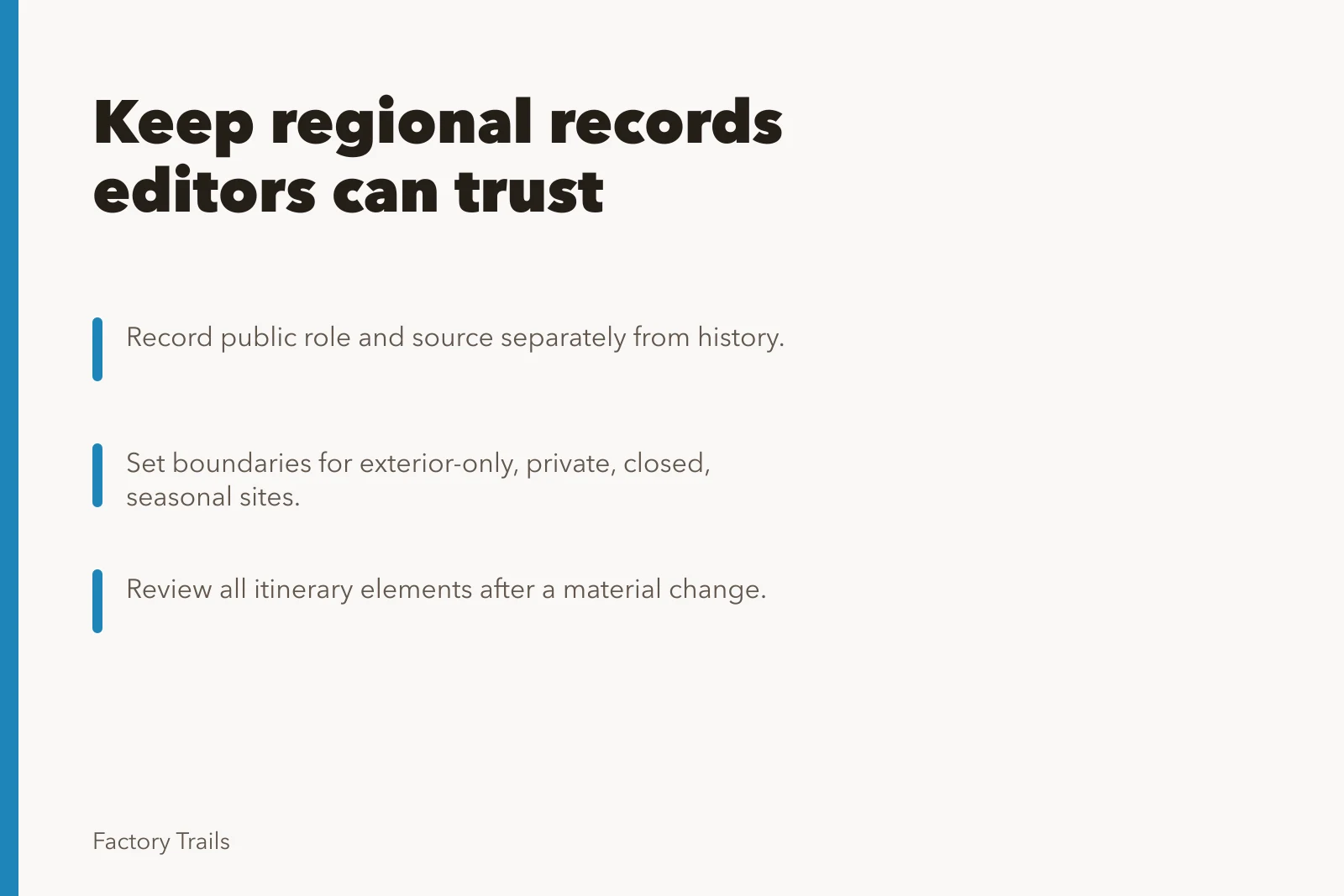
- Record a stop's public role and current source separately from its historical importance.
- Keep a clear boundary for exterior-only, private, closed, or seasonal places.
- Review every itinerary element before each seasonal planning period, and set the next review date whenever a record changes.
Core regional record
| Field | What to record |
|---|---|
| Stop and location | The public place name and a practical starting point. |
| Regional role | Objects, process, workers, transportation, setting, or orientation. |
| Public activity | Exhibit, tour, designated route, exterior context, or current program. |
| Responsible source | Specific operator page that supports the current claim. |
| Boundary | What the site does not promise, including private or unavailable areas. |
| Date checked | When the current information was confirmed. |
| Update trigger | A changed route, schedule, fee, program, or access term. |
The Blackstone River Valley industrial-heritage article connects mills, waterways, transportation, and communities across a larger region. That is exactly why a regional record matters. It keeps the guide's big story intact while making each individual visitor claim traceable.
Core regional record fields
- Stop and location
- Regional role
- Public activity
- Responsible source
- Boundary
- Date checked
- Update trigger
The National Park Service visitor conditions guidance explains why changing public conditions need a current check, so a record should name where an editor confirmed each time-sensitive visitor statement.
The National Archives' records-management fundamentals explain that records document organizational actions and decisions, and a publishing record should preserve the claim, source, date checked, and final public wording.
The National Park Service Museum Handbook page supports a simple distinction: a source-backed visitor statement belongs in the record, while an assumption does not.
Here is one worked example, filled for a real stop.
Field / Slater Mill, Pawtucket, Rhode Island
- Stop and location
- Slater Mill, Pawtucket, Rhode Island.
- Regional role
- Early textile mill and waterpower site on the Blackstone River.
- Public activity
- Tours and site interpretation, as listed on the operator page.
- Responsible source
- The operator's own visitor page.
- Boundary
- Interior access and tour times follow the operator's current schedule.
- Date checked
- The day the editor last confirmed the operator page.
- Update trigger
- Changed hours, tour terms, or access.
Keep records useful for publishing
Write the regional role plainly. "Orientation museum" is more useful than a vague praise phrase. "Public canal path with exterior mill context" is more accurate than calling a private building a tour. When a placement or local business is considered, record its real relevance and label commercial material clearly rather than altering the historical logic of the itinerary.
Review all records when an anchor changes. If the first museum closes, a route may no longer make sense as the second stop. A good record helps an editor substitute a confirmed alternative while preserving the reader's original question.
Keep the old record's review date rather than deleting it. It gives the editor a clear history of what changed and prevents an outdated route from returning through an older list or caption.
Record the change at the right level
A regional record should not be a long diary. It should make the next correction easier. Record the public claim that changed, the source that caused the change, and the revised wording. Keep any private correspondence or sensitive site information outside the public content process.
Record action / Example note
- Identify
- "Route entry promised an interior visit."
- Verify
- "Current operator page reviewed on this date."
- Revise
- "Entry now describes exterior public context only."
Use the same record identifier when a stop appears in a guide, a listicle, and social planning copy. That helps editors find related text without creating internal links for readers. The published article needs the current fact. The record gives the team a controlled way to keep it current.
Commercial requests deserve their own note. Record relevance and disclosure separately from visitor facts. A sponsor should never determine whether a historic place is called public, open, or part of a route.
A compact record also makes periodic review more efficient. The next editor can see what matters without re-reading old drafts or relying on a detached memory of the itinerary.
Before publishing the revised page, compare the record with the actual public copy one last time. The date, source, and stated boundary should agree across both places.
Common questions
Put the public activity field first
Readers need to know what they can actually experience.
Should records include private properties?
They may include them as historical context, but they must state the public boundary clearly.
When should a regional record be revised?
Revise it whenever a source, program, route, fee, or access condition changes.
Decide who approves a commercial placement
The editor owns the record and the final public wording. The operator owns the facts about its own site, such as hours, fees, and access terms. An editor should confirm that the placement is relevant, accurately labeled, and does not alter a verified public-access claim.