Guides
Manufacturing museum records: a guide for owners and editors
Manufacturing museum records lets curators separate archival context from live visitor terms and refresh public data without damaging original catalog entries.
A museum article goes stale in two different ways. The history gets thin, or the visitor facts drift. Separate records let you fix one without touching the other.
What to take away
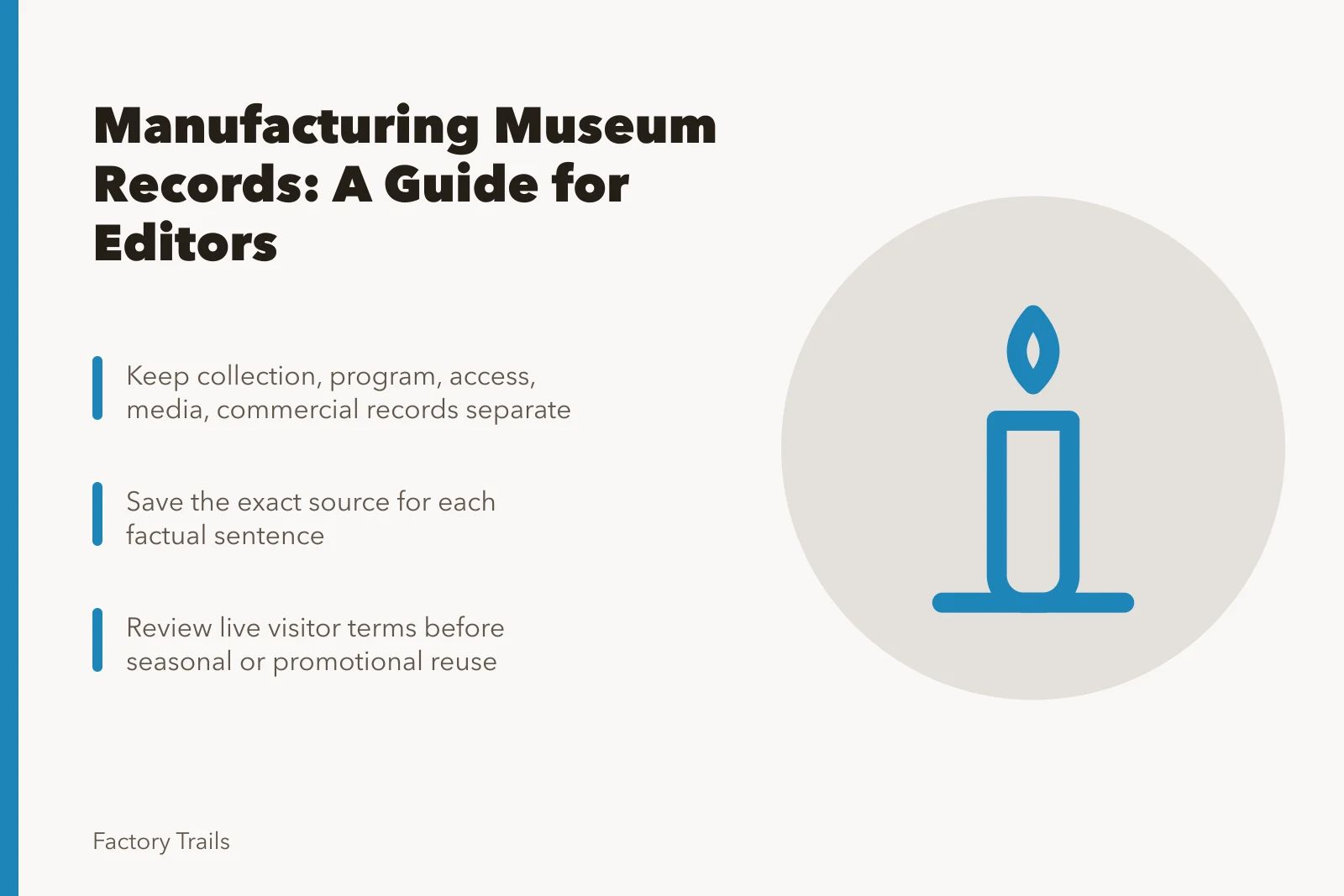
- Keep seven fields per museuminstitution and public program, collection source, visitor source, access note, media record, commercial note, correction log.
- Write the source limit beside every source, so a later writer knows where its authority stops.
- Give each visitor-facing claim a statusconfirmed, needs review, changed, or removed.
- Re-check the responsible page before any seasonal or promotional reuse, not after.
- Mark an outdated record instead of deleting it, so the stale claim cannot return.
The museum record
Field / What it holds
- Institution and public program
- The museum and the specific program the article covers.
- Collection source
- The page or finding aid behind the industrial-history sentences.
- Visitor source
- The page behind hours, tickets, and program terms.
- Access note
- Dated, specific features: a working line, a lift, a route closure.
- Media record
- Credit line and what the image actually shows.
- Commercial note
- Disclosure wording and any requested placement.
- Correction log
- Superseded wording, the source that prompted it, and who approved it.
The Thomas Edison National Historical Park collections overview is a good model for the collection source field. It covers laboratory equipment, machinery, materials, and production records from the West Orange works.
That page supports a sentence about what the site made and how. It cannot tell you this season's admission price or whether the machine shop is open on a Tuesday.
Keep exhibit change in its own record
A rotation or a closed gallery changes a visitor recommendation. It does not make the industrial-history paragraph wrong. Name the sentence that needs updating and the date the change was confirmed.
Give every record an owner. When a museum sends a correction, that person compares the new source against the published sentence and logs the decision. A valid update then stays an update instead of becoming an undocumented rewrite.
For a paid listing, store the disclosure decision apart from the collection facts. The collection can still support a historical sentence. The paid relationship has to stay visible, and it never becomes proof of a visitor claim.
Make each record usable at the next review
Put the status beside the source and the date, not in a private memory or a loose email thread. An editor can then see whether a claim still fits a scheduled article, a list entry, a newsletter mention, or a paid placement.
Add a source-limit field. A collections page may support a history sentence without proving today's ticket process. A calendar may support one event date without proving a weekly program. The limit marks the edge of what a source can honestly establish.
Review records as part of publishing
Before reuse, open the visitor record and compare it with the responsible page. Check the title, summary, table entries, captions, and promotional wording against it. If the source moved, revise the published sentence first, then log the decision and date. Do not carry a familiar phrase forward because it appeared in an earlier draft.
Keep corrections readable. Save the original wording, the source that prompted review, the replacement, and who approved it. A later editor gets a reasoned history, and an ordinary update stays distinct from a correction made after a museum or reader flags a problem.
When a record goes out of date, mark it rather than deleting its history. The old wording explains why a guide changed and stops the same stale claim returning at the next refresh. Keep that history private where it holds operational detail.
The National Park Service visitor conditions guidance is the reminder that visitor terms need re-checking. It says nothing about another institution's access. Your record should show the date the responsible page was checked for each live claim.
The National Archives' records-management fundamentals explain why traceable decisions matter. A record should carry the source, date, current statement, and limitation. It should also carry the decision and next review date.
The National Park Service Museum Handbook is a professional reference for collection care. It does not prescribe a publication system. It does support keeping collection context, visitor information, media, and editorial notes apart.
Common questions
Which record needs the most frequent review?
The visitor source, because hours, prices, programs, and access details move with the season. Set the next-review date from the museum's own published schedule.
Can a collection source support a paid listing?
It can support a narrow historical sentence. The commercial note handles disclosure and placement, and the two never merge into one field.
Why keep a media record?
It stops a generic image being read as evidence about the museum in the article. Credit line and subject both belong there.
What goes in a correction log?
The original wording, the source that prompted review, the replacement, and the approver. That chain separates a routine update from a correction.