Guides
How manufacturing museums keep planning records that hold up to review
A six-field correction log and the exhibit-planning stages that keep a plant tour guide accurate when shutdown dates and access terms change.
A plant tour page goes stale in one of two ways. The furnace is cold for December maintenance and the page still sells a December visit. Or the wording was wrong in March and nobody wrote down why it was changed in April.
What to take away
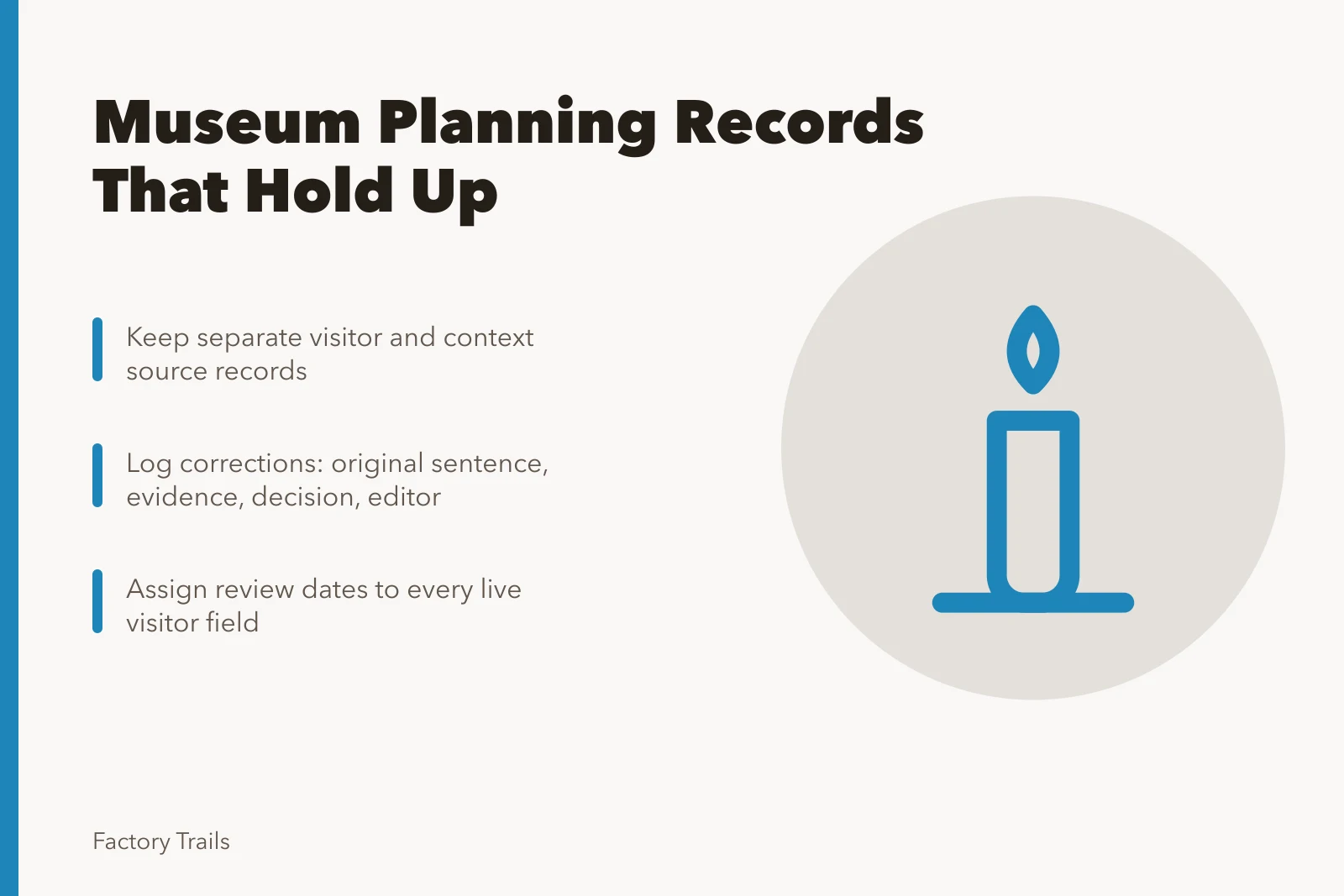
- Log every correction in six fieldsoriginal sentence, request date, evidence, decision, revised wording, editor.
- Run content, production and rights updates as separate stages, the way exhibit planners do.
- Record what a source does not prove, not only what it supports.
- Give each live visitor claim a review date and a statusconfirmed, needs review, changed, removed.
- Check the plant's own shutdown calendar before any seasonal claim goes live.
The six-field correction log
Field / What goes in it
- Original sentence
- The exact wording a reader saw, copied, not paraphrased.
- Request date
- The day the error was reported or spotted.
- Evidence
- The source that settles it, with the page and the date checked.
- Decision
- Change, keep, or narrow the claim, and the reason.
- Revised wording
- The replacement sentence, or the note that none was needed.
- Editor
- The person who signed the decision.
Two of those fields do the real work. Evidence without a check date is a rumour with a citation. A decision without a reason gets re-litigated the next time staff turns over.
Six-field correction log
- Original sentenceexact wording, copied not paraphrased
- Request dateday the error was reported
- Evidencesource, page, date checked
- Decisionchange, keep, narrow, and reason
- Revised wordingreplacement sentence or none needed
- Editorperson who signed the decision
A worked example
A guide reads: "The rolling mill runs daily tours through December." A reader emails in October to say the mill is shut for maintenance that month.
The log entry looks like this. Original sentence: the line above. Request date: the email date. Evidence: the operator's published maintenance window, checked that day. Decision: narrow the claim to the months the operator confirms. Revised wording: "Tours run on the operator's published schedule; the mill is closed for maintenance each December." Editor: the person who made the call.
The revised sentence is longer than the original and that is correct. It is also the only version a reader can act on.
Run updates as stages, not one pass
The NPS museum exhibit planning process separates updating content from checking production material and documenting rights. A tour page benefits from the same split, because the three fail differently.
Update in three stages
- Content: sentence matches operator's current terms
- Production: caption, alt text, photo match sentence
- Rights: image cleared, credited, licensed for use
Fix content and skip production and you get a corrected sentence under a photo of a building that was demolished. Fix production and skip rights and you get a clean page with an image the publication cannot lawfully run.
Record the limit of every source
A historic collection page explains objects and processes. It does not prove today's admission price or that a line is running. An event calendar proves one date, not a weekly program.
Write the limit into the record next to the source. The National Park Service Museum Handbook is a museum-practice reference; it does not prescribe a publishing system. Say so in the record, and the next editor will not treat it as one.
The National Archives' records-management fundamentals explain why decisions are kept traceable at all. Source, date, current statement, limitation, next review.
Keep commercial material out of the facts
When a museum or a coach operator pays for placement, log the proposed wording, the disclosure decision and the supporting sources in the same six fields. A commercial relationship proves nothing about access, dates or safety. Check those against the operator's own published information.
Where the shutdown calendar fits
Maintenance windows are the single most common source of stale tour copy, because they move. July and December are the usual slots in heavy industry, but the operator sets the dates and publishes them.
Never infer a window from last year's. Ask the operator or the site authority, write the answer into the evidence field with the date, and set the review date to just before the window opens.
Before the next promotion
Reopen the record and check the operator's current page. If the claim holds, log a fresh date. If it does not, revise the guide, the caption and the summary before the post, list update or sponsored placement goes live.
The National Park Service visitor conditions guidance explains why current visitor terms need rechecking. It establishes nothing about another institution's access.
Do not overwrite a changed term silently. Keep the prior date and say why the new wording is narrower. A status label, confirmed, needs review, changed or removed, stops a draft from treating an old note as a live fact.
Common questions
Which field gets checked most often?
Evidence, because a source that was right in spring can be wrong by the maintenance window. Re-date it rather than re-arguing the decision.
Why keep a source-limit note?
It stops a valid history source from being reused as proof of a current visitor claim. The limit is one line and it saves a correction later.
What belongs in a paid-placement record?
The disclosure, the requested wording, the source review and the final editorial decision, in the same six fields as any other correction.
Who signs off on a narrowed claim?
The editor named in the record, after checking the operator's own published information. Where access, safety or licensing terms are involved, the operator or site authority sets them, not the publication.