Guides
How manufacturing museums can keep mistake records that prevent repeat errors
Manufacturing museum mistake records for 2027 help U.S. editors log corrections, sources, public effects, approvals, and scheduled article reviews.
""" Correction records keep a manufacturing-museum guide trustworthy after conditions change. A short record explains what claim changed, which current source supports the correction, what visitor-facing content was updated, and when to review it again.
What to take away
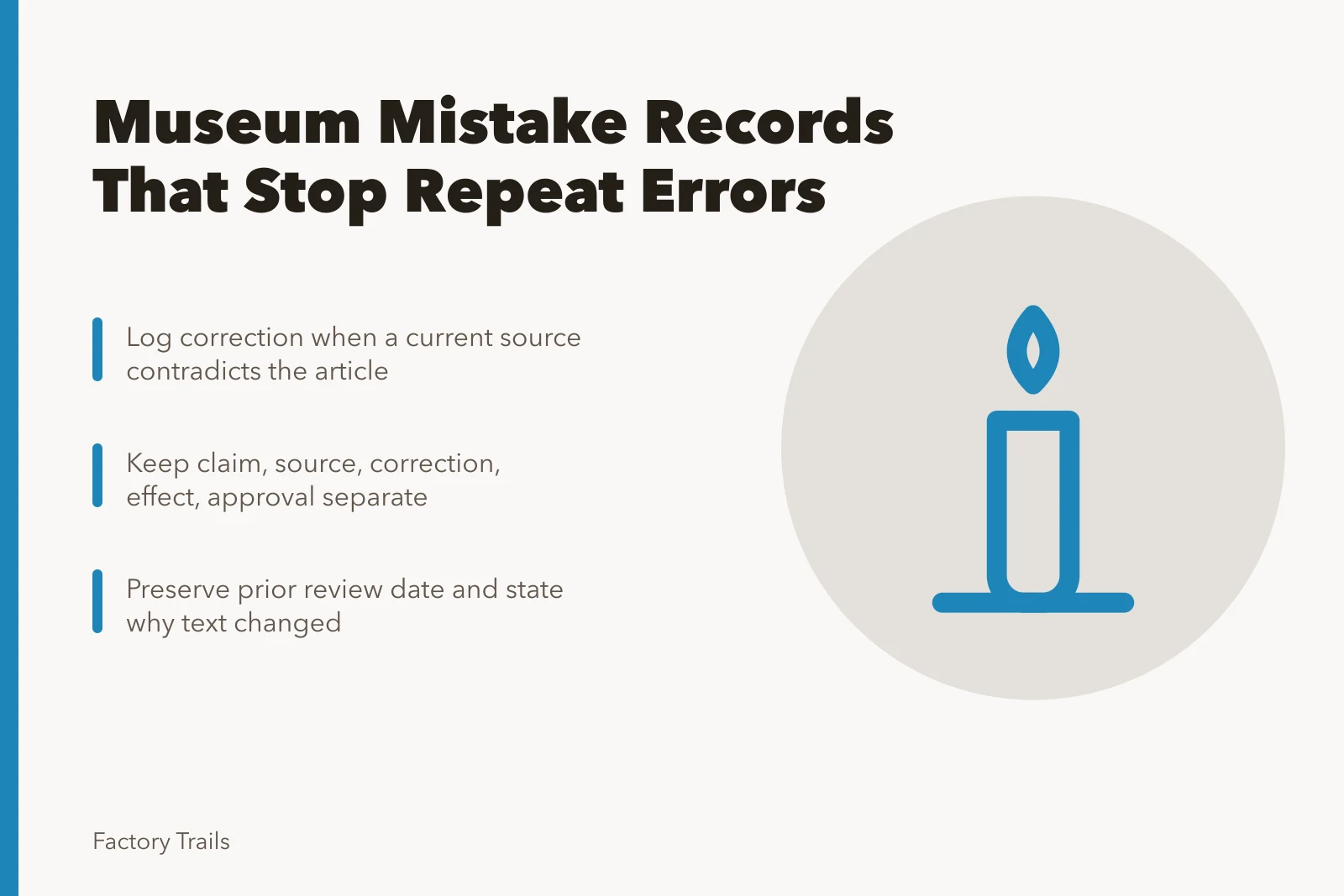
- Record a correction as soon as a current source contradicts the article.
- Keep the observed issue, approved wording, and public effect in separate fields.
- Do not publish sensitive internal, security, or incident details.
Correction record fields
| Field | What to record |
|---|---|
| Article claim | The sentence, caption, list entry, or map note that needs review. |
| Current source | Specific responsible page that supports the corrected wording. |
| Correction | The factual public wording now used. |
| Public effect | Closed route, paused program, changed access, or no current visitor effect. |
| Approval | The editor or responsible role that confirmed the revision. |
| Review date | When live terms should be checked again. |
The NPS Museum Handbook quick reference includes museum planning topics such as access, security, visitor circulation, and conditions in collection spaces. A content record should be similarly practical: it must connect a verified issue to the decision and public description that follow.
Correction record fields
- Article claimsentence, caption, list entry, map note
- Current sourceresponsible page supporting corrected wording
- Correctionfactual public wording now used
- Public effectclosed route, paused program, changed access
- Approvaleditor or role confirming revision
- Review datewhen live terms are checked again
The National Park Service's current-conditions guidance shows why live visitor information needs a review date.
The National Archives' records-management fundamentals describe records as information kept to document actions and decisions.
The National Park Service Museum Handbook page describes a professional reference for museum work.
Use records to prevent repeat errors
Do not silently overwrite a stale claim. Preserve the prior review date and state why the text changed. This gives future editors a trail to follow when the same museum appears in a listicle, a regional guide, or a paid placement. It also helps distinguish a corrected public-access claim from an unchanged historical description.
A correction record can be short. Its job is to let a later editor understand what changed without reopening every old search. Put the public sentence first, then the specific source, the date reviewed, and the replacement wording.
Keep sensitive detail in the internal note: security, collection location, staff, or an incident. The article can say that a route is unavailable or a program is paused without exposing operational information.
Use the same record identifier in every related list entry, map note, and social update so one correction can be checked across the whole site.
The section editor who owns the guide owns the record. The managing editor approves the public wording before it goes live. Keep one row per correction in a shared spreadsheet, using the six fields above as columns.
Retain the record for three years after the correction, or for the life of the page plus two years, whichever is longer, and store it with the article's source file.
Worked example
Illustrative record, not a real site.
Field / Example entry
- Article claim
- "The furnace-floor tour runs daily at 10 a.m."
- Current source
- The site's current visiting page, checked 12 March 2026.
- Replacement wording
- "The furnace-floor tour runs Saturdays at 10 a.m."
- Public effect
- The tour still runs, weekly rather than daily.
- Owner
- Section editor who maintains the guide.
- Approval
- Managing editor.
- Retention
- Three years after the correction.
- Review date
- 12 September 2026, six months later.
| Record step | A useful note |
|---|---|
| Identify | "Guide says the interior tour is available." |
| Verify | Name the current responsible page and its check date. |
| Revise | Quote the narrower public wording that replaced the claim. |
| Review | Set the next check at six months for volatile details such as hours, tours, and closures, or twelve months for stable ones such as building history and collections. |
| Close | Confirm that the title, body, caption, and list copy agree. |
Start a record when a responsible page contradicts a published claim, changes an opening day, tour time, price, or access rule, or when the claim has not been checked inside its review window. Avoid records that say only "updated." That wording loses the reason for the change and leaves the next editor guessing.
For a paid placement, keep editorial records separate from commercial correspondence. The article should still be corrected when a visitor claim changes, even if no sponsor asks for it.
Common questions
What starts a correction record?
A current responsible source that contradicts or materially changes a published visitor claim.
Should the whole record be public?
No. Publish the confirmed visitor effect and keep sensitive operational information internal.
When can a correction be closed?
Close it after the corrected public content is verified and the next review date is assigned.
"""