Guides
How to keep manufacturing museum case study records editors trust
Manufacturing museum case study records for 2027 show U.S. editors how to log sources, permissions, version dates, limitations, and corrections for publication.
A case-study record is the working file that lets an editor answer a basic question after publication: where did this sentence come from? It is not a pile of bookmarks. It is a compact, dated trail from each important claim to a source, interview note, permission, or decision to leave the claim out.
What to take away
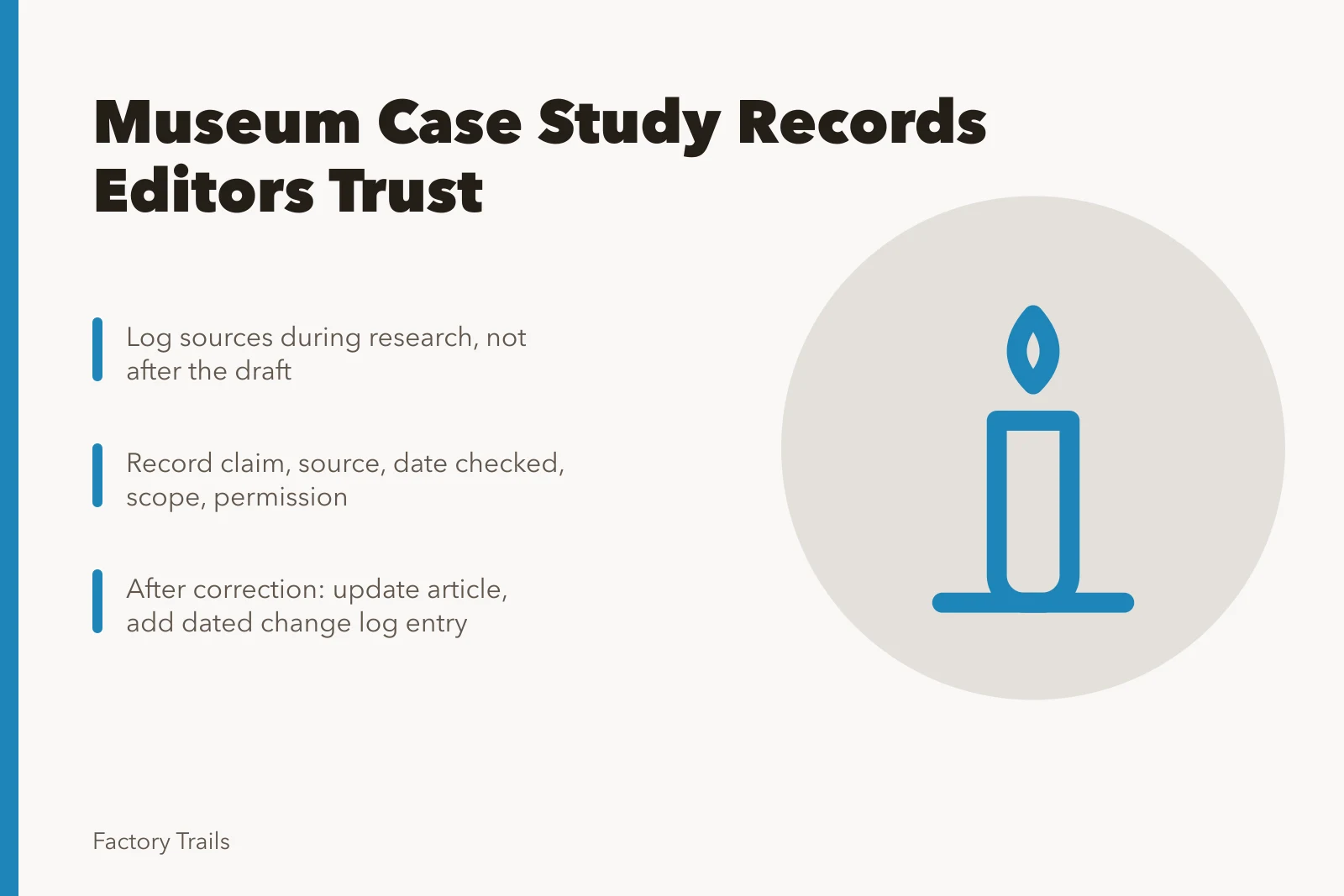
- Log sources while researching, not after the draft is finished.
- Keep current visitor details apart from historical evidence.
- Record limitations and corrections as carefully as favorable facts.
Fields, filenames, and a filled example
| Field | What to capture |
|---|---|
| Claim | The exact fact or carefully limited conclusion |
| Source | Specific page, report, accession record, or interview note |
| Date checked | When the source or visitor detail was verified |
| Scope note | What the source covers and what it does not cover |
| Permission | Any image, quote, or interview terms that matter |
| Change log | Corrections, retired claims, and the reason for each change |
Use stable filenames and a version date. Name the file with the article slug, the date of that version, and a version number, for example riverfront-stamping-2027-03-14-v2.md.
A source title alone is rarely enough for another editor to locate the same record months later. For a conversation, retain the interviewer's notes and enough context to prevent a later reader from mistaking an opinion for a dated fact.
A record covering an exhibit at the National Museum of Industrial History in Bethlehem, Pennsylvania, or The Henry Ford in Dearborn, Michigan, needs the same fields. Filled in, one row looks like this.
Field / Filled example
- Claim
- The drop-forge line ran from 1918 to 1974
- Source
- Accession record 1974-118, page 3, museum archive
- Date checked
- 2027-03-14
- Scope note
- Covers the forge line only, not the foundry
- Permission
- Staff photograph, written terms filed as item 21
- Change log
- 2027-03-14, v2: start year corrected from 1913 to 1918
Case Study Record Fields
- Claimexact fact or limited conclusion
- Sourcepage, report, accession record, note
- Date checkedwhen source was verified
- Scope notewhat source covers, omits
- Permissionimage, quote, interview terms
- Change logcorrections, retired claims, reasons
Ownership, approval, retention, and correction logs
For a site visit, log the date, the specific place observed, and whether information came from a posted notice, staff member, or official publication. Do not silently replace an older fact with a new one. Note the change and revise the article so the published wording stays accurate.
The assigning editor owns the final case-study file, and the current version sits in the publication's shared case-study folder. The research lead approves factual corrections and the editor approves wording. Both approvals go in the change log.
Keep the record for at least five years after the last update, and longer where an image licence or interview consent sets a term. Typical publisher schedules run five to seven years, so the terms attached to the material decide the final number.
Documentation guidance from the National Park Service and the National Archives sets the same standard: identify the item, preserve its context, and keep the trail reviewable. See the records-management profile guidance, records-management fundamentals, Museum Handbook, and Museum Handbook Part II for reference.
Review the record whenever a factual claim, media credit, or current visitor detail changes. Update the article and log the reason, source, date, and person responsible. Preserve the prior version so the correction remains reviewable without leaving outdated wording live.
If an interview supports a statement, include the speaker's role, interview date, consent terms, and whether the assertion was independently confirmed. This record does not make every source equally strong. It makes the strength and limits of each source visible.
After publication, add only changes that affect accuracy, source interpretation, or reader decisions. A correction log should not become a diary of copy edits. A concise history helps an editor see whether a recurring problem came from the evidence, the headline, a current visitor statement, or an image caption.
Add one dated entry to the change log for every factual fix. A worked entry: 2027-03-14, v2. Corrected the drop-forge start year from 1913 to 1918 after reading accession record 1974-118. New source added. Factual change approved by the research lead; wording approved by the assigning editor.
Common questions
How long should the record be?
Long enough for a different editor to trace significant claims and permissions without relying on memory. A small table is often sufficient.
Should unpublished notes be listed?
Yes, if they support a published statement. Mark them as notes, include the date, and state their limits.
What should happen after a correction?
Update the article, add a dated entry to the change log, and retain the prior source reference so the decision is reviewable.