Guides
How to read regional warning signs on industrial tours before routes break
Regional warning signs on industrial tours show up as repeat frictions, and reading them early keeps local access, arrival timing, and guest trust intact.
What to take away
- The signal is repetitiona one-off closure is weather, the same closure every rainy week is a broken plan.
- Every regional condition gets a guest message and a review date.
- Typical thresholdsa group cap of 20 to 25 where the site supplies one host, an arrival window of 15 minutes, and one weekly review slot.
- A shared street, gate, or transit stop belongs to the people who use it daily, not to the tour.
- Read open conditions at the weekly review, before coaches roll.
Regional trouble rarely arrives as one dramatic failure. It arrives as a coach that cannot use the expected loading bay, guests asking where to meet, a guide quietly skipping the same segment, or a wet week that changes the walking surface. Each is small. Together they are the warning system.
A single closure may sit outside anyone's control. A closure that returns every rainy week or every public event should change the route, the visitor message, the staffing, or the booking window.
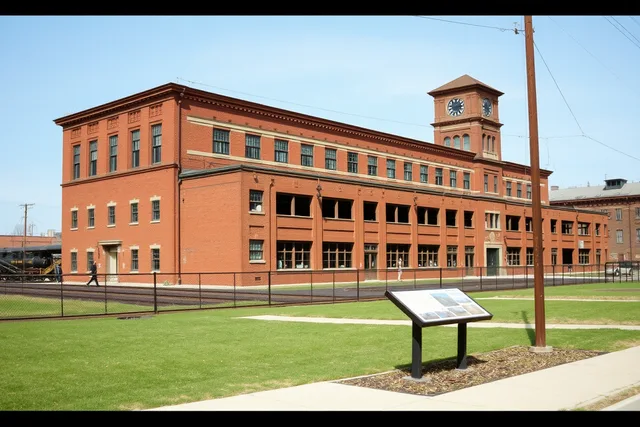
Take Lowell National Historical Park in Massachusetts. If the same downtown curb fails on three Saturdays running in October, when foliage traffic and school groups land between 09:00 and 11:00, the booking window is the cause, not the weather. The pattern can also appear at SteelStacks in Bethlehem, Pennsylvania, when a festival weekend takes the lots.
Watch for local drift
| Warning sign | What it may mean | Useful response |
|---|---|---|
| Arrival instructions keep changing | Local access plan is not stable | Verify the route and publish one current version |
| Group waits at a boundary | Capacity or site coordination is weak | Adjust timing, group size, or host coverage |
| Weather repeatedly changes the visit | Seasonal format is incomplete | Add a threshold and approved alternate |
| Nearby residents or businesses are affected | Tour flow is not fitting the place | Review arrival, parking, and gathering behavior |
| Guides use personal workarounds | The route card is out of date | Record the issue and decide on a durable change |
Drift is easiest to see at the arrival point, because that is where the tour meets the neighborhood. A loading bay that works in February may fail in July, when the same curb carries a farmers market, a school run, and a shift change at the plant next door.
Local Drift Warning Signs
- Arrival instructions keep changing
- Group waits at a boundary
- Weather repeatedly changes the visit
- Nearby residents or businesses affected
- Guides use personal workarounds
None of those users are going to move for a coach.
Weather guidance is a starting point, not a local answer. The National Weather Service wind safety guidance explains how wind affects people and property, so check exposed stops and structures on the day.
The U.S. Access Board guide to accessible routes explains how the ADA Standards treat the route from an arrival point to an accessible entrance. It does not approve your itinerary, but it does mean walking the whole path before you describe access or promise a detour.
Regional conditions to monitor in the US
Watch these four across US operations.
| Regional condition | What to monitor |
|---|---|
| Weather | Seasonal wind, heat, ice, and river flooding that change walking surfaces and outdoor stops |
| Events | Festivals, school terms, and plant shift changes that compete for the same curb or lot |
| Transit | Detours, closed stops, and schedule changes announced weeks ahead |
| Construction | Street, bridge, and utility work with posted detours and lane closures |
Separate a temporary condition from a broken plan
A one-day reroute is fine. It becomes a warning sign when nobody owns the change, guests get two different stories, or the alternate has never been checked.
Temporary Reroute or Broken Plan
- Name the exact local condition
- Confirm the immediate route control
- Tell staff and booked guests what changed
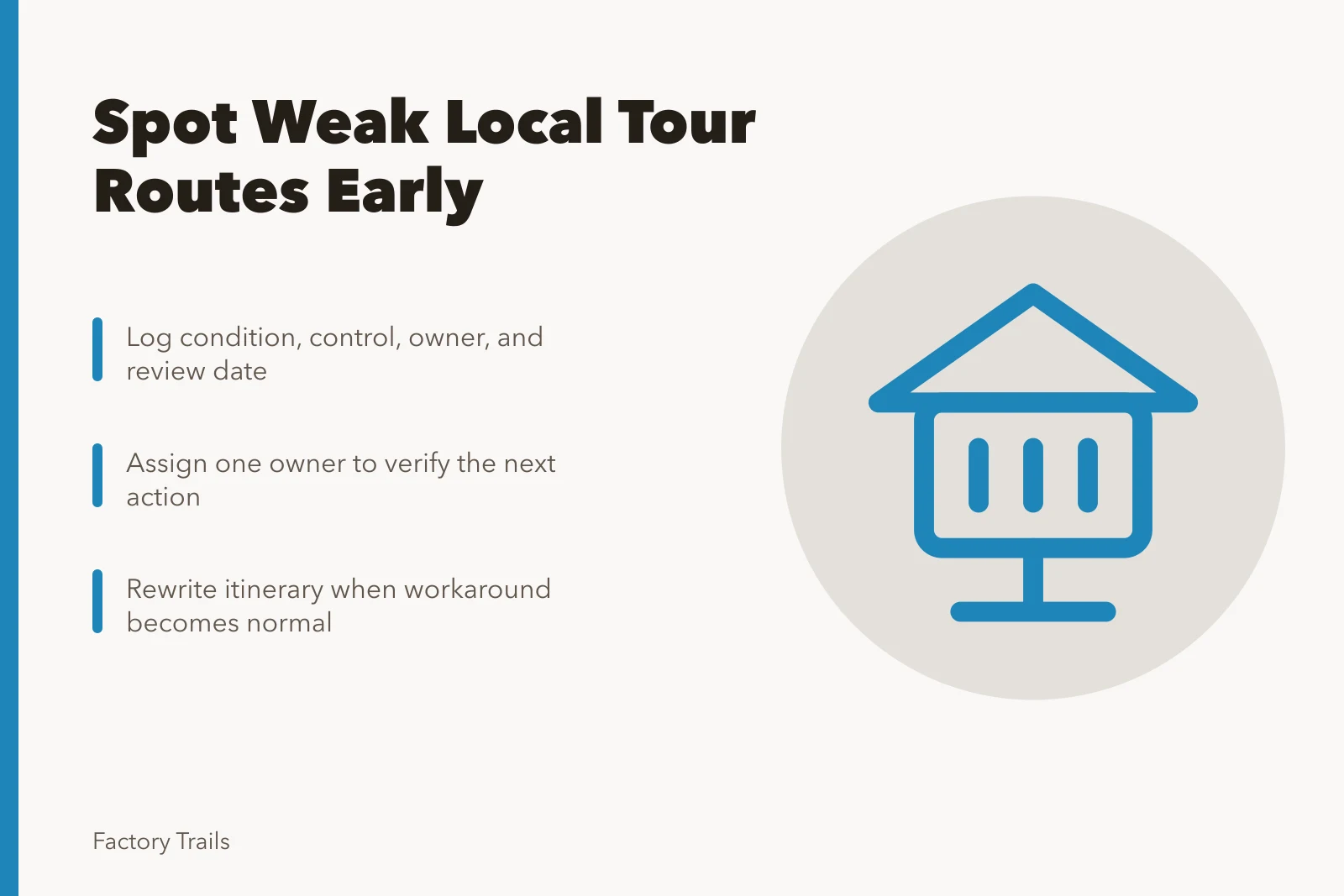
- Assign one person to verify next action
- Update itinerary if change becomes normal
- Name the exact local condition.
- Confirm the immediate route control.
- Tell staff and booked guests what changed.
- Assign one person to verify the next action.
- Update the itinerary if the change becomes normal.
Waiting points deserve the same care.
A group parked in a convenient doorway during a delay is a problem for the plant, whatever it does for the schedule. The Occupational Safety and Health Administration exit-route standard covers clear exit routes, so hold the group inside the facility's approved boundaries and ask the site where overflow should stand.
Protect the local relationship
When a visit touches a shared street, a neighborhood, a facility entrance, or a transit stop, the people who use that space every day are the ones who notice. A later arrival, a smaller group, or a different gathering place often removes the friction without weakening the visit. Ask them before you decide you cannot move.
Keep one local contact note with the route card and fill it in the same day:
Field / Entry
- Date
- Condition
- Who raised it
- Action taken
- Next review
Six months later, that note explains why an arrival time or group size is what it is.
Heat needs a written response too, not a verbal one. The National Weather Service heat-safety resource notes that heat strains the body and affects some people more than others. Decide the route change and the rest option before guests are already travelling. A plan made at the gate is a plan made too late.
Review open local conditions at the weekly review, which runs at 08:00 local time on the first working day. Prioritize anything that affects access, route boundaries, a visitor promise, or the community's normal use of a shared space. Then update the route card and the guest message from the same confirmed record, so the two never disagree.
Common questions
Is a local restriction always a warning sign?
No. A clear, well-managed restriction can show that the operator understands the site and the neighborhood. The warning sign is a restriction nobody owns, explains, or reviews.
What should be logged first?
Log whatever changes access, timing, safety, visitor information, or the promised route. A condition that alters none of those can wait for the weekly review.
When should an itinerary be rewritten?
Rewrite it when a temporary regional workaround becomes the normal operating plan. If the alternate has run for a season, it is no longer an alternate.