Guides
How to write industrial tour case study questions that hold up
Industrial tour case study questions for 2027 help U.S. operators choose useful topics, define evidence, compare outcomes, and avoid unsupported conclusions.
What to take away
- A narrow question creates a case study that can be checked.
- Ask about an observed change, not whether a tour was simply good or bad.
- Include a question about evidence limits before writing the conclusion.
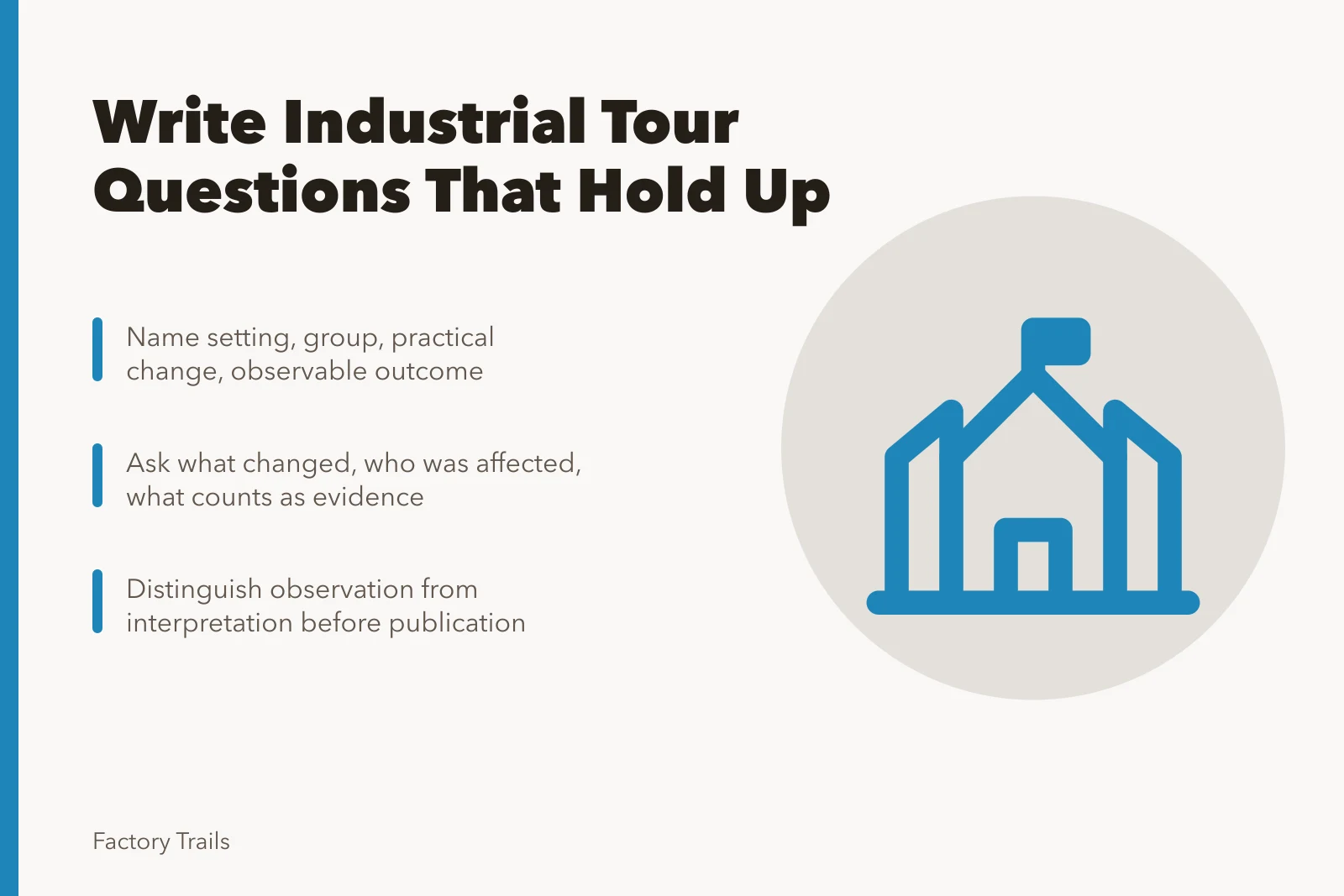
The best case-study questions help an operator make a next decision. They name a setting, a group, a practical change, and an outcome that can be observed. Questions that are too broad invite a promotional answer. Questions that are too narrow may produce a fact with no practical value. Use the questions below to find the useful middle ground.
Start with a question that matters to the people who operate the visit. A change to a meeting point, route length, opening explanation, or access option may seem small, but it can affect how guests begin and follow the experience. The article should not try to prove that a tour is universally better. It should show what happened in a defined setting and what the operator plans to do next.
Compare useful and weak questions
Stronger question
- Was the tour successful?
- Did a pre-visit route map reduce missed meeting times for first-time guests?
- Did visitors like the guide?
- Which guide explanation prompted the most follow-up questions at the equipment stop?
- Was the new route better?
- Did removing one stop create enough time for the final interpretation?
- Was access clear?
- Did the revised confirmation email reduce calls about parking and entry?
Evidence to plan
- Was the tour successful?
- Arrival notes and permitted feedback
- Did visitors like the guide?
- Guide notes and question log
- Was the new route better?
- Timed route record and staff observations
- Was access clear?
- Inquiry count and email version
The National Park Service's long-range interpretive plan for Brown v. Board of Education National Historical Park describes planning as a way to make practical, goal-driven choices for interpretive programs. An industrial-tour case study can use the same logic: let the question point to a decision the operator can actually take.
Weak vs Strong Tour Questions
Weak question
- Tour success
- Was the tour successful?
- Guide likeability
- Did visitors like the guide?
- Route quality
- Was the new route better?
- Access clarity
- Was access clear?
Stronger question
- Tour success
- Did a pre-visit route map reduce missed meeting times?
- Guide likeability
- Which guide explanation prompted follow-up questions?
- Route quality
- Did removing one stop create time for interpretation?
- Access clarity
- Did revised email reduce parking and entry calls?
Ask questions that expose a decision
Good questions identify a choice. For example, "Should the operator keep the five-stop route or use four stops and add a longer discussion?" is better than "Did visitors enjoy the tour?" The first question calls for route timing, observations, and a clear decision. The second may collect opinions but leaves the team unsure what to change.
Write down the expected direction before the visit. If the team believes a clearer map will reduce late arrivals, say that in the planning note and specify what record would support or contradict it. The Centers for Disease Control and Prevention guidance on focusing an evaluation design emphasizes setting the evaluation's purpose, users, questions, and methods. A visitor program can follow that sequence on a small scale without pretending to conduct academic research.
Questions to ask before collecting evidence
- What changed, and why was it changed?
- Who was affected by the decision?
- What would count as evidence of a useful result?
- What conditions might influence the result besides the change itself?
- What information cannot be shared because of privacy, security, or permission limits?
- What decision will the operator make after reviewing the evidence?
Add one question about the source of each answer. Who is recording the start time? Is a guide note a direct observation or an interpretation? Are visitor comments voluntary? Can the site contact verify the final route description? These details keep the later article honest. They also show readers whether an apparent result may be affected by a bus delay, weather interruption, unusually small group, or a separate change made at the same time.
Keep the route sheet, current confirmation, approval notes, and observation form with the case file. The National Archives records-management FAQ index offers background on retaining records so they can be retrieved and understood later. It is not a private operator's formal retention schedule. It does support a useful rule: a published conclusion should be traceable to a small set of clear, dated records.
Questions for the final review
Before publication, ask whether the article distinguishes observation from interpretation. Check whether a partner's account is attributed, whether dates and route descriptions are current, and whether the conclusion says more than the record can support. A good final question is: "What would a reasonable reader need to know before applying this lesson at another site?"
Question the financial claim separately when a study refers to cost, savings, or attendance revenue. The Internal Revenue Service recordkeeping guidance explains that businesses should retain records supporting income and expenses. It does not show that one tour change caused a financial result. It does mean the operator should locate the relevant business record before publishing an amount or comparison.
End with an action question: "What will we retain, revise, or test by a stated date?" That final question turns a case study into an operating tool. If the evidence is incomplete, the right answer may be another limited test rather than a larger claim.
Common questions
Can a case study answer more than one question?
It can, but begin with one primary question. Add secondary questions only when the same evidence can answer them without making the article unfocused.
Should questions be written before a tour happens?
Yes. Drafting them early helps staff collect the right notes and avoid reconstructing important details from memory.
What if the evidence contradicts expectations?
Report the result plainly. A contradicted expectation can identify a better next test and is more valuable than a forced success story.