Guides
How to build an industrial tour case study checklist before you publish
Industrial tour case study checklists for 2027 help U.S. operators define a visit, collect appropriate evidence, document limitations, and publish useful lessons.
What to take away
- Define the case before collecting notes or images.
- Capture evidence that answers one practical question.
- Publish limits and next steps alongside the result.
Use this checklist to turn a real industrial-tour decision into a useful case study. It works for an operator's internal review or a public article. The standard is simple: a reader should understand what was tested, what evidence was available, and what the result can reasonably support.
Complete the first half before the visit and the second half immediately afterward. The checklist does not turn one event into formal research. It gives a team a practical way to make a fair record, identify a small decision, and avoid publishing a confident conclusion that the available evidence cannot support.
Define the case before the visit
| Check | Record | Test |
|---|---|---|
| Question | One operational question | It can be answered with planned evidence |
| Boundary | Site, date, route, and group | The case has a clear beginning and end |
| Decision | What changed or was tested | The change is described in plain language |
| Evidence | Notes, counts, documents, feedback | Each item relates to the question |
| Permissions | Images, quotes, site facts | Publication authority is confirmed |
| Limit | Missing data or unusual condition | The conclusion remains proportional |
The CDC's guidance on focusing an evaluation design stresses that an evaluation should be designed around intended use and users. Apply that idea here: decide who needs the case study and what decision it should inform before gathering a large pile of material.
Define the case before the visit
- Questionone operational question
- Boundarysite, date, route, group
- Decisionwhat changed or was tested
- Evidencenotes, counts, documents, feedback
- Permissionsimages, quotes, site facts
- Limitmissing data or unusual condition
Add an evidence plan beside the question. Name what will be counted, who will make the record, and when it will be reviewed. For a route test, that might be start time, actual transition time, use of an alternate, and the number of guests who reached the first stop after the opening talk. Do not collect personal information merely because it might be interesting later.
Capture the right evidence
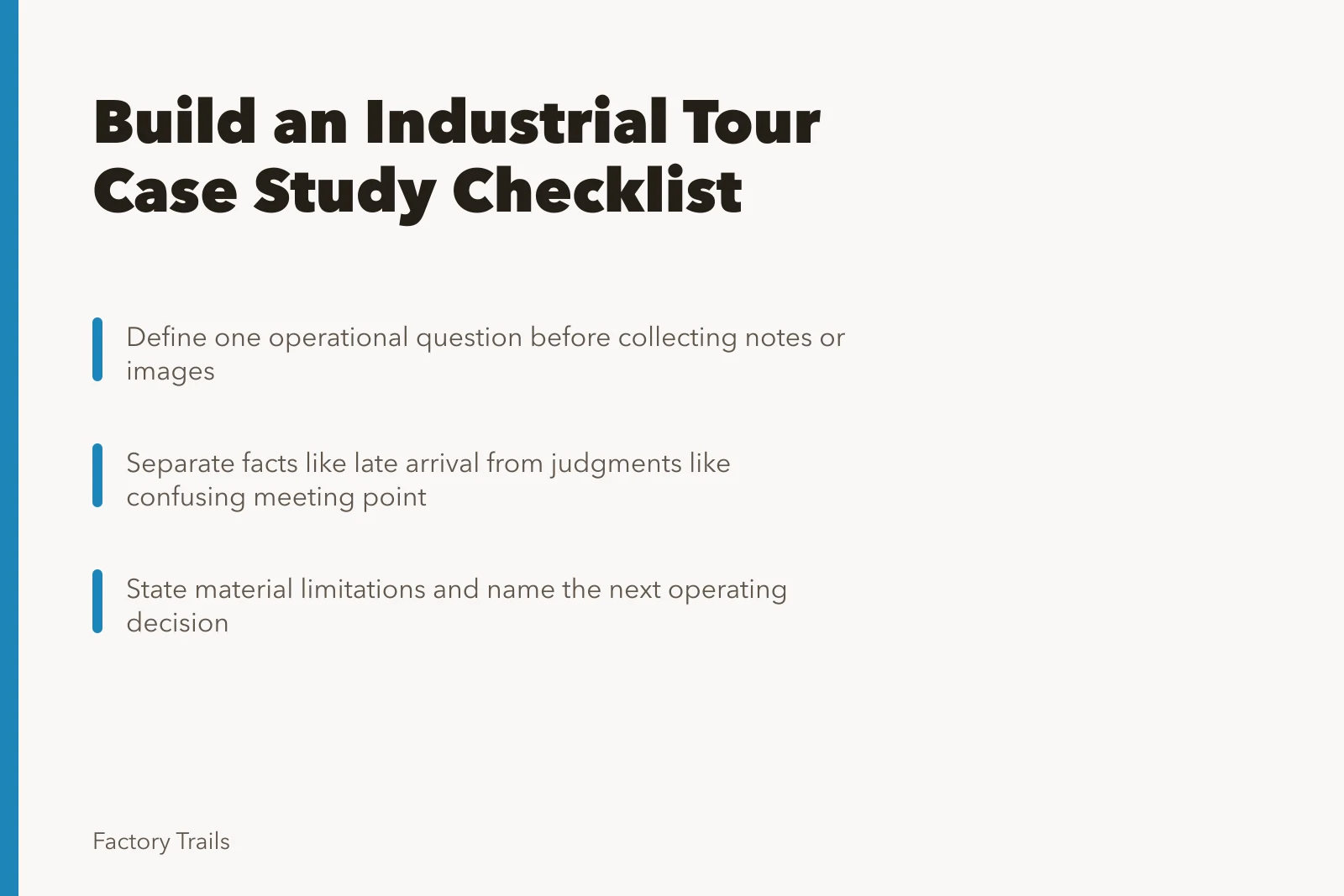
Retain the route version, visitor briefing, approved change, time-stamped observations, and any feedback method used. Separate a fact, such as a group arriving ten minutes late, from a judgment, such as the new meeting point being confusing. If you use a quote, obtain permission when needed and identify whether it is a visitor, partner, guide, or staff perspective.
Keep source documents together with a version label. The National Archives records-management FAQ index offers background on managing records so they can be found and used later. A private operator has its own obligations, but the discipline fits: retain the route sheet, approval, notes, and permissions that allow a reviewer to understand the published account.
Use a short observation form during the visit. Record times, route changes, and visible conditions first. Put comments and hypotheses in a separate field. This makes it easier to distinguish "the group waited eight minutes" from "the wait damaged the experience." Both can matter, but they are different kinds of statement.
Review before publication
- Check all dates, names, route descriptions, and captions.
- Remove confidential operational or personal details.
- Confirm that a conclusion does not claim more than the evidence shows.
- State any material limitation in the body of the article.
- Name the next operating decision or test.
For a public article, review images as carefully as the text. Confirm that the image is authorized, the caption names the correct place or event, and the credit points to the original source page. Do not use a photograph to imply that it depicts the study group if it only illustrates the type of tour.
If a case study includes costs or revenue, retain the source records through the operator's usual business process. The Internal Revenue Service recordkeeping guidance explains that businesses should keep records supporting income and expenses. It does not validate the study's conclusion, but it helps keep a documented cost finding separate from a rough estimate.
The National Park Service interpretive planning account describes a planning process that brings together visitor experience, planning workshops, and longer-term direction. An industrial-tour case study can use the same modest idea: connect a specific operational test to a stated visitor purpose, then decide what the team will keep or revise.
Common questions
Must every case study use visitor surveys?
No. Use the evidence that fits the question. Route notes, timing records, staff observations, and permitted visitor feedback can complement one another.
What is a useful limitation to disclose?
Disclose conditions that could affect the result, such as an unusually small group, a weather disruption, a changed host, or incomplete feedback.
Can the checklist be used for a failed test?
Yes. A well-documented result that did not work can prevent the same mistake and reveal a better next question.