Guides
Working factory visits: 7 cost planning warning signs to catch in 2027
Seven warning signs that mark a working factory visit cost plan as unreliable, from missing shutdown dates to access promises no plant has confirmed.
A working plant is not a museum. Lines run, maintenance shuts sections, and the safety officer can close a route the week you arrive. Cost plans built on a preserved site's rhythm fail against that calendar.
What to take away
- An estimate with no production calendar behind it is a guess with a number attached.
- Access promises, escort counts and photography rules come from the plant, in writing, before pricing.
- A shutdown week is cheaper to tour and shows less. Price the trade-off, not just the saving.
- Every uncertain line needs an owner and a date, or it will still be open at approval.
- Federal cost guidance is a documentation standard, not a factory-visit rulebook.
1. The calendar has no shutdown dates
Every working plant runs maintenance windows, and most sit in July or December. A tour priced without them assumes the line is running every week you might sell.
Running vs Shutdown Tour
Running week
- Line status
- Operating
- Access
- Restricted
- Product
- Standard tour
- Pricing
- One scenario
Shutdown week
- Line status
- Idle
- Access
- Often better
- Product
- Different product
- Pricing
- Second scenario
Ask the plant for its published maintenance schedule and its visitor blackout dates. Then price two scenarios: a running week and a shutdown week. A shutdown tour sees idle equipment and often better access, and it is not the same product.
2. Access is promised but not confirmed
"Behind the scenes" means different things at Sloss Furnaces, a preserved site, and at a plant casting today. Only the second has a safety officer who can refuse a route.
Get the access level in writing: which buildings, which walkways, whether a running line is included. Until the plant's own safety officer confirms it, mark the line pending. No operator can promise a route a plant has not agreed to.
3. Induction, PPE and escort ratios are unpriced
Safety induction, PPE and escort ratios drive guide hours more than distance does. A plant that requires one escort per ten visitors needs three staff for a group of thirty, not one.
The requirements vary by site and by state. Confirm them with the plant's visitor office, never from another tour's notes. Price the escort count the plant states, not the count that makes the margin work.
4. Photography terms are assumed
Tripods are banned in most production areas, and some plants bar cameras entirely. A tour built around photography sells something the site may not permit.
Ask where tripods are allowed, whether phones count as cameras, and who clears commercial images. If the answer is unclear, price the tour without the photo stop and add it only once the plant confirms.
5. Transport and vehicle timing are missing
Coaches cannot idle at a loading dock, and shift change clogs the gate. Arrival windows are set by the plant, not the operator.
Price the vehicle standing time, the driver's wait, and the buffer around shift change. A ten-minute window that slips costs a full coach hour.
6. Insurance and liability lines are blank
Visitor cover, guide cover and plant-imposed indemnity are separate lines. Leaving them blank does not remove them; it moves the cost to whoever signs.
Requirements differ by jurisdiction and by site. Ask a qualified attorney and the plant's own terms before you quote a price that includes access. This article does not give that advice.
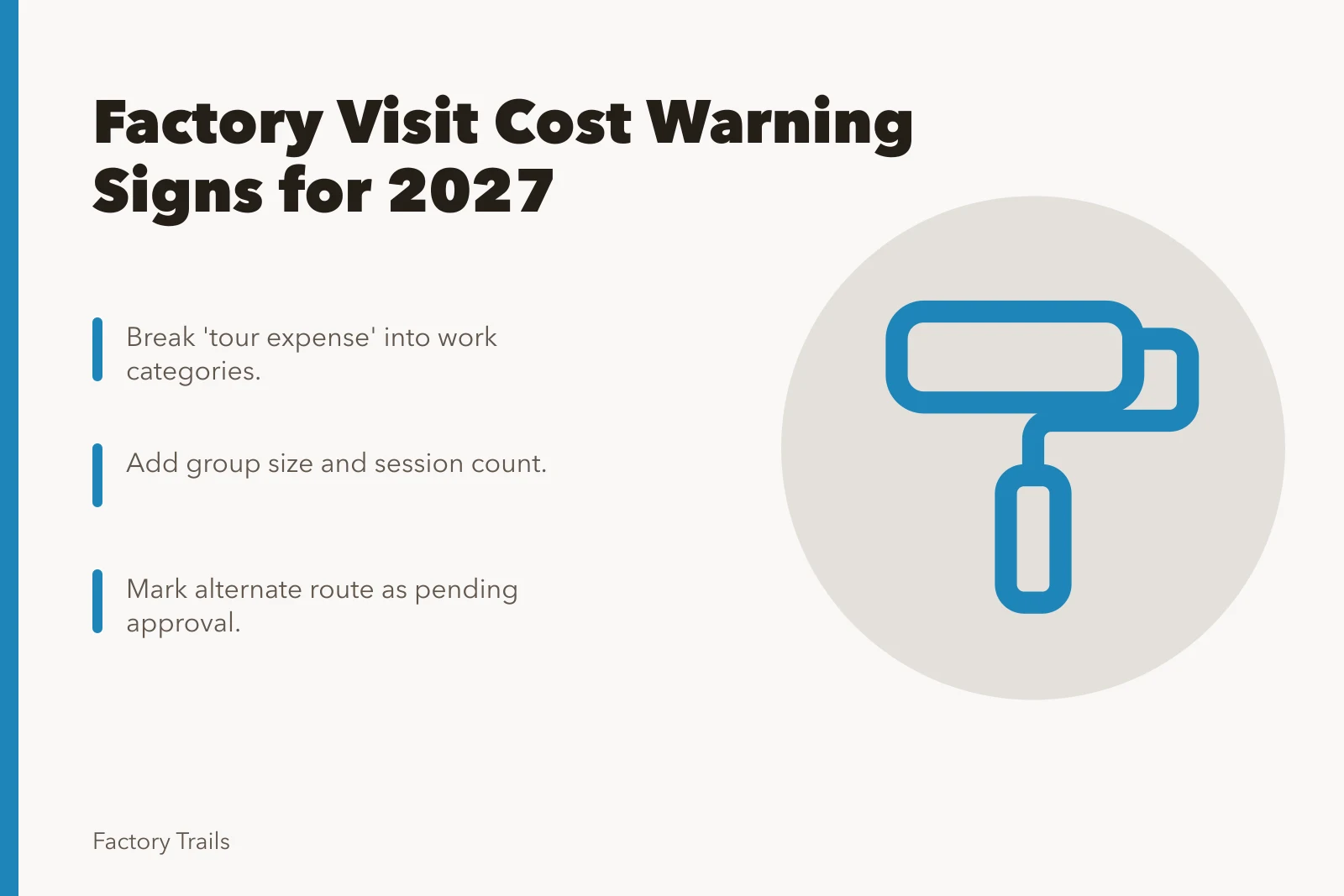
7. The estimate has lost its scope
The GAO cost-estimating guide lists purpose, scope, schedule, assumptions and data as core documentation. A factory visit estimate needs the same labels.
Flag any worksheet with a total but no format, group cap, date range or session count. The VA construction-estimate review makes the same point for federal construction: if a new reviewer cannot see why a number exists, it is not ready for a decision. That report concerns construction, not visitor programs, but the documentation test travels.
Keeping the plan current
The GSA's project-cost guidance treats estimates as information that develops with the project. Revisit yours after a pilot, a staffing change, a route decision or a plant calendar shift.
The National Archives web-records guidance is a useful habit here: keep a dated note for each material correction, saying what changed and why. A short history stops the next team restoring an old number because it looked familiar.
A worked check
Take a group of thirty at a plant requiring one escort per ten visitors. That is three escorts, plus a lead guide, for a half day each. Multiply headcount by hours by the rate the plant and your guides charge, and you have the staffing line.
Do the same for coach standing time, induction hours and the buffer around shift change. Where a figure is not confirmed, write the variable and leave it open rather than inventing a number.
Common questions
Is a lower estimate always better?
No. It may omit escorts, induction hours or insurance, or assume a shutdown week it never priced. Compare the visitor outcome and the documented basis before choosing.
What makes a factory visit estimate stale?
A material driver changed since it was written: the plant's maintenance window, the escort ratio, the group cap, the route, or the transport window. Recheck it against the current plant calendar.
How should a pending item be shown?
Name the item, its likely effect, the decision owner at the plant, and the date the estimate will be updated. A pending line with no owner is a blank line with better wording.