Guides
Factory tour safety signs in 2027: five decisions before you approve a route
Factory tour safety warning signs for U.S. sites in 2027 help staff spot route failures, barriers, missing coverage, weather exposure, and unclear emergency access.
What to take away
- A warning sign is a condition that needs action before it becomes an incident.
- Treat broken supervision, blocked exits, and unclear boundaries as operating failures, not minor inconveniences.
- When a condition cannot be controlled quickly, close or reroute that part of the visit.
Five signs that need a decision
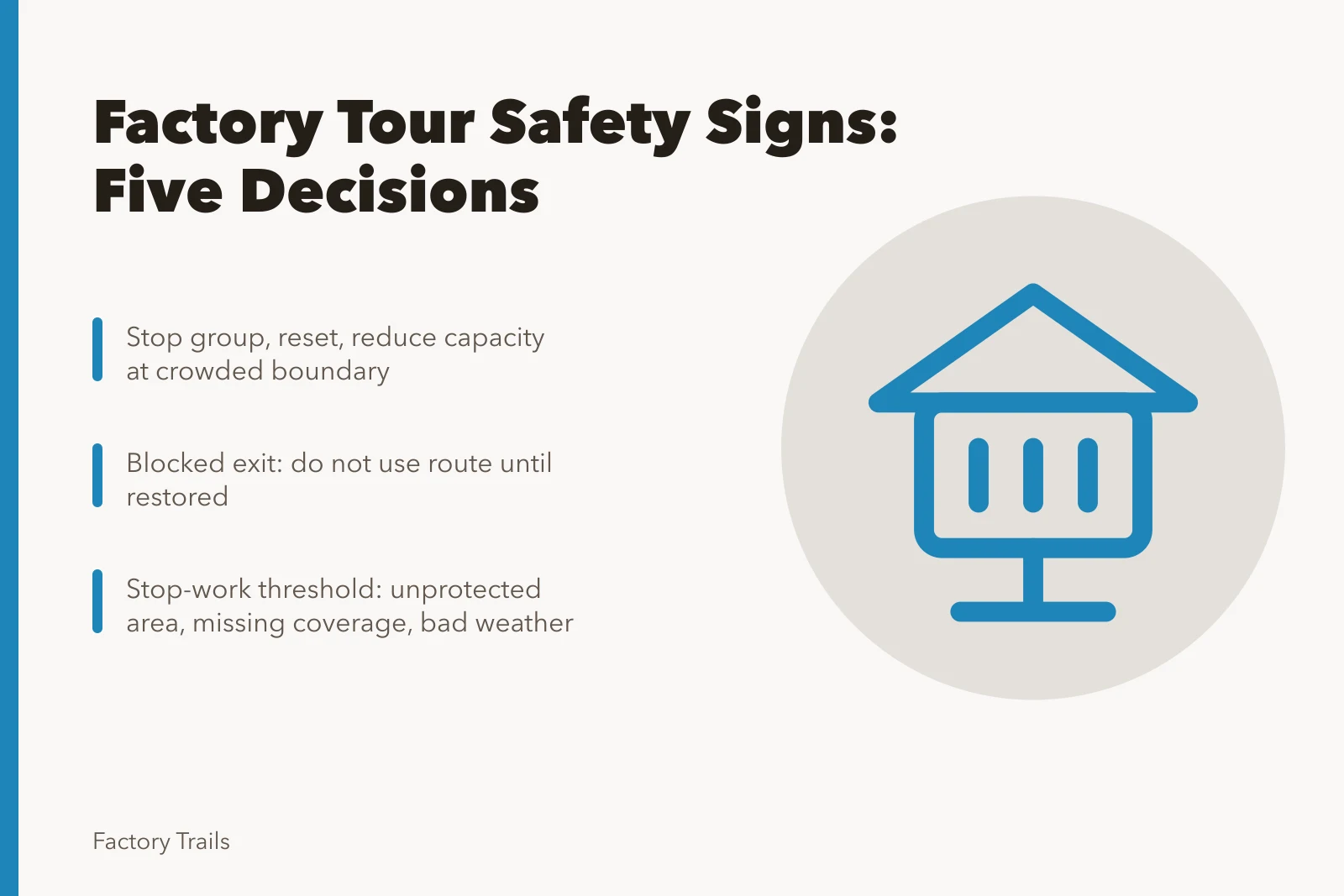
Five Warning Signs to Decide
- Visitors crowd a boundary
- Exit blocked or unclear
- Surface has changed
- Staff coverage is thin
- Weather threshold reached
| Warning sign | Why it matters | Immediate response |
|---|---|---|
| Visitors crowd a boundary | A guide cannot reliably see or redirect everyone | Stop movement, reset the group, and reduce capacity if needed |
| An exit is blocked or unclear | Evacuation may be delayed or confused | Do not use the route until the exit is restored |
| A surface has changed | Water, frost, debris, or a loose edge can alter safe footing | Isolate, reroute, or close the affected section |
| Staff coverage is thin | One person cannot guide, supervise, and respond at once | Reduce the tour, add support, or postpone |
| A weather threshold is reached | Heat, lightning, wind, or low visibility changes exposure | Apply the prepared delay, shelter, or cancellation rule |
Look for patterns, not just dramatic events
Most safety problems start as small, repeatable signals: guests constantly step around a sign, a guide loses sight of the last person in a tight room, a radio has a dead zone, or an outside stop has no shade during the hottest hour. Log these patterns. A condition that is manageable once may be a predictable failure on a busy weekend.
OSHA recommends that employers keep exits and passageways clear, test emergency systems, train people who help evacuate occupants, and identify meeting locations. Its evacuation responsibilities guidance supports a basic standard for a public route: access, communication, and accountable staff must be ready before guests enter.
Use a stop-work threshold
Write the conditions that mean "do not proceed." Examples include an unprotected demonstration area, missing staff coverage, an unavailable exit, unsafe surface conditions, or weather beyond the site's stated threshold. This is not excessive caution. It lets a guide act promptly without making a judgment call under pressure.
Use a simple response sequence:
- Stop the group before the affected area.
- Move visitors to a known safe waiting point.
- Tell the site lead what changed and what part of the plan is unavailable.
- Choose the approved alternate route, indoor activity, delay, or cancellation.
- Record the condition and who owns the correction.
Correct the root cause
Do not solve a recurring warning sign with a louder reminder. If guests miss a boundary, improve its placement, visibility, or physical strength. If a guide regularly needs help at one stairway, schedule another trained person or reduce group size. If the response card is outdated, change it and brief the whole team.
Close the loop after each repair or adjustment. Walk the route again, test the revised step, and note the result. A completed correction is stronger evidence than a promise to "be careful" next time.
For a walking-surface warning, inspect the condition instead of relying on a label such as "rough." The U.S. Access Board's floor and ground-surface guide explains that accessible surfaces must be stable, firm, and slip resistant. A qualified local review determines the needed response.
When a warning requires evacuation or a stop-work decision, use the host site's staff procedures. OSHA's emergency action plan guidance addresses reporting, evacuation procedures, and assigned duties. It supports naming who closes a route, moves the group, and calls for assistance.
Keep the warning in the log until staff can check the result. The Visitor Use Management Council's monitoring guidance distinguishes implementation from effectiveness monitoring. The route may be marked closed, but the team should still determine whether the change controlled the condition.
Keep the language factual. Record the time, location, condition, action, and owner. A short record makes it easier to compare similar warnings without blaming a visitor or a staff member for a condition the site still needs to correct.
Common questions
When should a guide close a route?
Close it whenever an exit, surface, barrier, staffing level, or weather condition falls outside the approved operating plan and cannot be corrected immediately.
Are near misses worth reporting?
Yes. A near miss can reveal a weak barrier, confusing instruction, or poor sightline before someone is hurt.
Who should approve reopening?
The person assigned by the site's operating plan should confirm that the hazard is corrected and that staff know any revised procedure.