Reviews
Part of Factory tour fundamentals: what U.S. visitors should confirm before they go
Factory tour questions to ask before you book a visit
Factory tour questions for U.S. visitors in 2027 help you compare active and historic sites, confirm access, and ask guides useful, respectful questions.
The right questions make a factory tour more useful without turning a guide into a private consultant. Start with practical questions before the visit, then ask interpretation questions once you understand the site's rules and pace.
What to take away
- Ask access and reservation questions before leaving home.
- Use different questions for a live operation and a historic site.
- Let a safety briefing finish before asking a guide about history.
- Treat a site's limits as information, not an invitation to negotiate around them.
Ask these questions before you book
| Question | Why ask it |
|---|---|
| Where does the tour begin and end? | Visitor centers, gates, and parking can be separate |
| Is the full route accessible to my group? | A general access label may not describe every surface |
| What can visitors bring or photograph? | Security and preservation rules vary |
| What happens in poor weather or an operational change? | The route or timing may be modified |
| Is there a late-arrival policy? | Some tours cannot safely pause or repeat sections |
Write down the answer when it affects your trip. If an operator says that conditions can change, use the answer to make a backup plan instead of expecting an exception on arrival.
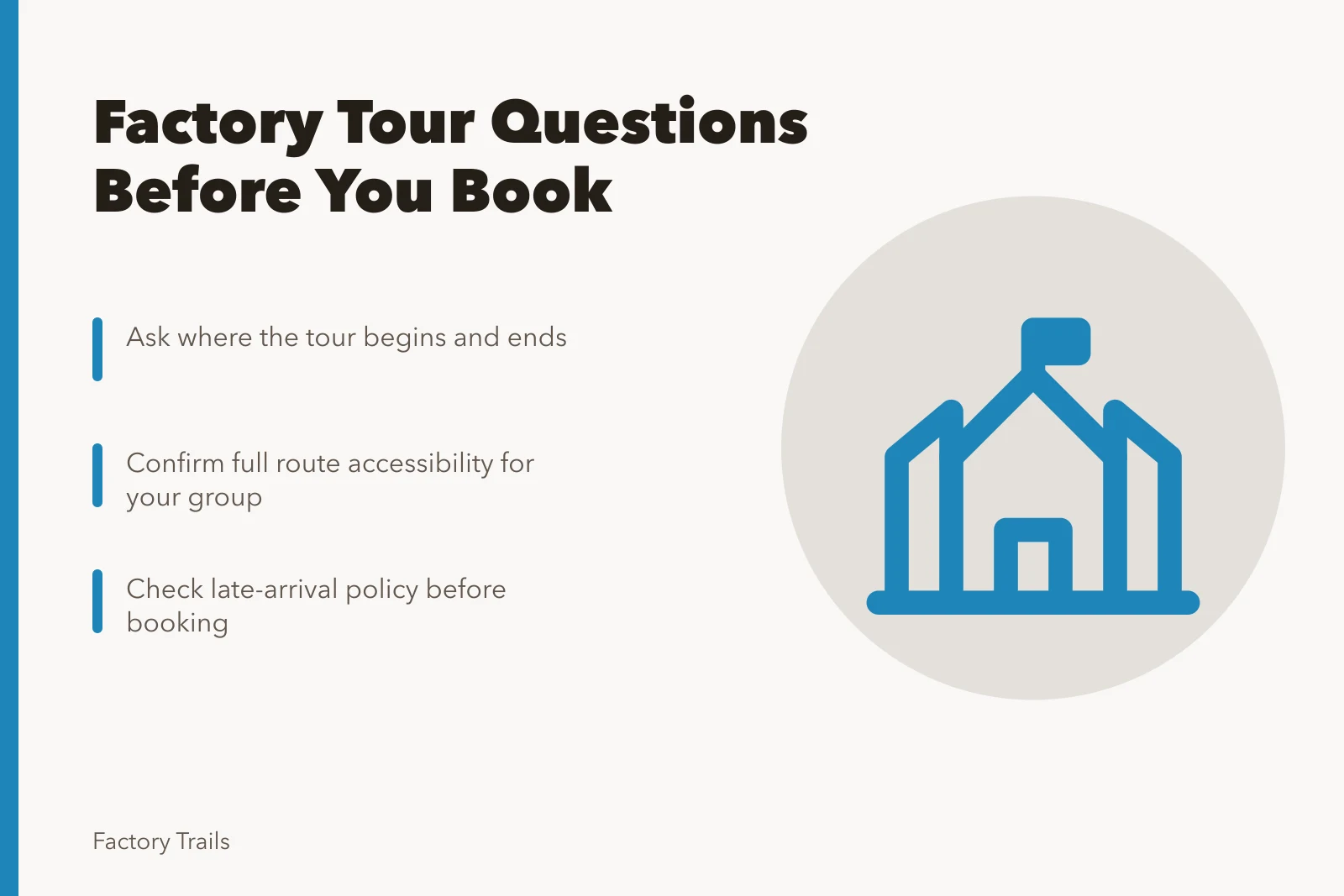
Pre-Booking Tour Questions
- Where does the tour begin and end?
- Is the full route accessible to my group?
- What can visitors bring or photograph?
- What happens in poor weather or operational change?
- Is there a late-arrival policy?
Compare an active tour with a historic tour
| Active operation | Historic industrial site |
|---|---|
| Ask what visitors should know about safety and confidentiality | Ask which records and artifacts support the interpretation |
| Ask which part of the process can be explained publicly | Ask what changed across the site's periods of use |
| Expect operational limits to shape the route | Expect preservation limits to shape the route |
| Focus on systems and skills, not employee details | Focus on evidence, context, and multiple experiences |
An active site may be unable to answer questions about formulas, customers, production volumes, or individual work roles. A historic site may not have a complete record for every worker or building. In either setting, a clear "we do not know" or "we cannot share that" is a useful answer.
Active vs. Historic Tour Questions
Active operation
- Safety & confidentiality
- Ask what to know
- Public explanation
- Which process is public
- Route limits
- Operational limits shape
- Focus
- Systems and skills
Historic industrial site
- Safety & confidentiality
- Ask which records support
- Public explanation
- What changed across periods
- Route limits
- Preservation limits shape
- Focus
- Evidence and context
Ask the safety question directly
Some industrial visits have limits that are easy to miss in a short event description. The National Park Service's Minuteman Missile tour information, for example, specifies capacity restrictions, bag rules, weather cancellations, and physical requirements for an underground section. That example is not a rule for every tour. It shows why visitors should ask about the exact route rather than assume a public attraction has no constraints. See the National Park Service tour-safety page for the specific requirements.
Ask whether there are stairs, ladders, confined spaces, loud areas, moving equipment, uneven ground, or a point beyond which you cannot leave easily. Ask early enough for staff to give a meaningful answer.
Ask guides questions that open a story
Good questions invite an explanation without demanding private or speculative information:
- What detail should a first-time visitor notice here?
- Which change most altered the way this place operated?
- What evidence helps you explain this object or building?
- What part of the story is often misunderstood?
- How does the site protect people, machinery, or collections during tours?
Save a question about your own research for the end if the group is large. Guides need to manage time, safety, and other visitors as well as interpretation.
Ask a practical route question before treating an access label as an answer. The U.S. Access Board's accessible-route guide identifies walking surfaces, doors, ramps, curb ramps, elevators, and permitted lifts as route components. It gives visitors useful terms for asking about the actual tour. It does not determine the access status of every historic feature.
Ask the operator what visitors should do if a program stops, changes route, or ends early. OSHA's emergency action plan guidance explains reporting, evacuation procedures, and assigned employee duties. The host site controls its response, while the visitor can understand the public instruction and decide whether a backup or reschedule is needed.
Ask which exact source confirms current program details. The National Archives research-room guidance advises visitors to confirm local procedures, hours, and availability with the relevant facility. This makes an official current page more useful than a broad history article or an old review when a visitor needs to decide whether to travel.
Keep the question list short. One question about the route, one about the program, and one about the story is usually enough for a first visit. The best question is the one whose answer could change the plan or help the group notice something important once it arrives.
When a guide cannot answer, ask where the site recommends continuing the research. A collection page, exhibit bibliography, local archive, or current operator contact can be more useful than pressing for an unsupported answer during a busy public program.
Common questions
Is it okay to ask about production methods?
Yes, when the operator invites such questions. Respect any confidentiality or safety limits.
What if a guide cannot answer a historical question?
Ask where the site recommends continuing the research, such as a collection catalog, exhibit source list, or local archive.
Should I ask about accessibility at the ticket desk?
Ask as early as possible, ideally before booking, so staff can describe the actual route and available options.