Guides
Factory tour mistakes: 4 questions U.S. sites should ask in 2027
Factory tour mistakes questions for U.S. sites in 2027 help teams decide whether a problem needs a same-day adjustment, a repair, or a redesigned visitor experience.
What to take away
- A good operating question leads to a decision, not a vague concern.
- Separate a minor inconvenience from a failure of safety, supervision, access, or preservation.
- Use the answer to choose a same-day adjustment, a repair request, or a program redesign.
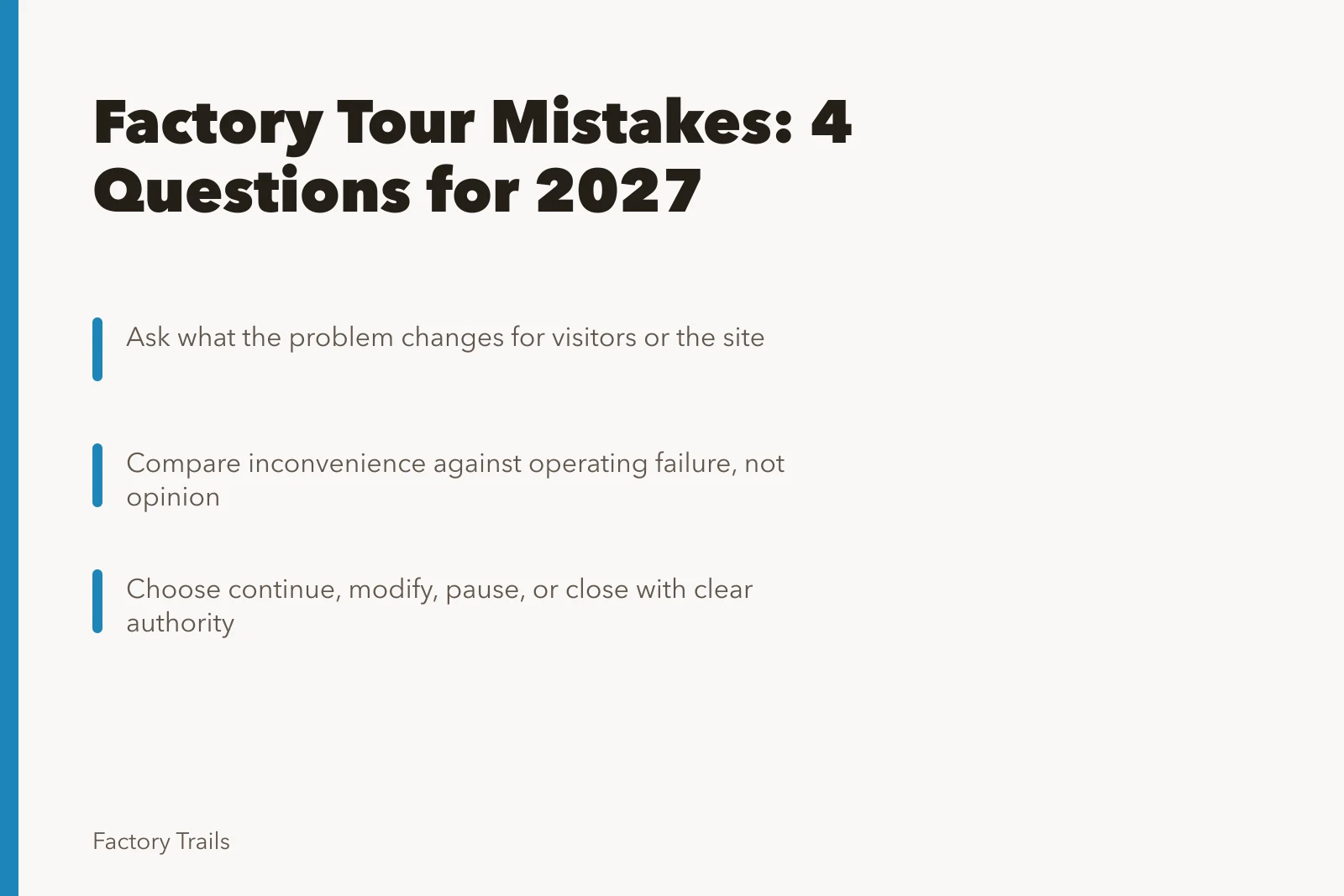
Ask what the problem changes
When staff say a tour has a problem, begin by asking what the condition changes for visitors or the site. Does it affect safe movement, guide visibility, emergency access, the condition of a historic feature, or the promised experience? The answer determines whether staff can adjust the day or need a more durable solution.
Same-Day or Long-Term?
Can the guide supervise this stop?
Add a guide or shorten the stop
Change capacity, route, or barrier design
Check the route before calling a problem minor. The U.S. Access Board's guide to floor and ground surfaces explains that accessible surfaces must be stable, firm, and slip resistant. That rule is not a blanket assessment of a historic property, but it helps staff identify when a condition needs specialist review rather than a verbal warning.
Same-day adjustment
- Can the guide supervise this stop?
- Add a guide or shorten the stop
- Does the condition affect historic fabric?
- Keep visitors clear and document it
- Can every booked guest use the stated route?
- Offer the approved alternate
- Is the disruption unusual or repeating?
- Use the alternate plan
- Can staff explain the change clearly?
- Give the group a short direct instruction
Long-term response
- Can the guide supervise this stop?
- Change capacity, route, or barrier design
- Does the condition affect historic fabric?
- Consult preservation staff and revise use
- Can every booked guest use the stated route?
- Improve information or change the route
- Is the disruption unusual or repeating?
- Fund repair or update the operating season
- Can staff explain the change clearly?
- Revise bookings, signs, and briefing language
Compare inconvenience and operating failure
A full parking lot may be inconvenient if visitors can use a clear alternative. It becomes an operating failure if the alternative blocks emergency access, removes the only accessible arrival option, or causes groups to arrive unsafely across a traffic area. A wet floor may be manageable if it is promptly isolated and the route is changed. It is not manageable when every group is expected to navigate it with a verbal warning.
The National Park Service's museum guidance addresses use of collections in historic furnished structures. Its Chapter 8 resource supports a core decision principle: public interpretation and access need to be planned with the protection of historic setting and material in mind. If the activity and the resource are in conflict, alter the activity rather than asking visitors to carry the burden of protection.
Use the four decision choices
- Continue:the route meets the plan and no new condition affects operation.
- Modify:a prepared alternate can provide a safe and meaningful experience.
- Pause:staff need a short interruption to clear, inspect, or reset a condition.
- Close:safety, access, preservation, or supervision cannot be restored promptly.
Write these choices into the operating plan. A guide should know the authority they have and when a site lead must decide. Clear authority is not rigid. It keeps a busy staff member from trying to improvise a complex decision in front of guests.
Staff decisions also need to fit the site's employee emergency procedures. OSHA's emergency action plan guidance describes assigned duties and evacuation procedures as plan elements. Use the site's actual plan to decide who communicates, who leads the group, and who confirms that a route is closed.
Questions for the after-action review
After an altered tour, ask: What did staff see? Which operating assumption failed? Was the visitor message accurate? Did the alternate work? Who owns the next action? Keep the answer factual and brief. This is how a problem becomes an improvement instead of a story that gets retold without a fix.
The Visitor Use Management Council's monitoring guidance distinguishes checking whether an action happened from checking whether it worked. Apply that distinction to a tour change. A barrier placed on time is implementation. Fewer unsafe crossings after it is placed is evidence of effectiveness.
Common questions
When should a guide close a stop instead of modifying it?
Close it when the condition affects safe movement, emergency access, the ability to supervise, a protected feature, or an essential promised access option and no prepared alternative controls the issue.
Can a visitor complaint reveal an operating mistake?
Yes. A complaint about surprise stairs, heat, unclear parking, or a closed feature may show that the visitor information or route design does not match the real experience.
Who should review repeated decisions?
The program lead should review them with facilities, interpretation, safety, and preservation staff, then assign a specific corrective action.