Guides
Factory tour mistakes checklist: what to fix before your U.S. site opens in 2027
Factory tour mistakes checklist for U.S. sites in 2027 helps teams catch route, capacity, preservation, visitor, and staffing errors before a public program.
What to take away
- Run this checklist before publishing a new tour and before the first public date.
- A pass means staff can point to a real condition, owner, or documented alternative.
- Correct the plan before asking visitors to compensate for a site weakness.
Pre-tour mistake-prevention checklist
| Check | Pass condition | Fix before opening |
|---|---|---|
| Route | Staff walked the route at operating time and identified the tightest point | Map an alternate or remove the unsafe segment |
| Capacity | Group limit matches guide visibility, exit access, and backup coverage | Reduce tickets or add trained staff |
| Boundaries | Fragile features have a route, barrier, or viewing distance that works | Change the route or install compatible protection |
| Visitor information | Guests can find distance, stairs, surfaces, weather rules, and help contact | Revise the event page and confirmation message |
| Alternate program | Indoor or lower-exposure option has staff, materials, and a clear trigger | Prepare it before public booking |
| Emergency action | Address, exit, assembly area, contacts, and communications are current | Update the response card |
| Follow-up | A log exists for modifications, near misses, and repair ownership | Set a review schedule and owner |
For an accessibility check, inspect the actual path. The U.S. Access Board's accessible-route guide identifies walking surfaces, doors, ramps, curb ramps, elevators, and permitted lifts as parts of an accessible route. Use it to prompt a site-specific inspection. It does not determine whether a particular historic space must be included in a tour.
Pre-Tour Mistake-Prevention Checklist
- Routewalk at operating time, find tightest point
- Capacitygroup limit matches visibility and exits
- Boundariesfragile features have barrier or distance
- Visitor informationdistance, stairs, surfaces, weather, contact
- Alternate programindoor option with staff and trigger
- Emergency actionaddress, exit, assembly, contacts current
- Follow-uplog modifications, near misses, repair ownership
What is different in 2027
The Department of Justice web accessibility rule for state and local government entities requires WCAG 2.1 Level AA. The deadline for public entities serving 50,000 or more people was April 24, 2026. Smaller public entities and special district governments have until April 26, 2027.
Many industrial heritage sites are run by a city or county, so the 2027 date can cover the booking page. Private operators have no matching federal web deadline.
If your season runs from late spring through early fall, hold the first 2027 public date until after a staffed dry run at expected capacity.
Step 1: check the activity against the historic structure
An appealing idea can still be the wrong activity for a historic structure. Before adding a hands-on demonstration, a new sign, an event setup, lighting, or a visitor path, ask whether the change protects the character of the place and whether it can be supervised safely.
The Secretary of the Interior's treatment standards distinguish preservation, rehabilitation, restoration, and reconstruction and provide a framework for decisions about changes to historic properties. The NPS treatment guidance supports a practical tour question: can this visitor use be made compatible with the resource, or should the activity happen from a different location or in a different format?
The Hoover-Mason Trestle at SteelStacks in Bethlehem, Pennsylvania is an elevated public walkway over the former ore yard, so visitors get a route without entering the blast furnace structures.
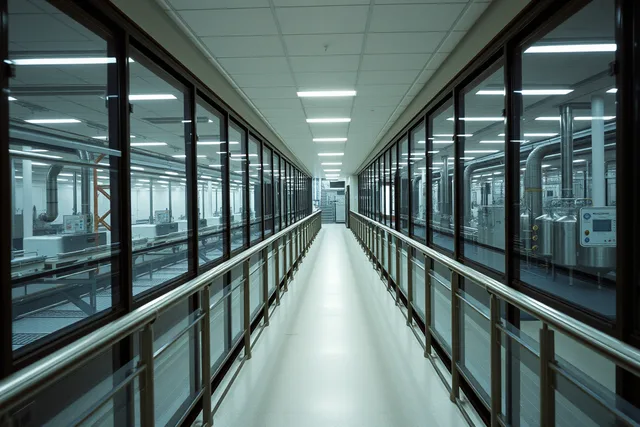
The Rouge Factory Tour at The Henry Ford in Dearborn, Michigan keeps visitors on an elevated walkway above the final assembly line rather than on the plant floor.
Cost depends on the barrier, not the tour size. A reprinted route card is minor; a lift or platform is a capital project that needs a contractor quote.
Step 2: test the visitor information with a first-time visitor
Give the booking page and confirmation email to someone unfamiliar with the site. Ask them to identify:
- Where to arrive and park.
- How far the group walks and whether stairs or uneven surfaces are involved.
- What clothing, water, or footwear is sensible.
- What happens if weather or maintenance changes the route.
- How to request assistance before the program.
If the person cannot answer, the visitor information is incomplete. Fix the message instead of expecting guides to explain everything at check-in.
Step 3: verify every role, not just the names
The schedule may list enough people and still leave a gap. Assign opening check, check-in, guide, demonstration supervision, backup guide, emergency call, and closure authority. Each person should know the role and who takes over if they are absent.
Typical planning ranges, not fixed rules: one guide for every 10 to 15 visitors, and a group maximum near 20 to 25 where the route narrows. Add a second trained person at any working machine or demonstration station.
Use a five-minute opening huddle to confirm weather, route status, capacity, known maintenance work, and visitor needs.
The huddle should be consistent with the site's formal emergency plan. OSHA's emergency action plan guidance covers employee reporting, evacuation procedures, and assigned duties. It is a reference for staff preparation, not a substitute for local instructions or the host site's own plan.
Keep the checklist after the tour, not only before it. The Interagency Visitor Use Management Framework treats monitoring and adjustment as part of managing visitor use. Mark failed items, name an owner, and check whether the correction worked on the next operating day.
Write the result in plain terms. "Route check completed, west stair closed, alternate used" is better than "reviewed." It lets the next shift see the real decision, check the condition again, and avoid reopening an issue because a vague note hid the reason for the change.
Common questions
Who should use this checklist?
The program lead should complete it with facilities, interpretation, safety, and visitor-services staff before a new or substantially changed tour opens.
Does the checklist replace a formal safety plan?
No. It is an operating check that supports the site's safety, emergency, preservation, and accessibility procedures.
When should a failed item cancel a tour?
Cancel or modify when the issue affects safe supervision, emergency access, preservation protection, or a promised essential access feature and cannot be corrected promptly.