Guides
Factory tour hiring questions for U.S. sites this year
Factory tour hiring questions for U.S. sites in 2027 help teams compare provider fit, methods, public controls, qualifications, references, and final documentation.
What to take away
- Ask candidates questions that expose how they will work at this site, not just what they have done elsewhere.
- Compare methods, public-operation plans, people, and handover records as well as cost.
Questions that reveal fit
Provider fit questions
- Similar worknamed crew and scope
- Historic featuresbarriers and sequencing
- Visitor impactroute, hours, notice
- Scope changesnamed approval and record
- Handoverphotos, changes, warranty
| Question | Strong answer includes | Warning sign |
|---|---|---|
| What similar work has your team completed? | Comparable materials, public setting, and scope | Only generic company history |
| How will you protect adjacent historic features? | Specific methods, barriers, sequencing, and supervision | A promise to "use care" without details |
| How will work affect visitors? | Route control, access, hours, notice, and emergency access | No plan beyond a construction fence |
| Who decides when conditions differ from scope? | Named approval process and written change record | Assumption that field staff can proceed |
| What will the site receive at handover? | Photos, materials, changes, care guidance, and warranty | No records beyond an invoice |
Compare a specialist with a general provider
A specialist may be the right choice when work affects historic material, complex treatment, or a decision that is difficult to reverse. A general provider may be appropriate for routine work with clear methods and suitable oversight. Do not make the choice based on a title alone.
Compare the actual scope, the person doing the work, and the controls proposed for the site.
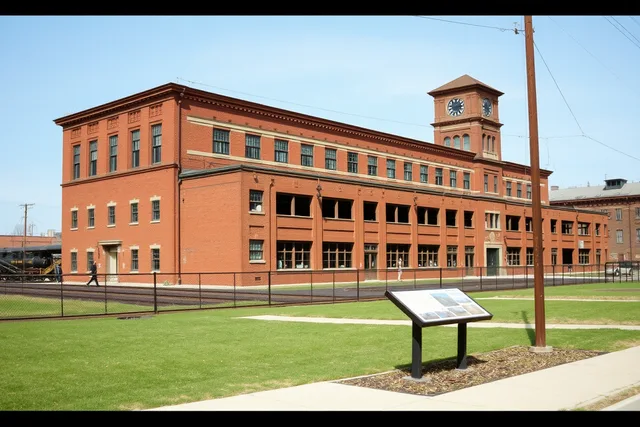
A 19th-century textile mill museum in New England and a modern assembly plant both host tours. The mill's masonry and window work calls for a preservation specialist; the assembly plant's routine railing repair may not.
Specialist vs general provider
Specialist
- Best for
- Historic material
- Complexity
- Complex treatment
- Reversibility
- Hard to reverse
- Oversight
- Close supervision
General provider
- Best for
- Routine work
- Complexity
- Clear methods
- Reversibility
- Easily reversed
- Oversight
- Suitable oversight
The National Park Service architectural-preservation quality-assurance checklist calls for records of condition, treatment and use, recommended work, technical data, and contract summaries. Its QA checklist supports one question: how will the work be documented so a future owner can understand what was done and why?
Ask candidates to describe the actual people who will answer these questions after award. The Department of the Interior's professional qualifications standards guidance describes minimum education, training, and experience for historic-preservation disciplines. It is a screening framework, not a guarantee. It supports matching the named project lead and field supervision to the complexity of the site work.
Ask about the people, not only the company
Request the project lead, field supervisor, daily crew, and subcontractors by role. Ask how often the qualified lead will be onsite and who can stop work if a new condition appears. A proposal can list excellent credentials while assigning day-to-day work to people who have not seen the site or the relevant material.
For public-facing work, ask who will coordinate with guides, visitor services, and facilities staff. A strong provider treats those teams as part of the site condition, not an interruption to technical work.
Test the proposal against a scenario
Give each candidate the same realistic scenario: a hidden deteriorated element is found beside an active tour route, or a weather event prevents the planned work. Ask what they would do in the first hour, the first day, and the next update. The response should show safety, documentation, communication, and decision control.
Ask how the candidate will maintain the approved visitor movement while assessing the condition. The Occupational Safety and Health Administration exit-route guidance says exit routes in covered workplaces must remain free and unobstructed. A host site's own plan governs visitors, but the answer should identify who has authority to alter barriers or open an alternate route.
What the work typically costs
Preservation work is usually billed by the hour or by a fixed fee per phase. S. hourly rates range from $150 to $300 for a preservation architect, $75 to $200 for a conservator, and $50 to $120 for a preservation carpenter. Travel, scaffolding, and document review are often separate.
A small tour-related condition survey may cost $5,000 to $25,000, while a full treatment plan can exceed $100,000. Ask for a breakdown by phase and for the unit used for each line.
A typical procurement sequence for a small tour contract runs four to eight weeks: issue request for proposals, hold a site visit, receive written proposals, score them, interview top candidates, check references, and award.
Choose with a written rationale
After interviews, record the criteria, proposal scores, reference checks, strengths, unresolved risks, and decision. The written rationale is useful when a budget owner, board, or future staff member asks why the provider was selected. It also proves that price was considered alongside qualifications, method, and fit.
Use the same questions and scoring sheet for every provider so the decision is fair and documented.
Weight
- Method and materials
- 30%
- Visitor and safety plan
- 20%
- Assigned people
- 20%
- Handover records
- 20%
- Cost and assumptions
- 10%
Score (1-5)
- Method and materials
- Visitor and safety plan
- Assigned people
- Handover records
- Cost and assumptions
Weighted score
- Method and materials
- Visitor and safety plan
- Assigned people
- Handover records
- Cost and assumptions
For the question of what happens to the scored proposals and the decision record, the National Archives records-management FAQ index offers general guidance on keeping records understandable and identifiable. It is not a vendor-selection policy. It supports preserving the scored proposals, dated decision, and source of each material condition that informed the award.
Other standards may apply. The Secretary of the Interior's Standards for the Treatment of Historic Properties (36 CFR Part 68) govern work on historic fabric, and Section 106 of the National Historic Preservation Act requires review when federal funds or permits are involved.
Close each interview with a next action
Record unanswered questions and the person responsible for resolving them before selection. A polished interview should not erase an unclear exclusion, route control, or final-record requirement. The point is to reduce uncertainty before a visitor route and historic material are affected.
Ask how the provider will operate on site
Request a named contact, arrival process, access restrictions, visitor count, cancellation terms, and the source of every safety or privacy instruction. The provider should distinguish its own service terms from the host facility's requirements. Keep the answer with the hiring record so staff can prepare visitors consistently.
Ask candidates to state which questions they cannot answer without a site visit or records review. That response is more useful than an early promise. It shows whether the provider recognizes the limits of the information provided and whether the proposal will separate confirmed work from assumptions that require a decision before the tour operates.
Common questions
Should a provider guarantee an exact final cost?
For some work, fixed pricing may be appropriate. Historic conditions can create legitimate uncertainty, so the proposal should explain assumptions, allowances, exclusions, and the change-approval process.
What reference question matters most?
Ask how the provider handled a change or unexpected condition. The answer reveals communication, judgment, and follow-through.
Can a site use one provider for every need?
Possibly for routine work, but specialist expertise or independent review may be needed when historic fabric, complex access, or significant preservation decisions are involved.