Guides
How to budget factory tour hiring for U.S. sites in 2027 dollars
Build a 2027 factory tour hiring budget from loaded guide wages, escalation rates, and real prices for recruiting, scheduling, audio, and insurance.
What to take away
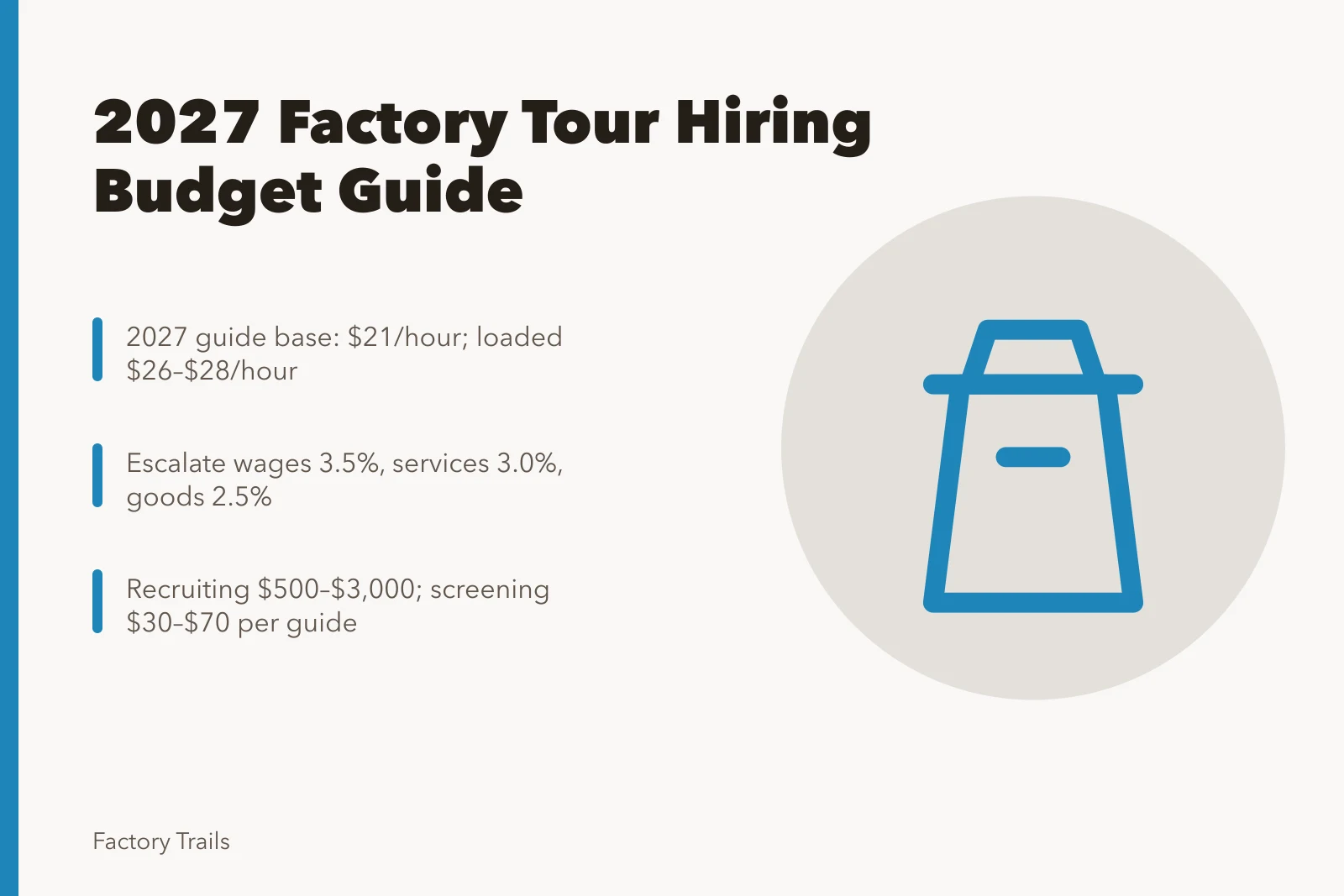
- A guide who costs $21 an hour costs $26 to $28 once payroll taxes, workers compensation, and benefits are added.
- Escalate wages with the BLS Employment Cost Index, services with CPI-U, goods with the Producer Price Index.
- Recruiting, screening, scheduling, audio, and PPE are separate budget lines, not overhead.
- Compare fully loaded annual cost per guide against the posted hourly wage.
- Reserve 10% to 15% for conditions that only appear once a route is walked.
Set the 2027 wage base
The U.S. Bureau of Labor Statistics files tour and travel guides under occupation 39-7010. May 2024 data put the median near $19 an hour. Three years of escalation at 3.5% lands the 2027 base near $21.
2027 Guide Wage Base
- $19May 2024 median hourly wage
- $212027 base after 3.5% escalation
- $26–$28Loaded hourly cost
- $39k–$59kSeasonal to year-round guide cost
Add 25% to 35% for payroll taxes, workers compensation, and benefits. Loaded cost runs $26 to $28 an hour. A 1,500-hour seasonal guide costs $39,000 to $42,000. A 2,080-hour year-round guide costs $54,000 to $59,000.
Sloss Furnaces in Birmingham runs guided and self-guided routes through a preserved iron plant. Pullman National Monument near Chicago interprets a company town. Both staff seasonally, and both show why hours, not headcount, drive the wage line.
Escalate old costs into 2027 dollars
The arithmetic is 2027 dollars = 2025 dollars x (1 + rate)^2. Two compounding years, one rate per category.
Escalation Rates by Category
Category
- Wages
- ECI
- Benefits
- Blend
- Services
- CPI-U
- Goods
- PPI
Index
- Wages
- 3.5%
- Benefits
- 4.0%
- Services
- 3.0%
- Goods
- 2.5%
Rate
- Wages
- Benefits
- Services
- Goods
Use the Employment Cost Index for wages and salaries. Use CPI-U for services such as insurance and scheduling software. Use the Producer Price Index for goods such as PPE and audio hardware. A workable blend is 3.5% for wages, 4.0% for benefits, 3.0% for services, 2.5% for goods. Round each line to the nearest $100.
Price the hiring tools
| Line | Provider | What it does | Pricing model |
|---|---|---|---|
| Job posts | Indeed, LinkedIn, ZipRecruiter | Fills open guide roles | Indeed pay-per-click; ZipRecruiter plans near $299 per month |
| Background checks | Checkr, GoodHire | Screening before plant access | Per check, often $30 to $70 before court fees |
| Scheduling | When I Work, Deputy, Homebase | Shift coverage and swaps | When I Work has a free tier; Deputy near $3.50 per user per month |
| Payroll | Gusto, ADP, Paychex | Payroll and tax filing | Gusto Simple near $40 per month plus $6 per person |
| Training | American Red Cross, National Association for Interpretation | CPR, AED, interpretive certification | Red Cross blended learning $35 to $50; NAI Certified Interpretive Guide $700 to $850 |
| Tour audio | Listen Technologies, Sennheiser, Williams AV | Headsets for noisy floors | Rental $15 to $40 per receiver per day; purchase $2,000 to $10,000 |
| Liability cover | Next Insurance, Hiscox, The Hartford | General liability for guided access | Often starts near $25 to $50 per month |
| PPE | 3M, Honeywell, Magid | Hard hats, glasses, hearing protection | $50 to $250 per guide |
Budget $500 to $3,000 per hire across the recruiting line once sponsored posts and screening are counted.
Budget the work behind the visible tour
A staffing plan often lists guides and stops there. Route design, safety review, qualified oversight, and visitor controls are real costs. So are documentation and handover.
| 2027 budget item | Range | What it protects |
|---|---|---|
| Recruiting | $500 to $3,000 per hire | Filled shifts |
| Screening | $30 to $70 per guide | Clean records |
| Training | $35 to $850 per guide | Accurate tours |
| Scheduling software | $0 to $5 per user per month | Coverage |
| Payroll processing | $40 to $80 per month plus $4 to $6 per person | Correct pay |
| Tour audio | $15 to $40 per receiver per day | Clear communication |
| Insurance | $25 to $150 per month | Liability |
| PPE | $50 to $250 per guide | Plant-floor protection |
| Contingency | 10% to 15% of total | Conditions found late |
The Secretary of the Interior's treatment standards frame preservation, rehabilitation, restoration, and reconstruction decisions before work starts. The NPS standards overview matters to a budget because the treatment choice sets the scope. Choosing the right method early costs less than reversing a change that damages historic character.
The National Park Service's architectural-preservation quality-assurance checklist covers condition, treatment, technical, and contract records. It is not a private budget form. It does argue for funding documentation and handover, since an invoice alone will not tell the site how to inspect the finished work.
Fund change control
Factory conditions stay partly hidden until someone walks the route. Set a contingency and a written approval process instead of assuming the first budget covers every discovery.
Do not let the contingency become an undefined reserve. Review each draw, record why it was needed, and ask whether similar conditions should change the next scope. Britannia Mine Museum near Vancouver runs underground tours where ground conditions and ventilation shape the route. The same logic applies above ground.
Keep the public program running
If the plant stays open, price the alternate route, barriers, signs, and staff time. Add visitor notice and the access path. Blocking a popular stop without an alternative can cost more in lost admissions than the construction saved.
The Occupational Safety and Health Administration's exit-route guidance requires exit routes in covered workplaces to stay free and unobstructed. The host site's own safety officer and published visitor rules control movement. Your budget should carry the approved barrier, alternate route, and staffing response as planned lines, not surprises.
Record the source behind each allowance
Keep the quote, site note, condition photograph, approval, and date for every allowance and contingency draw. The Internal Revenue Service recordkeeping guidance explains that businesses should keep records supporting income and expenses. It will not build your hiring budget, but it supports holding evidence behind a material cost.
At closeout, compare approved budget, actual cost, and unresolved maintenance needs. Say which differences came from scope, site condition, public operations, or a deliberate call. That record makes the next procurement sharper.
Common questions
Should a site take the cheapest qualified proposal?
Price is one column. Compare method, exclusions, public-operation plan, documentation, and handover. The cheapest bid that meets the full scope responsibly is the one to take.
How much contingency is right?
It depends on condition and uncertainty. Use existing records, professional advice, and the odds of concealed work to set the reserve. Ten to fifteen percent is a starting point, not a rule.
Who approves provider changes?
Name the budget owner and the technical or preservation reviewer before work starts. The agreement should state what needs written approval and who signs it.
Where do current wage figures come from?
The BLS Occupational Employment and Wage Statistics series for occupation 39-7010 publishes the median hourly wage by area. Check the release date before you escalate, and confirm PPE and access requirements with the plant's safety officer.