Guides
Before you budget factory tours: a 2027 cost planning checklist
Factory tour cost checklist for 2027 helps U.S. operators capture fixed, variable, mixed, one-time, safety, access, staffing, and uncertainty inputs accurately.
Use this checklist before entering a total in a factory-tour budget. It makes cost inputs visible, including work with no vendor invoice that still uses staff time or facility capacity.
This is a template you can copy. The columns are Input, What to record, Basis type, Basis source, Checked by, and Checked on.
What to take away
- Copy the checklist as a template and add one row per cost input.
- Expect a typical small-plant pilot to land near $21 to $33 per visitor in 2027.
- Give a responsible role to safety, access, and staffing lines.
Cost-input checklist
| Input | What to record |
|---|---|
| Program unit | Visitor, group, session, or operating month used for the model |
| Route capacity | Current group limit and the condition that sets it |
| Fixed costs | Amount, period, contract or policy basis, and owner |
| Variable costs | Amount per visitor or session and what triggers it |
| Mixed costs | Base portion, threshold, volume portion, and evidence for the split |
| Staff time | Preparation, delivery, check-in, reset, follow-up, and time displaced from other work |
| Safety and access | Assessment, equipment, communication, training, and review needs identified by responsible roles |
| Uncertainty | Known unknown, amount reserved, decision needed, and due date |
Worked example. A pilot session of 12 visitors. Preparation 3.0 hours, delivery 4.0 hours, reset 1.0 hour. At a 2027 loaded rate of $28 to $42 per hour, a typical planning range, staff time comes to $224 to $336.
Consumables add $2 to $5 per visitor, or $24 to $60 for the group. The session estimate is $248 to $396, or $21 to $33 per visitor. Both figures are planning placeholders, not confirmed amounts.
Treat $28 to $42 per hour as a wage assumption, not a quote. Check your own 2027 payroll rate plus benefits before you reuse it.
The U.S. Occupational Safety and Health Administration recommends integrating safety and health into planning and budgeting, assigning responsibilities, and estimating the resources needed. Its management-leadership guidance supports one tour-budget rule: do not leave a known safety responsibility outside the model because its cost is inconvenient or still being confirmed.
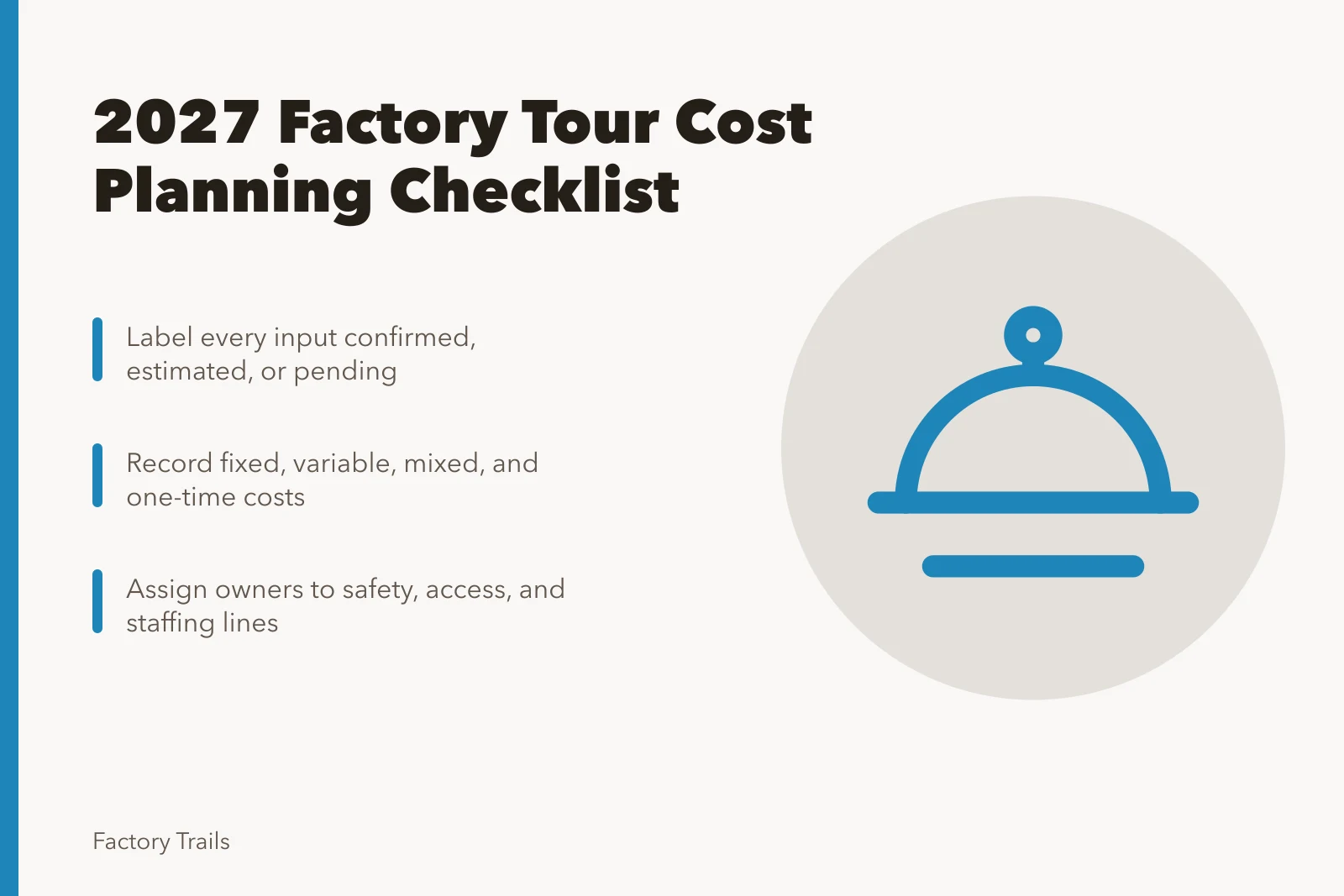
Factory tour cost inputs
- Program unitvisitor, group, session, month
- Route capacitygroup limit and condition
- Fixed costsamount, period, basis, owner
- Variable costsper visitor or session
- Mixed costsbase, threshold, volume portion
- Staff timeprep, delivery, reset, follow-up
- Safety and accessassessment, equipment, training
- Uncertaintyunknown, reserve, decision, due date
Label each line: confirmed, estimated, or pending
Every line should carry one of three labels: confirmed, estimated, or pending. A confirmed line has a documented basis, such as a contract, purchase record, or measured staff time. An estimated line states the assumption.
A pending line names the missing review or decision. Add the date, source, and person who supplied the value. Record whether the amount is a cash payment, an internal labor allocation, or a deferred obligation. This makes a spreadsheet useful in a meeting because people can challenge the right thing.
The Government Accountability Office's cost-estimating guide calls for a documented estimate with explicit assumptions and supporting data. The General Services Administration notes the value of maintaining estimate information as a project develops. The National Archives' records-management overview explains why records document organizational actions. Keep the quote, the time observation, and the date each entry was checked.
Before approval, read down the checklist for missing units. A labor amount without hours, a vendor quote without scope, or a visitor cost without the number of sessions is not ready to compare. Mark the gap and assign an owner instead of forcing a total.
Use the checklist at the beginning and end of the pilot. Before delivery, it identifies the unknowns that need observation. After delivery, it turns actual experience into a better estimate. Record the session date, group size, route version, preparation time, delivery time, reset time, and any variation from the original plan.
Do not assume one busy or unusually quiet session represents the normal program. Note the condition that made it unusual. Then decide whether the next model should use the observation, repeat the test, or keep the line pending. This creates a useful trail from early estimate to informed decision.
File the completed checklist with the pilot record on the same day. Memory changes fast after a busy session.
Common questions
Should staff salaries be counted?
Record the staff time consumed by the tour, even when the employee is already on payroll. The model should show the operational tradeoff.
What belongs in contingency?
Use it for defined uncertainty, such as a needed replacement item or post-pilot review. Do not hide a known requirement there.
How often should the checklist be refreshed?
Refresh it before a pilot, after a material change, and at each planned budget review.