Guides
Factory tour budgeting records: what owners must track before 2027
Factory tour budget records guide for 2027 helps U.S. operators track costs, route limits, staffing, changes, incidents, cancellations, and review decisions clearly.
Keep one operating record for a factory tour. It should show what was planned, what was delivered, what changed, and who approved the change. This is not a public marketing document. It is the internal file that makes a later budget review useful.
What to take away
- Record assumptions beside actual labor and attendance.
- Keep route changes, cancellations, and incidents dated.
- Assign one owner to update the record after each session or review.
What is new for 2027
New for 2027: owners must keep one version-controlled index for route sheets, budgets, and public copy, with a named owner and review date. No U.S. federal rule sets a 2027 factory tour records deadline. The date is a budget and version-control deadline, not a compliance date.
The essential fields
| Field | What to log |
|---|---|
| Session | Date, route version, group size, start and end time |
| Staffing | Roles present, preparation time, delivery time, and reset time |
| Cost note | New purchase, recurring expense, or cost assumption tested |
| Route condition | Closed stop, production conflict, access issue, or alternate route used |
| Visitor communication | Arrival instructions, cancellation message, question, or complaint that required a change |
| Review decision | Keep, change, pause, or test again, with the responsible role |
Use exact language. "Guide overtime due to delayed check-in" beats "staff issue." "Viewing stop unavailable during maintenance" beats "route changed." Specific notes help the next program lead see whether a cost was temporary, avoidable, or part of normal operations.
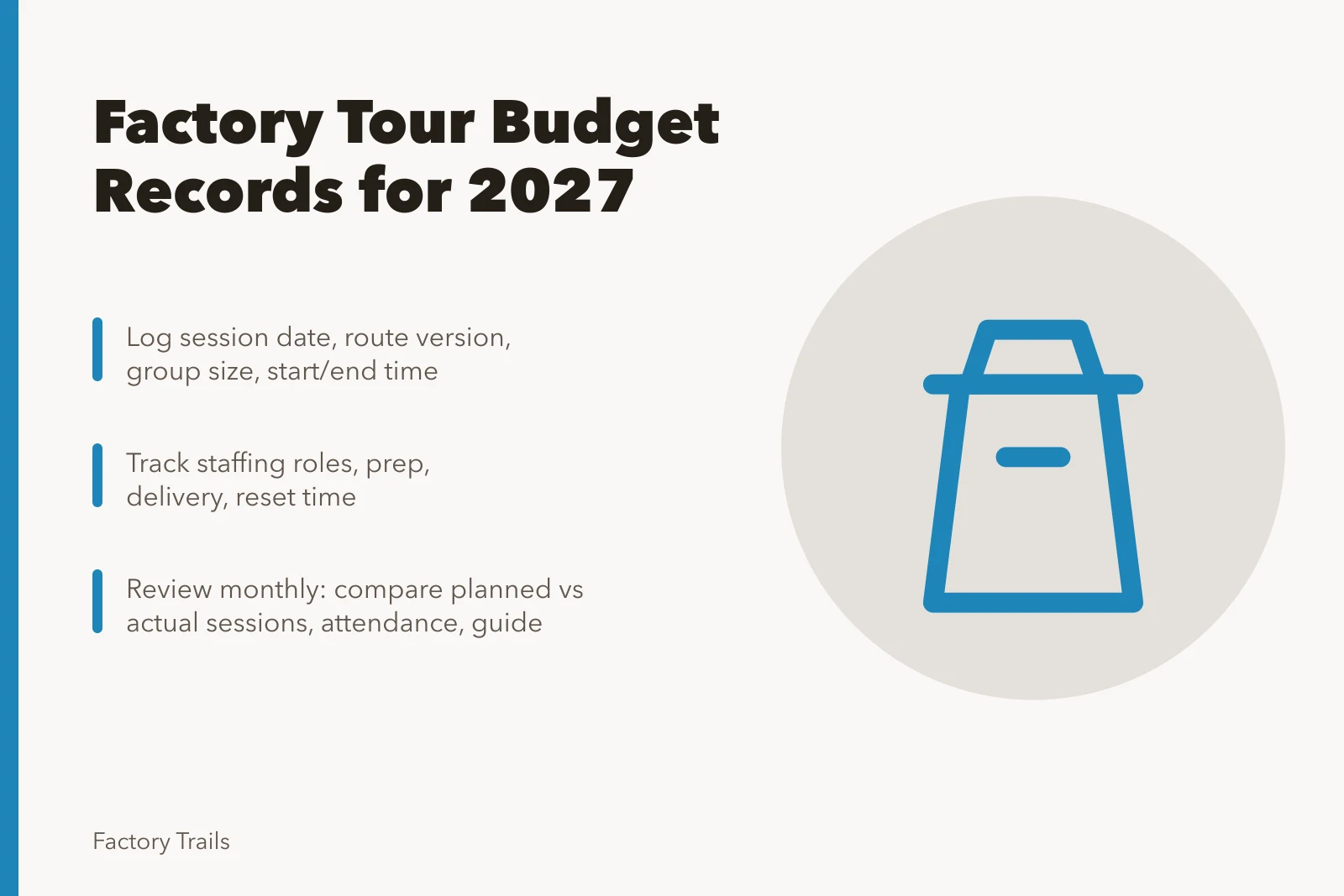
Tour budget fields to log
- Sessiondate, route version, group size, times
- Staffingroles, prep, delivery, reset time
- Cost notepurchase, recurring, assumption tested
- Route conditionclosed stop, conflict, access issue
- Visitor communicationarrival, cancellation, question, complaint
- Review decisionkeep, change, pause, test again
Cost example: two staff spend 10 hours each on a tour, at a typical $18 to $30 per hour, so labor runs $360 to $600. Add one hour of preparation and one hour of reset for each person, or $36 to $120 more. Use the table above as the one-page session form. Track actual hours against this range.
Route sheets and version control
The National Park Service's Museum Handbook Part II covers documentation and accountability. The National Archives' records-management profile guidance identifies who owns recorded information. Its basic records-management material explains why records document activity. Its records scheduling guidance prompts an owner and review date for superseded models and public copy that explain a past visitor promise.
Keep the old route sheet when a new one replaces it. Note the effective date, the reason, and any impact on capacity or staffing. For public information, record the date the website and booking message changed too. This reduces the chance that staff are following one plan while visitors are reading another.
Keep superseded route sheets and budgets for three years after replacement. Keep public copy for seven years. Review the archive once a year. Adjust the period if a contract, insurer, or tax rule requires longer. IRS Publication 583 points to a three-year period for most tax records and up to seven years for some claims.
Monthly review of route sheets and budgets
At the end of a month or pilot cycle, compare planned and actual sessions, attendance, guide hours, cancellations, safety or access notes, and operating disruptions. Ask one question: which assumption most changed the budget? Update the next forecast only after the answer is supported by the record.
Create a one-page index for the current program. It should point to the approved route, current budget, latest pilot note, public-copy version, and next review date. Keep working drafts separate from files used for an actual approval or visitor communication.
Set a regular record review that follows the operating calendar. Open the current index before new dates are released and compare it with the route, booking message, and budget. Record the reviewer, date, and any file that no longer reflects the planned visitor experience.
If the team changes one of those documents, update the index and retain the prior approved version in an archive.
This gives staff a dependable handoff point and prevents an old script or estimate from silently returning to use. It also keeps visitor information tied to the decision that approved it, rather than to an informal copy saved on one person's computer.
Common questions
Who should update tour records?
The program owner should maintain the master file, with input from guides, operations, safety, booking, and maintenance staff.
How detailed should each session entry be?
Capture enough detail to explain material differences from the plan. Ordinary sessions can use a short standardized form.
Should visitor names be kept in the operating record?
Keep only the personal information needed for the stated booking or service purpose, and follow the organization's privacy and records practices. Review access regularly and remove information according to the approved records practice. Log the reviewer, date, reason, and action in the program file.