Reviews
Working factory visits options comparison: how to pick the right format
Working factory visit formats compared by what visitors actually see, from Sloss Furnaces to Boeing's Future of Flight, with criteria for picking one.
A working plant and its preserved twin are not the same visit. One runs on a shift calendar, the other runs on a maintenance budget. Choosing a format means choosing which of those two you can honestly sell, and then matching it to what your site can actually open.
This comparison is written for operators, planners and site coordinators choosing a format. It is not a booking page, and it does not sell tickets. It is dated to 2027: re-check plant calendars, admission rates and visitor rules before you rely on any detail.
What to take away
- Four formats dominate the sectorthe elevated walkway, the live line behind glass, the retired plant reworked as a museum, and the demonstration floor that runs on demand.
- Sloss Furnaces, Pullman National Monument, Britannia Mine Museum and Boeing's Future of Flight each solve a different part of the access problem.
- The shutdown calendar decides your season more than the marketing calendar does. July and December maintenance close routes that brochures still advertise.
- Escort ratios and PPE rules come from the plant's own safety officer, never from a tour operator's copy.
- A preserved site can tell the process story year round. A live one cannot, and should not pretend otherwise.
The four formats, and where each one lives
Almost every industrial visitor program in North America resolves to one of four shapes. They differ in how close the visitor gets to a running process, and in what the operator has to guarantee to keep the doors open.
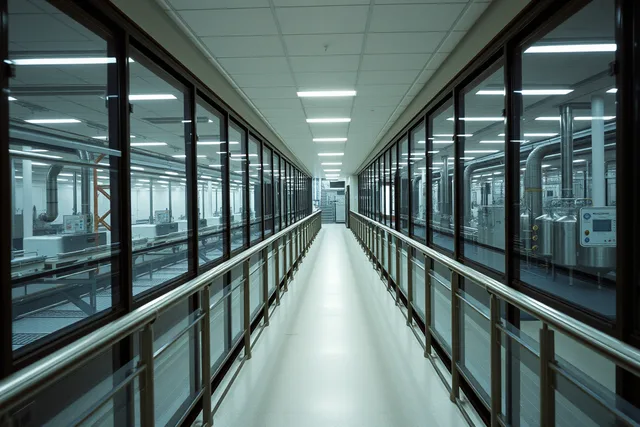
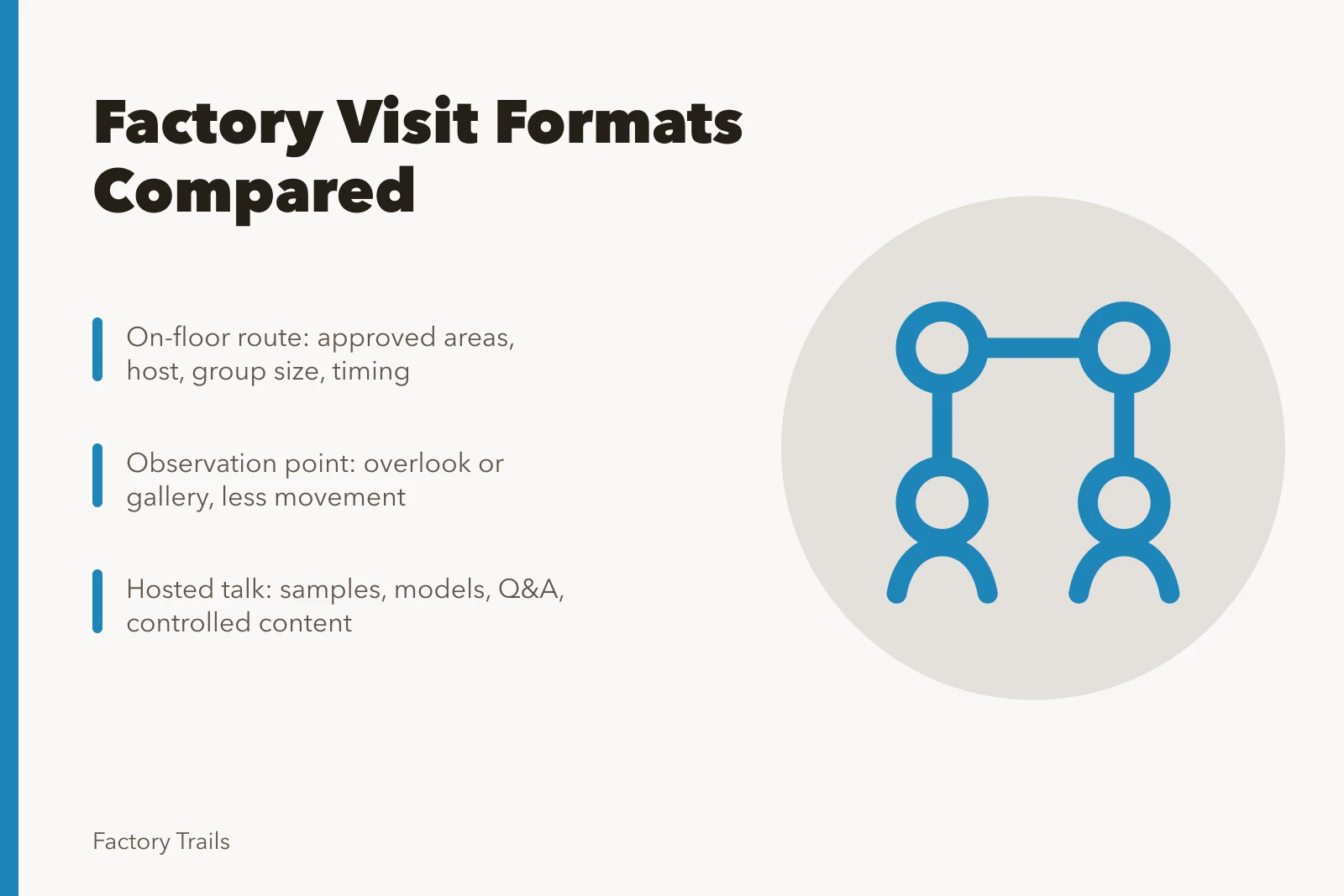
The elevated walkway. Visitors stay above or beside the line on a fixed structure. No PPE beyond closed-toe shoes, no escort inside a hazard zone, no stopping the shift. This is the format that scales, and it is the one most likely to survive a busy production week. Pick it when the plant runs continuously and you need throughput.
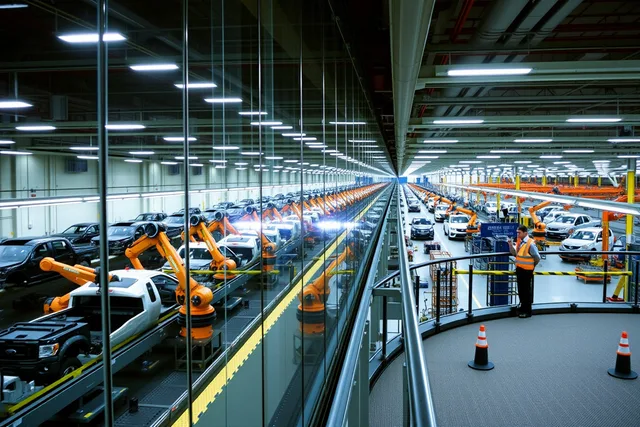
The live line behind glass. A gallery window over a real floor. Visitors see motion and hear the plant, but the glass is doing the safety work. Good for large groups, weak on sequence, because you cannot follow one unit from raw to finished. Pick it when the plant will not stop production but can give you a gallery window.
The retired plant as museum. Nothing runs. The equipment is the exhibit, interpretation carries the story, and the site can open on a Sunday in February. Sloss Furnaces in Birmingham, Alabama is the reference example: a 20th-century blast furnace site preserved as a National Historic Landmark, open to the public with self-guided and guided routes. Pick it when no live process remains and you need a year-round calendar.
The demonstration floor. A small line or single machine runs on a published schedule for visitors, separate from production. This is how most food, glass and craft manufacturers handle tourism without exposing a commercial line. Pick it when you control a small line and can schedule runs for visitors.
The named programs worth comparing
These four are real, publicly documented, and each represents a different answer to the same question.
| Program | Where | Format | What it proves |
|---|---|---|---|
| Sloss Furnaces National Historic Landmark | Birmingham, Alabama | Retired plant, self-guided and guided | A dead plant can carry a full process story with no shift calendar |
| Pullman National Monument | Chicago, Illinois | Preserved district, NPS interpretation | Interpretation can hold a site whose industry has left |
| Britannia Mine Museum | Britannia Beach, British Columbia | Retired mine, underground train, live equipment demo | A retired site can still run machinery on a schedule |
| Boeing Future of Flight | Mukilteo, Washington | Elevated gallery over an active assembly floor | A live line can be shown at scale without stopping work |
Sloss is the cheapest model to copy: the site is static, the interpretation is the product, and there is no production schedule to negotiate. Entry is free, the grounds are self-guided, and guided tours run on a posted schedule. A typical visit runs about an hour.
Pullman shows the same principle applied to a district rather than a single plant, with the National Park Service carrying the interpretive load. Entry is free, ranger programs run through the year, and the grounds need no booking. Plan for one to two hours.
Britannia adds the middle case, a retired site that runs a piece of equipment on a timetable, which is the closest a museum gets to a working visit. Admission is charged, tickets are booked online with timed entry, and the underground train tour is included. A typical visit runs one to two hours.
Boeing's gallery is the live-line model at its most polished: visitors look down on an active floor, and the plant keeps working. Tickets are timed, booked online, and the gallery route runs about 90 minutes. Summer slots often sell out.
Entry costs differ. Sloss and Pullman charge no admission. Britannia and Boeing charge admission that varies by season, age and add-on. Check each operator's own page for current rates before you print.
Choosing between them
Score each candidate format against the same questions, and do not compare a 90-minute walkway tour with a 20-minute gallery stop as if they deliver the same thing.
| Criterion | What to ask |
|---|---|
| Visitor outcome | What will the group understand when they leave? |
| Approval | Which route, room or machine needs sign-off, and from whom? |
| Host role | What can the guide explain accurately without guessing? |
| Group fit | What size, age range and schedule does the format serve? |
| Access | What has the site confirmed in writing for visitors with mobility needs? |
| Change path | What replaces this format when the line is down? |
| Honesty | Does the booking page describe what visitors will actually see? |
The National Park Service's interpretive planning guidance is the standard reference for matching a story to a delivery method. It was written for parks, but the logic holds for a plant: one story, several possible formats, and a plan that says which one carries it when conditions change.
What the live formats demand in access
A gallery or walkway visit is not free of operational strings. The plant still has to decide who is on the floor, what they wear, and how many escorts walk with them.
Escort ratios, PPE requirements and photography permissions are set by the facility's safety officer and published visitor rules, not by the tour operator. Ask for those in writing before you print anything. A typical planning figure is one escort for every 10 to 15 visitors, with live-floor groups often capped near 20.
Photography rules in particular vary by plant and by area within a plant, and tripods are banned in more galleries than you would expect.
Noise is the underrated constraint. A live floor can sit above the level where a guide's voice carries, which pushes you toward headsets or a scripted talk at the end. That changes the format whether you planned for it or not.
The shutdown calendar is your real season
Live-line tours book against production, and production stops. July and December maintenance windows are the common pattern in heavy manufacturing, and a route that runs in June may be closed in July with no notice to your booking page.
Build the calendar before the brochure. If the plant cannot confirm a recurring visitor path through the maintenance period, your summer product is a preserved-site product, and you should sell it that way.
Keeping it accurate
An alternative should carry the same story, not fill the same hour. If the walkway explains how a product moves through five steps, the fallback uses a model, a photo sequence and a guide who can walk the group through the same five steps in a room.
Say so in the booking copy before you need it. "When the line is not running, the visit uses an observation gallery and a guided explanation of the same process" is a sentence a visitor can trust. "Full access to all production areas" is not, and it is the sentence that generates complaints.
The Smithsonian accessible exhibition design guidelines treat multiple information channels as the baseline rather than the backup. Tour listings go stale faster than almost any other page on a site, because the underlying access changes with the production calendar.
The National Archives web-records guidance sets out life-cycle management for published web information. Applied here, it means every format description carries a publication date and a review trigger. The records-management profile guidance makes the same point about responsibility: someone owns the record.
Run a pilot before you commit. Test a new format with a small group. Watch four things: whether they find the arrival point, whether they can hear the guide, whether they follow the story, and whether the instructions they got matched the ones they were given at booking. Ask the guide which question they could not answer.
That answer usually tells you what the next version of the script needs.
Common questions
Is an on-floor route always the best option?
No. It is the strongest format when the plant can confirm a recurring path and a stable shift pattern. Where it cannot, a gallery or a demonstration floor delivers more of the story more often.
Can we advertise an alternative before the main route closes?
Yes, described as a possible format rather than a promise for a specific session. The plant's responsible role confirms the day-of condition, and the booking copy should say so.
How do we choose between the four formats?
Fix the visitor outcome first, then compare approvals, host capability, group fit and the fallback. Pick the format the site can deliver accurately in the season you are selling.
Does this replace the site's safety or access review?
No. Escort ratios, PPE, induction and accessibility determinations belong to the plant's safety officer and published visitor rules. This is a planning comparison, not a substitute for either.