Reviews
Manufacturing museum maintenance plan comparison questions to ask first
Manufacturing museum care questions for 2027 help U.S. sites compare risks, clarify responsibilities, protect visitors, and choose the next review.
Care planning improves when a museum asks questions that separate observation, risk, authority, and public impact. These questions help staff describe a concern clearly before choosing an action.
What to take away
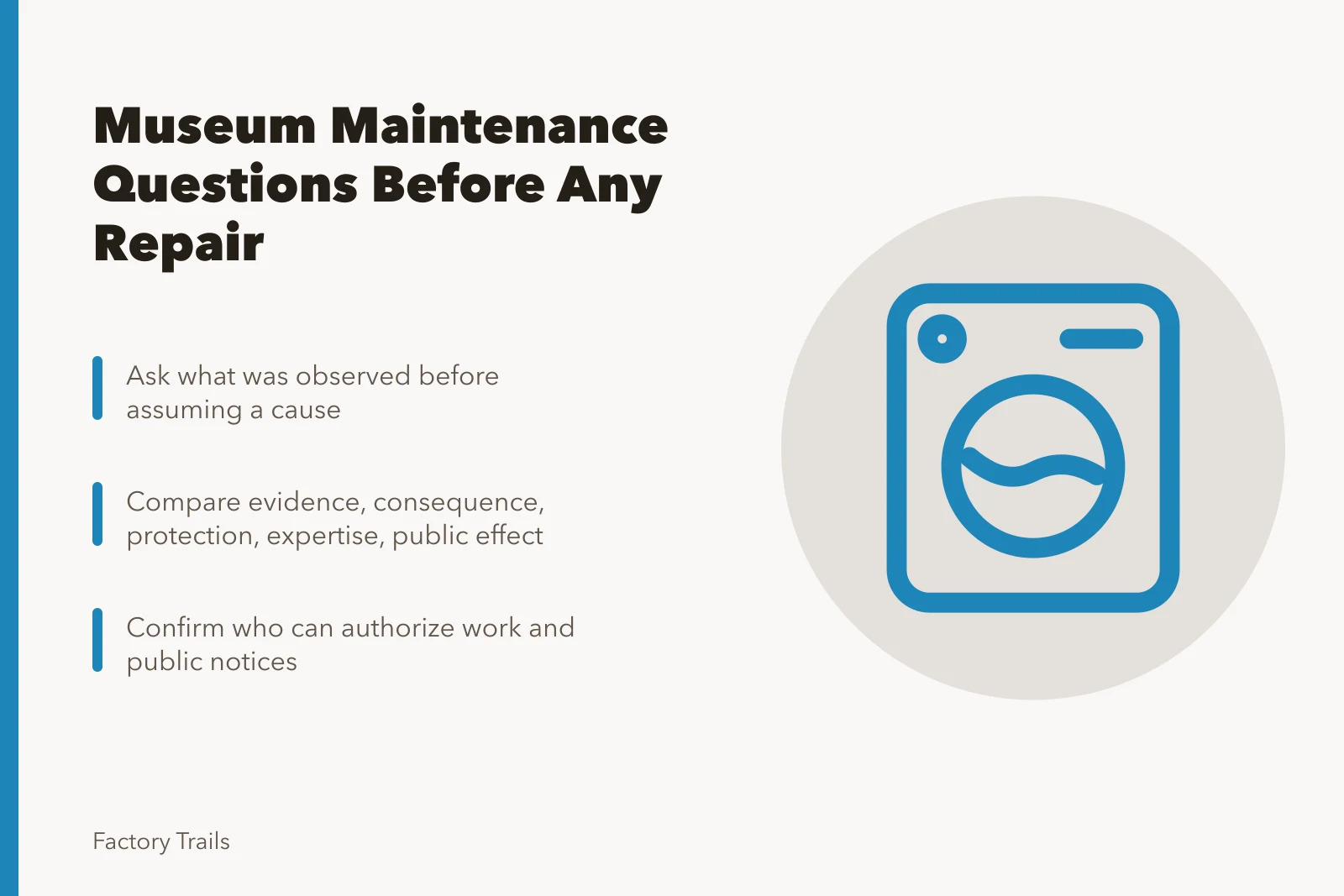
- Ask what is known before asking what should be fixed.
- Compare resource risks without assuming every concern needs the same response.
- Confirm who can authorize work and public notices.
Questions to ask before action
| Question | Why it matters |
|---|---|
| What exactly was observed? | Keeps the record tied to evidence. |
| Which resource is affected? | Separates an object, machine, building feature, or visitor route. |
| What could worsen if nothing changes? | Helps prioritize without inventing urgency. |
| Who has authority to assess or approve work? | Prevents improvised treatment or messaging. |
| Does the concern affect public access? | Supports a precise visitor update. |
| What evidence will close the item? | Creates a useful review point. |
The Smithsonian Museum Conservation Institute's preventive conservation guidance describes preventive conservation as identifying and mitigating risks such as light, pests, pollutants, unsuitable temperature or humidity, physical forces, water, fire, theft, vandalism, and dissociation.
Pre-action questions
- What exactly was observed?
- Which resource is affected?
- What could worsen if nothing changes?
- Who has authority to assess or approve work?
- Does the concern affect public access?
- What evidence will close the item?
Compare the right things
An exposed machine, a paper archive, and a cracked exterior wall may all need attention, but they should not be ranked by appearance alone. Compare the evidence, the potential consequence, the current protection, the required expertise, and the public effect. This produces a more honest plan than a single "most urgent" list with no documentation.
Worked example:
| Resource | Observation | Risk if nothing changes | Authority to approve | Public effect | Evidence to close |
|---|---|---|---|---|---|
| Machine, a floor-standing lathe | Oil film under the bed | Corrosion and a slipping hazard | Collections manager and safety officer | Keep the aisle open with a floor sign | Condition note and oil-tray repair filed |
| Archive item, a bound ledger | Foxing and a musty smell | Mold spread and further staining | Archivist | Item stays off display | Stable housing note and humidity reading filed |
| Building feature, a brick lintel above a loading door | Diagonal crack that appears to widen | Water entry and falling masonry | Facilities manager and structural engineer | Reroute tours from that door | Engineer letter and repair date recorded |
Write an answer that can be checked later. "Condition to be assessed by a qualified professional" is better than declaring a cause that the record cannot support. If a visitor area must change, explain only the approved boundary and the current alternative route or program.
The Smithsonian Museum Conservation Institute's collections-care guidance describes preventive care as risk reduction before treatment, not as a diagnosis of an individual item.
The National Archives' records-management basics explain why organizations retain decision-supporting information, which lets editors keep a source, date, and reason for each change to a care-related visitor note.
The National Park Service Museum Handbook reference connects museum work with documentation, and it does not answer site-specific care questions.
Ask questions in the right order
Start with what was observed, then confirm the public boundary, the assessor, and the next review date. This order prevents a visitor article from publishing a diagnosis or a repair plan that the responsible institution has not approved.
Use a separate question for the visitor effect. A care concern may require no change to public access, a temporary route adjustment, or a paused program. Readers need that practical result, not the technical reasoning behind it.
Before closing the review, ask whether the public page, any list entry, and the photo caption tell the same story. A careful body paragraph cannot correct a short field that still promises an unavailable experience.
If the source is not current enough to answer the question, remove the live claim and preserve only the stable historical context.
The result should be a short fit note, not a technical report. State the confirmed visitor experience, any limitation that affects planning, and the current source for further information. A fit note template: resource, observation, authority, visitor effect, evidence to close, next review date.
The editor should be able to explain every statement without expanding the article into an internal care plan or professional assessment.
If they cannot, the sentence needs a source, a narrower scope, or removal.
That restraint keeps the comparison useful when conditions change.
2027 review triggers
Hold the 2027 review to this cadence.
- January 15, April 15, July 15, and October 15, 2027reopen every open care item and check the source date on each visitor page.
- March 1, 2027compare the machine, archive, and building lists against the six questions.
- Within five working daysany changed public route, paused program, or new visitor notice.
- At the next weekly checka new water leak, pest finding, or reported injury near a listed resource.
- Before the page stays livea source older than three years, an expired permit, or a lapsed inspection.
Common questions
What question prevents the biggest planning error?
Who owns this item, and when is it reviewed? A cause named too early is harder to correct than a record kept to evidence.
Should visitors be told about every maintenance concern?
Tell them about confirmed changes to public access, programs, or routes. Keep technical assessment details accurate and approved.
Can one question set fit every resource?
It can provide a starting structure, but the action and expertise must fit the particular material and site conditions.