Guides
Part of Industrial site interpretation options: how to compare formats before you choose
Industrial site interpretation options: how to compare scope before you choose
Industrial interpretation options checklist for 2027 helps U.S. teams choose formats by visitor need, sources, site conditions, access, ownership, and upkeep.
Use this checklist before selecting a guide, panel, hosted stop, web page, or mixed visitor experience. It sets the scope before you spend on fabrication, printing, or staff time.
What to take away
- Format choice follows message, place, audience, access, and upkeep.
- Check access and maintenance before committing to a medium.
- Give each chosen format a distinct job.
Complete the selection checks
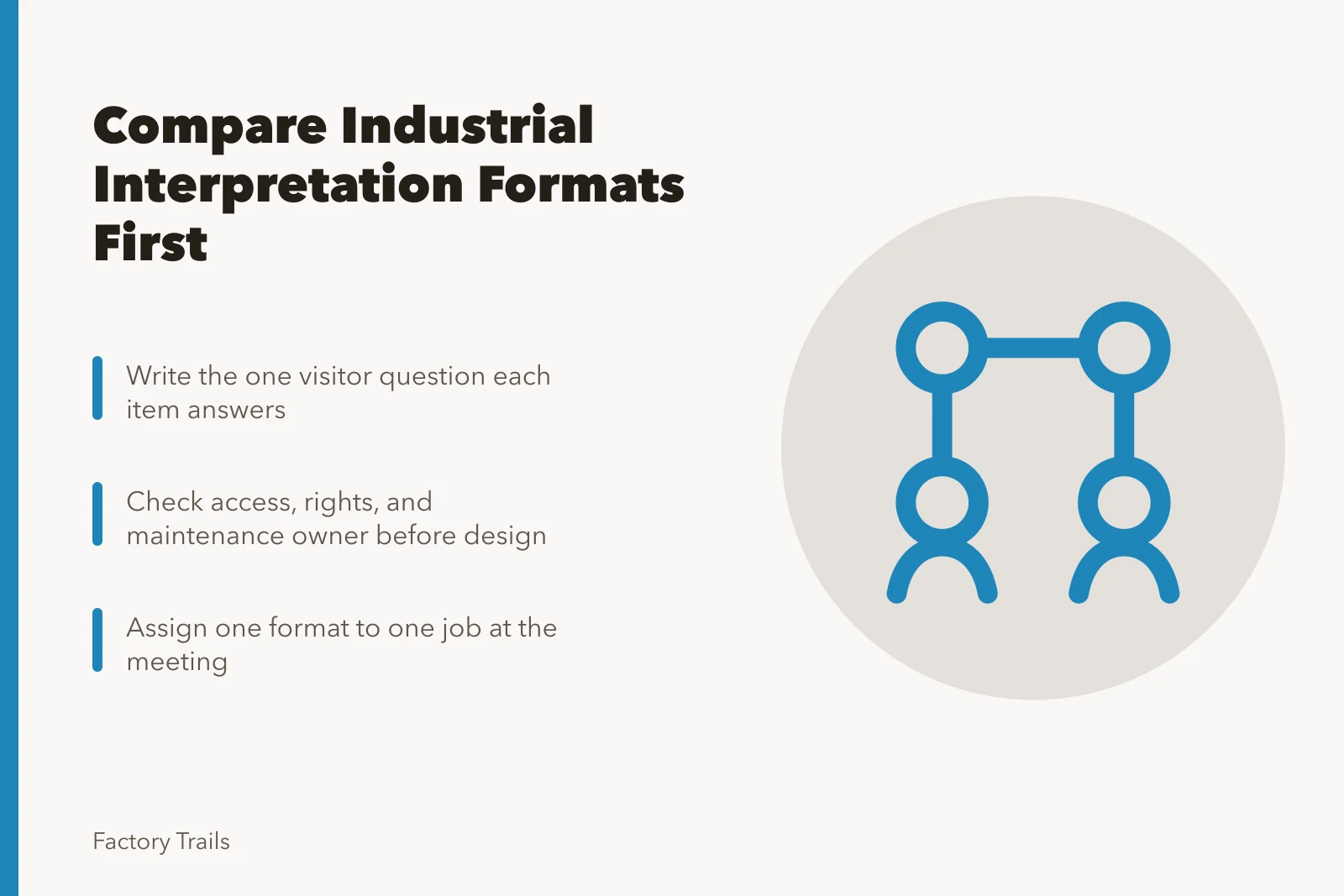
- Write the one visitor question the item should answer.
- Identify the visible feature, route point, or pre-visit moment involved.
- Confirm the source that supports the message.
- Name the audience, time available, and likely questions.
- Test whether the format works in the actual location.
- Separate orientation from deeper interpretation.
- Check readable language, route access, viewing, and alternate formats.
- Assign a content owner, inspection date, and replacement trigger.
| Option | Check before choosing |
|---|---|
| Guided stop | Host authority, schedule, group size, and script review |
| Outdoor panel | Site-specific view, approach, weather, and maintenance |
| Printed guide | Route clarity, version date, distribution, and reprint plan |
| Web page | Findability, device limits, editorial owner, and access review |
Format-selection decision matrix
Weights: message fit 30%, place fit 25%, audience fit 20%, access 15%, upkeep 10%. Scores 1 to 5.
| Format | Message 30% | Place 25% | Audience 20% | Access 15% | Upkeep 10% | Weighted total |
|---|---|---|---|---|---|---|
| Guided stop | 5 | 3 | 4 | 3 | 2 | 3.7 |
| Outdoor panel | 3 | 5 | 3 | 4 | 5 | 3.9 |
| Printed guide | 3 | 2 | 4 | 5 | 4 | 3.3 |
| Web page | 4 | 1 | 3 | 5 | 4 | 3.2 |
Worked example: at Sloss Furnaces, a team compared a guided stop and an outdoor panel for one stop. The panel scored higher on upkeep and place. The team rejected the panel for that spot because the story needed a host to answer questions about furnace operation. They chose the guided stop and recorded the panel as a rejected alternative.
Cost drivers and typical ranges
| Format | Main cost driver | Typical range or figure |
|---|---|---|
| Guided stop | Host hours, training, scheduling | Typical 2 to 4 staff hours per stop including preparation |
| Outdoor panel | Fabrication, mounting, installation, replacement | Typical $2,000 to $12,000 installed per panel, driven by size and material |
| Printed guide | Design, print run, reprint, distribution | Typical print run 500 to 5,000 copies; unit cost falls as quantity rises |
| Web page | Editorial time, review, hosting, updates | Typical first build 8 to 40 staff hours; hosting often under $200 per year |
NPS wayside exhibit design guidance describes design as problem-solving for a purpose, not decoration. Use that test for every medium. Checklist item: write the purpose, visitor, and place on one line before comparing formats, and stop if any of the three is blank.
Selection Checks Before Choosing
- Write the one visitor question
- Identify visible feature or route point
- Confirm the supporting source
- Name audience, time, and questions
- Test format in actual location
- Separate orientation from deeper interpretation
- Check language, access, viewing, alternates
- Assign owner, inspection date, replacement trigger
Record the choice and upkeep
Record the format selected, the alternatives considered, evidence reviewed, known limitations, owner, and next review date. A short note protects continuity when staff change and gives the next reviewer a starting point.
Upkeep: name one person to inspect each installed format. For an outdoor panel, a typical inspection is quarterly, with replacement triggered by fading, graffiti, loose mounting, or a route change. For a web page, review at least once a year or when the source record changes. Budget 1 to 2 staff hours per panel per quarter.
Before launch, repeat the checklist with the current draft and real route. This final pass can catch an outdated instruction, a crowded viewing point, or an access issue that was not visible during desk planning.
Ask a first-time visitor to use the chosen item without coaching. Their questions can reveal a missing orientation cue or a message that assumes knowledge the audience does not have.
Run a place test before finalizing a physical option. The NPS wayside exhibit planning guidance treats placement, site conditions, and the visible resource as part of planning.
Record the actual pause point, view, light, route choice, and likely weather exposure. If the draft message makes sense only away from the proposed location, assign it to a different format instead of forcing the location to carry it.
Use a version record for any option that may change. The National Archives web-records guidance discusses tracking content revisions and keeping enough context to explain them. A later reviewer needs to see what changed and why.
Checklist item: put the version date, the source file, and the approved wording in the same folder, and note what changed and who approved it.
Add an access review task to the selection record with a named reviewer and a test date. The ADA Title II web rule resource describes accessibility obligations for covered public entities' web content and mobile apps. Checklist item: test both the digital and on-site path before launch.
Use the checklist at the decision meeting
Bring one proposed message, one relevant source, and one site condition note for each option. Work through the visitor question first. Then compare the time available, location, route, host availability, access considerations, rights, and owner capacity. Mark a missing source or approval as a launch blocker, not an item to resolve after design begins.
At the end of the meeting, assign one format to one job. A panel might explain a view. A page might carry a deeper source note. A guide might orient a visitor between stops. The record should name the job, limitation, next test, and review date. It should not try to make every format responsible for the whole story.
Common questions
Can one format do every job?
Usually not. Orientation, place-based context, deeper research, and dialogue often need different approaches.
Is the least expensive option best?
Only if it serves the visitor need and can be kept accurate and usable.
What is a good reason to delay a choice?
Delay when the source record, site approval, access review, or maintenance owner is not ready.