Guides
Part of Industrial site interpretation options: how to compare formats before you choose
How to keep industrial site interpretation option records your team can trust
Option records for industrial site interpretation show why a visitor format was chosen, what it replaced, and when the choice must be reviewed again.
An option record explains why a visitor format was chosen and what keeps it current. It lets the next owner check the decision without rebuilding the project from old messages.
What to take away
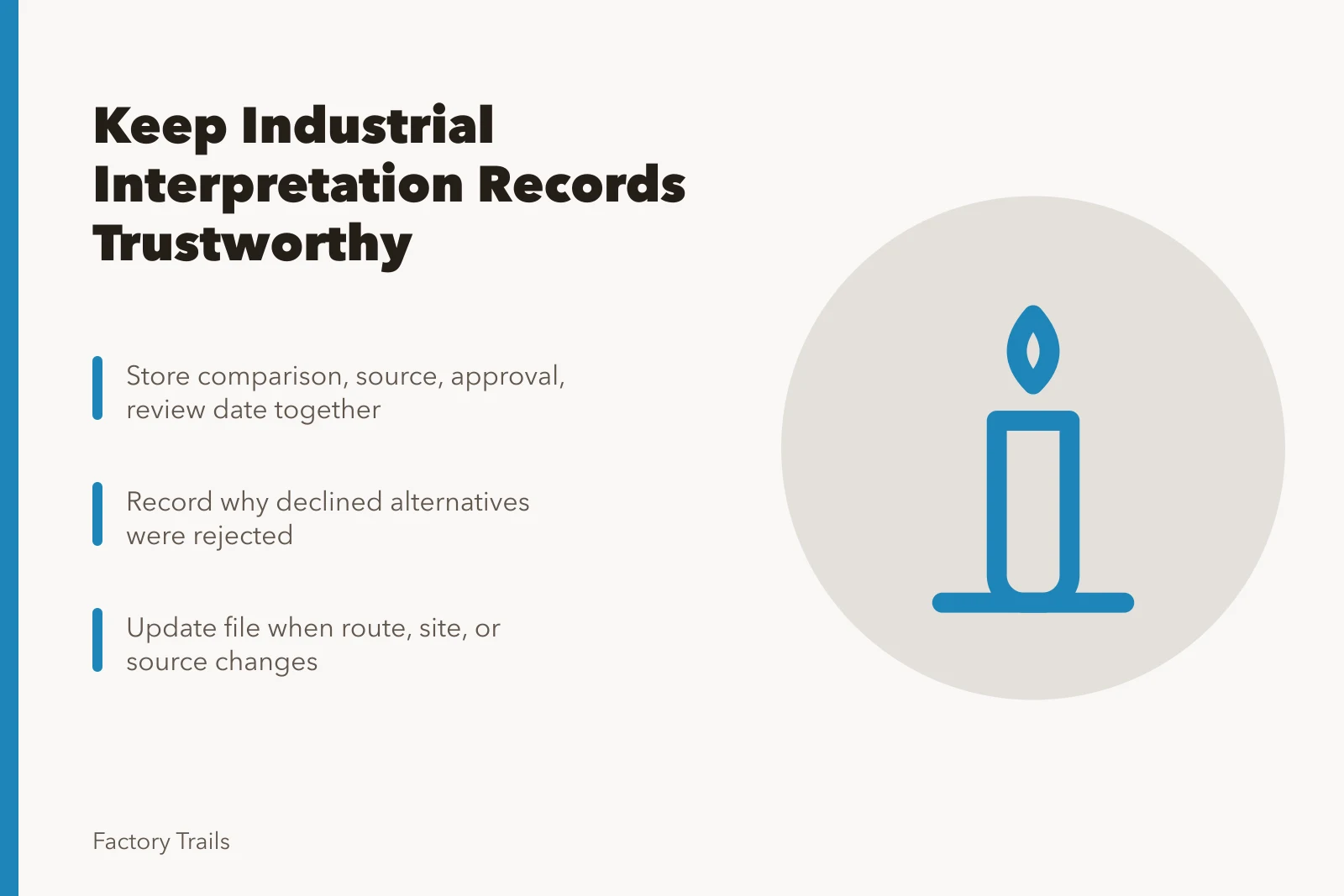
- Keep the comparison, source file, approval, and review date in one place.
- Record why each alternative was declined, not only why the winner won.
- Reopen the record when a route, source, or site condition changes.
- Give every option a stable identifier so handoff does not depend on memory.
- Note the access-review path and who completed it, without claiming the outcome.
Keep these decision records
| Record | What it should show |
|---|---|
| Visitor question | The need the option addresses |
| Comparison | Alternatives, tradeoffs, and selection reason |
| Declined options | Why each was set aside, and what would revive it |
| Source file | Claims, source, rights, reviewer, and limits |
| Site check | Location, approach, access, and conditions |
| Approval | Owner, date, scope, and restrictions |
| Review plan | Next date, trigger, and update owner |
The NPS archive finding aid for Independence National Historical Park lists proposal and design-development records for visitor-service work. Its interpretation records finding aid shows the value of retaining proposal and revision material as a project develops.
Compare the alternatives you declined
A comparison table with one row per option is the cheapest part of the file to write and the most expensive to lose. A preserved plant that chose a self-guided panel over a guided walk in 2027 will face the same question after a route closure, a change of site owner, or a new maintenance calendar.
Compare declined options
Guided walk
- Visitor does
- Follows guide
- Where they stand
- Along route
- Who staffs it
- Guide hours
- Running cost
- Guide, transport, insurance
- Cannot do
- Flexible timing
- Why it lost
- December shutdown
Self-guided panel
- Visitor does
- Reads at own pace
- Where they stand
- At fixed points
- Who staffs it
- No staffing
- Running cost
- Printing, platform fees
- Cannot do
- Live questions
- Why it lost
- Chosen option
"Cost" alone is not a reason. State the cost line as a figure, not a category.
Worked example, with typical figures. Two guides at $20 to $25 per hour for three hours come to $120 to $150 in labor. Printing 500 route cards at 10 to 15 cents each adds $50 to $75.
A ticketing platform charging about 3 percent on $8 tickets takes roughly $0.24 per ticket, or $72 across 300 sales. The annual cost line is $242 to $297 before transport and insurance. Local rates and quantities set the real numbers.
One filled-in record. Visitor question: how do we show the pump house while the upper floor is closed for repair? Option A: a guided walk, 45 minutes, two guides. Option B: a self-guided panel route with six stops.
Chosen: the panel route, because the walk needed the closed upper floor. Cost line: $242 to $297 a year across both options, itemized above. Trigger: reopen the record if the upper floor reopens or the route changes.
The same field order works as a template: visitor question, options, selection reason, cost line, trigger, review owner.
A guided walk shelved over a December maintenance shutdown needs its reason written down. Without the reason on file, the next team re-runs the whole comparison.
Record the text each link depends on
Links often hang on a random noun inside a list of roles or tasks. Cut the list and the link goes with it. If the sentence must go, re-anchor the link on the word that describes its destination, in the replacement sentence.
The NPS wayside exhibit design guidance treats design as a response to a defined problem. Record the visitor task, the site point, and the source baseline. Note why a guide, panel, host, or page was selected. This stops a later editor copying the decision to a location with different conditions.
Keep version information for digital records
The National Archives web-records guidance covers reliable, authentic, usable web records and how changes are tracked. A local file can stay compact.
Retain the current public copy, the prior version, the date, the approver, and the reason for the change. Add the visitor materials checked after publication. Use stable filenames and a version date. Never label several documents "final."
Record the access-review path
The ADA Title II web rule resource covers web content and mobile apps for covered public entities. Your record should name which format needed review and who completed it.
Note what alternate information is provided and when it must be checked again. A generic link is not proof of an item's access status. Review requirements vary by jurisdiction and by the site's own accessibility statement, so confirm the current position with the site authority.
Prepare the record for handoff
Give each selected option a stable identifier. Use a site code, the word OPT, the year, and a sequence number, so the pump house panel route becomes PUMP-OPT-2027-03. Store the visitor question, comparison sheet, source list, site test, and approved public material under that identifier.
Name files as ID_field_version_date, for example PUMP-OPT-2027-03_comparison_v2_2027-05-14.md. The identifier never changes when the document does.
Keep working comments and private contacts in the project file, not in visitor material. The public version carries only approved content and required credit.
When a format is retired, save the final version and the reason. State whether visitors were redirected to another format, a public contact, or nothing. That stops an old file returning as a current option after the route or the visitor need has changed.
Set review triggers
Every active option needs a trigger, not just a date. A seasonal route check, a corrected source, a rights question, or recurring visitor confusion all qualify.
Record the date and the person responsible. A short record someone actually reopens beats an elaborate file nobody revisits after launch.
Common questions
Who owns the option record?
Assign the program owner, with a named backup, to maintain the current decision and review file. Ownership should survive staff changes, so record the role rather than only the person.
Is a source list enough?
No. Link each source to the exact claim, image, or choice it supports. A bare bibliography tells a later reviewer nothing about which part of the material depends on which source.
When should the choice be reconsidered?
Reconsider it when visitor needs, route conditions, access, sources, or operating capacity change. The trigger belongs in the record, with a date and an owner attached.