Costs
Working factory visits maintenance plan budget notes: what to review before 2027
Factory visit maintenance budget notes for 2027 name Airtable, MaintainX, Signs.com, Mailchimp, and Twilio with public prices, review steps, and change controls.
What to take away
- Separate recurring upkeep from one-time improvements.
- Budget for accurate information wherever guests encounter it.
- Attach a public price signal, review schedule, and owner to every line.
Ongoing visitor-program care is different from the initial cost of launching a factory visit. It covers recurring work that keeps directions, signs, host materials, and change messages accurate. Review these items before 2027 and attach a dollar range to each one. Public list prices give a starting point, not a quote. Site conditions, visitor season, route changes, and staffing still drive the final number.
Named tools and budget signals
| Review item | Real tool or provider | Public price signal |
|---|---|---|
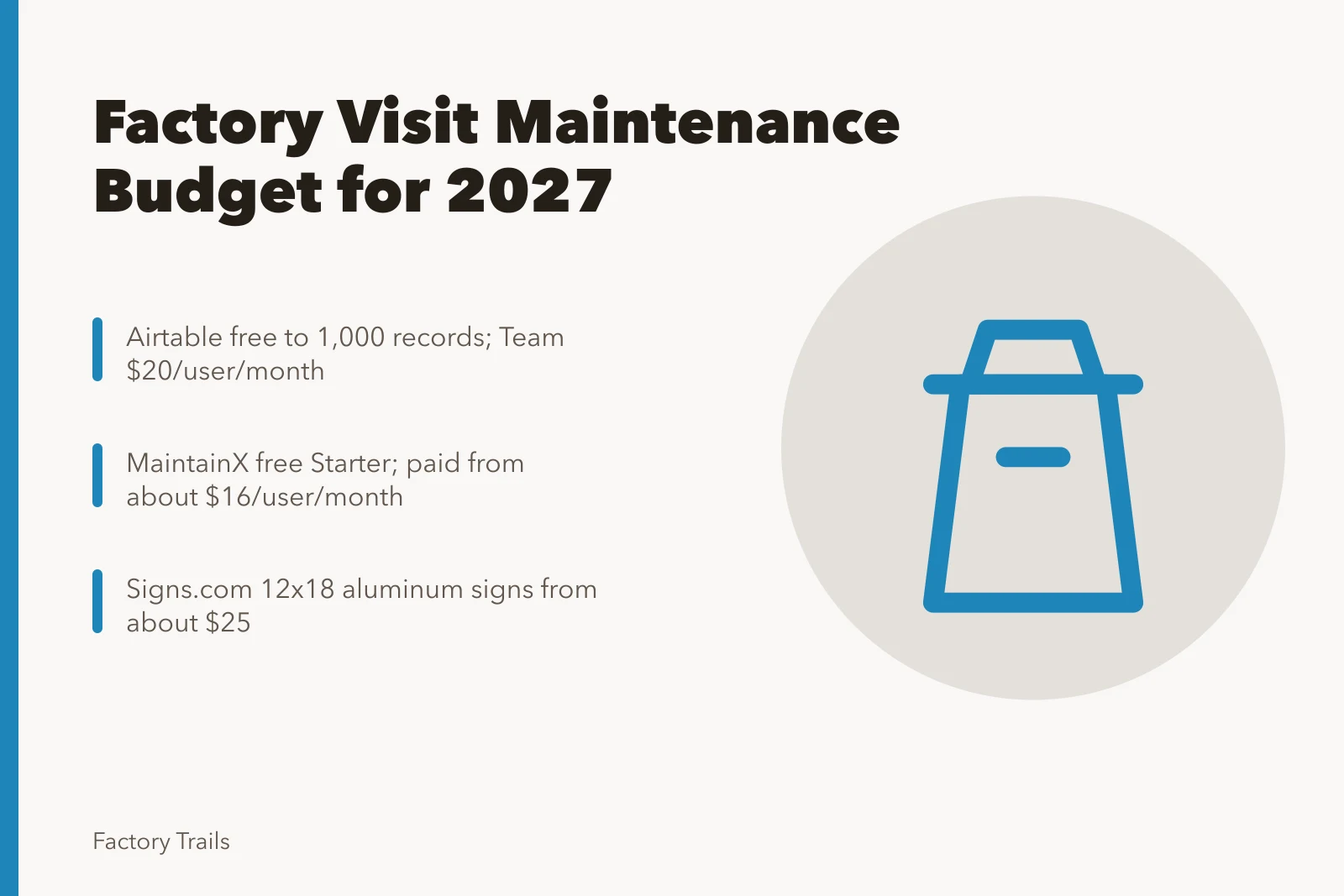
| Review tracker | Airtable | Free for up to 1,000 records per base; Team from $20 per user/month billed annually. |
| Sign and repair work orders | MaintainX | Free Starter plan; paid plans from about $16 per user/month. |
| Replacement signs | Signs.com | 12x18 aluminum signs from about $25; 24x36 from about $70. |
| Change messages | Mailchimp | Free up to 500 contacts; paid plans from about $13/month. |
| Booked guest alerts | Twilio | SMS in the U.S. from $0.0079 per message. |
The National Park Service's wayside exhibit installation and maintenance resource treats interpretive assets as items that need planned installation and maintenance. It does not set a factory visit budget. It supports a practical rule: include the work that keeps visitor-facing assets usable and current.
Tools and Public Price Signals
Airtable
- Free tier
- 1,000 records
- Paid from
- $20/user/mo
- Use
- Review tracker
MaintainX
- Free tier
- Starter plan
- Paid from
- $16/user/mo
- Use
- Work orders
Signs.com
- Free tier
- No
- Paid from
- $25/sign
- Use
- Replacement signs
Mailchimp
- Free tier
- 500 contacts
- Paid from
- $13/mo
- Use
- Change messages
Twilio
- Free tier
- No
- Paid from
- $0.0079/SMS
- Use
- Guest alerts
Add figures to assumptions
State the number of sessions, material types, review frequency, and likely route changes. Add public price signals for each line. A host refresher may cost $0 to $500 per session. A temporary 24x36 poster print at FedEx Office starts near $30. A Canva Pro seat costs $15 per month or $120 per year. If information changes rarely, document that basis instead of carrying a generic monthly line.
Decide what can wait
Separate a correction that affects a booked guest from an improvement that can be scheduled. An inaccurate entry instruction or time-sensitive route message requires prompt verified communication. A redesign of a reusable visual can wait for the next material cycle. This distinction helps a program protect visitor expectations without treating every editorial adjustment as an emergency expense.
| Situation | Budget decision |
|---|---|
| Booked groups have outdated directions | Fund and send the confirmed correction now |
| A handout is worn but facts remain current | Schedule replacement with the next material order |
| A recurring question reveals a content gap | Allocate approved revision and host review time |
| A seasonal route changes | Include message update, alternative support, and post-season review |
Review the upkeep estimate
After several sessions, compare actual work with the assumed review cycle. If the team repeatedly corrects the same message, add front-end content review. If material replacement is rare, reduce that line only after checking condition and availability. The goal is not the smallest total. It is enough upkeep for a consistent and truthful visitor experience.
Budget the recurring visitor work
The GAO Cost Estimating and Assessment Guide describes documented scope, assumptions, and cost elements as parts of a reliable estimate. Use that discipline for visitor-program care. List review time, approved sign replacement, host-material updates, accessibility work, and communication changes separately. Do not present this as a full facility maintenance budget.
Track a change before it becomes a commitment
The General Services Administration cost-management guidance addresses scope, funding, and changes in project work. Apply the practical part. Note the requested update, reason, cost effect, and approval before the team promises a new item or date. A $50 SMS batch or a $70 sign replacement still needs an owner.
Preserve the estimate record
The National Archives records-management fundamentals cover records inventories, schedules, and file plans. Keep the assumption, quote or time estimate, approval, actual amount, and closeout note together. The next budget then starts from a known scope.
Review what the care work achieved
After a season or set of visits, compare planned care work with completed updates. Note whether a recurring issue needs a standing budget line or a dated exception. This prevents a team from treating every repair as a permanent cost or every delayed item as completed.
Common questions
What is a recurring care cost?
It is work needed to keep a visitor program accurate and usable after launch. Examples include message review, material replacement, or host-brief updates.
Should an unapproved change be budgeted as final?
No. Mark it as pending, state the assumption, and identify the owner who can confirm the visitor-facing result.
How can a team avoid duplicating costs?
Separate regular facility work, existing staff contributions, and new visitor-program care work. Then a reviewer can see what each line covers.