Costs
How to write factory visit cost planning budget notes that hold up
Factory visit budget notes for 2027 help U.S. teams organize cost elements, note assumptions, avoid double counting, and present a clear basis for review.
A useful budget note explains the basis for a visitor-program figure. It should not present an estimate as a quote from a facility or a universal price for a factory visit.
What to take away
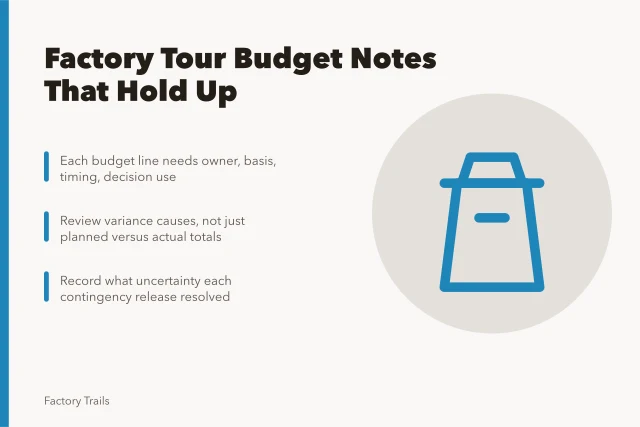
- A budget note must show the work included, the conditions assumed, the exclusions, the main cost elements, any contingency, and the person who can confirm an uncertain item.
- Label each line as an actual prior result, a current quote, an internal estimate, or an allowance awaiting confirmation.
- Use actual program results to improve the next version.
Build a readable budget note
Line / Record beside it
- Staff time
- Role, hours assumed, session count, and source of estimate
- Visitor materials
- Quantity, reusable or per-session status, replenishment assumption
- Coordination
- Planning meetings, route reviews, and message updates included
- Alternate format
- Conditions that require it and its approval owner
- Contingency
- Event covered, amount or approach, and decision authority
GSA's life-cycle cost analysis requirements call for documentation of data and cost elements such as investment, replacement, and operations.
Budget note line records
- Staff timerole, hours, sessions, source
- Visitor materialsquantity, reusable status, replenishment
- Coordinationplanning meetings, route reviews, updates
- Alternate formatconditions and approval owner
- Contingencyevent covered, amount, decision authority
Worked example, using typical ranges and no invented quote:
| Line | Label | Entry |
|---|---|---|
| Host coverage | Estimate | 12 to 16 staff hours for two half-day sessions. Typical range. |
| Room hire | Quote | Facility quote, dated and attached. Typical range for a meeting room is $150 to $500 per day. |
| Printed handouts | Actual | Prior pilot invoice for 40 visitors. Typical print cost is a few dollars per copy. |
| Backup materials | Allowance | $100 to $300, pending route confirmation. Typical range. |
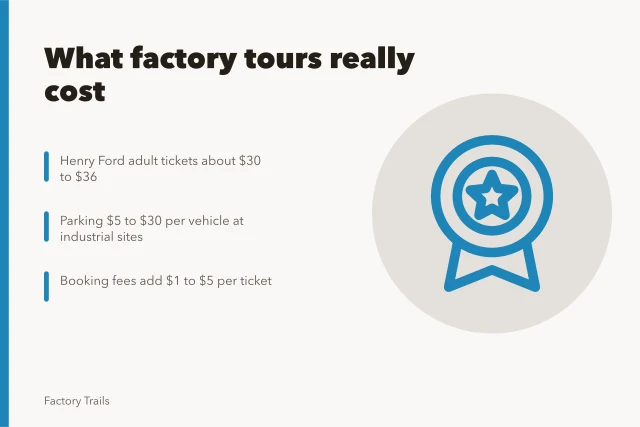
Typical cost elements for a factory visit include host or guide time, printed guides and safety gear, room or route setup, transport, catering, insurance, and any permit or facility fee. A free public tour may carry only staff time.
A custom group visit can add several hundred dollars for transport and catering. Printed materials often run a few dollars per visitor. Treat those as planning ranges, not quotes.
Draw the budget boundary before adding lines
The GAO cost-estimating guide calls for a clear purpose, scope, and set of assumptions. Use those elements at the top of the visitor-program budget note: state the session format, expected group cap, date range, and decision the figure supports. A budget for a first pilot should not quietly become the budget for a recurring season.
Then mark the items outside the note. Regular security, building maintenance, or staff duties that are funded elsewhere may still affect how a visit operates, but they should not be presented as new program spending unless the estimate includes them. This protects a reviewer from treating a partial figure as the full cost of every facility activity.
Separate known figures from planning allowances
The GSA guidance for managing project costs emphasizes documenting estimate information and revising it as the work develops. In a budget note, identify each line as an actual prior result, current quote, internal estimate, or allowance awaiting confirmation, and do not mix those categories in one total without a label.
For an uncertain item, name the event that could change it. A backup presentation space may require materials only if the normal route is unavailable. Host time may change if a group must be split. A plain note beside the line is more useful than a large unexplained contingency.
Preserve the reason for each update
The National Archives records-management training describes records as evidence of work and decisions. Keep the prior version when a budget changes. Add the reason, date, owner, and affected line. This lets the next planner distinguish a genuine program change from a simple correction.
Avoid double counting
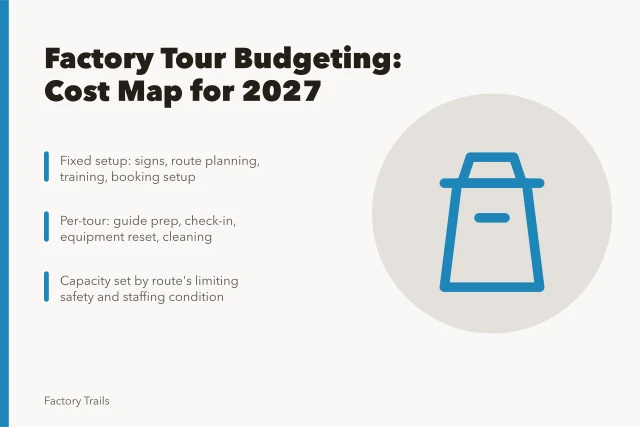
Check whether a line appears in both setup and session costs. For example, a launch meeting is usually a setup item, while a brief route confirmation may recur for each session. Also check whether regular facility work is being listed as a new visitor-program expense. It can be shown as an in-kind or existing contribution without being counted twice.
Use notes for uncertainty
Write a pending condition as a note, not as a false precision. "Host coverage assumes one person; facility confirmation pending" is more useful than a final-looking total that hides a staffing question. Give the note an owner and a decision date.
Read the completed note from the viewpoint of the person approving it. That person should be able to see the program purpose, the work included, the main uncertainty, and the point at which the estimate must be revisited. If a calculation needs a separate sheet, label the sheet and date it.
Keep the budget note focused on the decision, while leaving a traceable route to the supporting arithmetic.
Confirm that the total and the written scope describe the same option. If either changes, revise both before the note is circulated for approval.
Common questions
Does a contingency belong in every budget?
Consider one when a defined, likely program change could create work. State what it covers rather than using an unexplained percentage.
What should a reviewer be able to see?
The labeled lines, the source for each figure, and any item that could change the total.
Can prior session costs be reused?
Yes, as a reference, after checking whether the group, route, staffing, and timing conditions are comparable.